
General information, not advice for your individual circumstances. Requirements can change. Obtain case-specific advice before acting.
In this article
Renewing a Greek financially independent person residence permit requires more than showing the expiring card. Prepare current evidence of sufficient resources and insurance, review family changes, and check your travel history against the rules applicable to this route. The passive FIP permit has a three-year statutory term, but the dates on your actual permit and decision must drive the renewal calendar.
Absence rules are not a substitute for that review. Greek immigration law protects certain temporary absences, subject to category-specific provisions; tax residence and eligibility for a later long-term status are separate questions. Begin preparation early enough to resolve evidence gaps before the legal filing window, not on the last day of validity.
Identify the exact permit being renewed
Check the decision behind the card, including its legal basis and any observations. The passive financially independent route falls under Article 163(8) of the Migration Code. Its standard statutory duration is three years, renewable for an equivalent period if the applicable conditions continue to be met.
Do not identify the route from the I.8 label alone. The code also uses that category in the distinct digital-nomad framework. Someone renewing a permit originally granted for qualifying remote work should not substitute a passive-income checklist just because an online article uses the same category number.
Keep the original approval, subsequent renewal decisions and both sides of the current card together. If the dates appear inconsistent, ask the authority or reviewing lawyer to explain them. An older card, a later legal amendment and a delayed issuance may need to be understood together.
Record the principal applicant and each dependent separately. Coordinated family applications do not justify overlooking a child's age change, a different passport expiry or an individual document request.
Use the current renewal filing window
Article 11 of the Migration Code, as amended by Article 12 of Law 5275/2026, requires the renewal application within the two months before expiry. Plan to have the file ready when that window opens, rather than treating the opening date as the start of document research.
The amended provision allows late submission up to three months after expiry, with a EUR100 fine for each month of delay. Beyond that period, applications are not accepted unless proven force majeure applies. This is a late-filing provision, not a recommended extension of your planning calendar or a general travel authorisation.
A practical preparation schedule might start four months before expiry with a document audit, move to updated income and insurance evidence three months before expiry, and target submission during the lawful pre-expiry window. Those preparation milestones are organisational suggestions, not extra statutory deadlines.
If expiry has already passed, seek a case-specific assessment immediately. Preserve evidence of any genuine exceptional circumstance, but do not assume illness, missing paperwork or an appointment problem will automatically satisfy the legal force-majeure standard.
Rebuild the resources evidence around current facts
The official supporting-documents decision 95391/2024, Article 66, identifies sufficient-resources evidence and private insurance for passive FIP renewal. The renewal should demonstrate the position now, not merely reproduce a bank statement used several years earlier.
Decision 225679/2024 sets the resources baseline at EUR3,500 monthly, increased by 20% for a spouse and 15% per child, with net income or capital assessed under the relevant rules. Do not assume an older approval permanently preserves an older income threshold.
Prepare a concise reconciliation of pension payments, rental receipts, distributions or deposits relied upon. Show lawful origin and availability. Identify exchange-rate effects and explain missing or irregular credits. Where assets have been sold, distinguish the resulting capital from recurring income.
Maintain a fuller archive even if the filing checklist requests a narrower period. It allows you to answer questions about continuity without searching years of correspondence at short notice. Do not invent a universal twelve-month bank-statement requirement; confirm the evidence period applicable to your file.
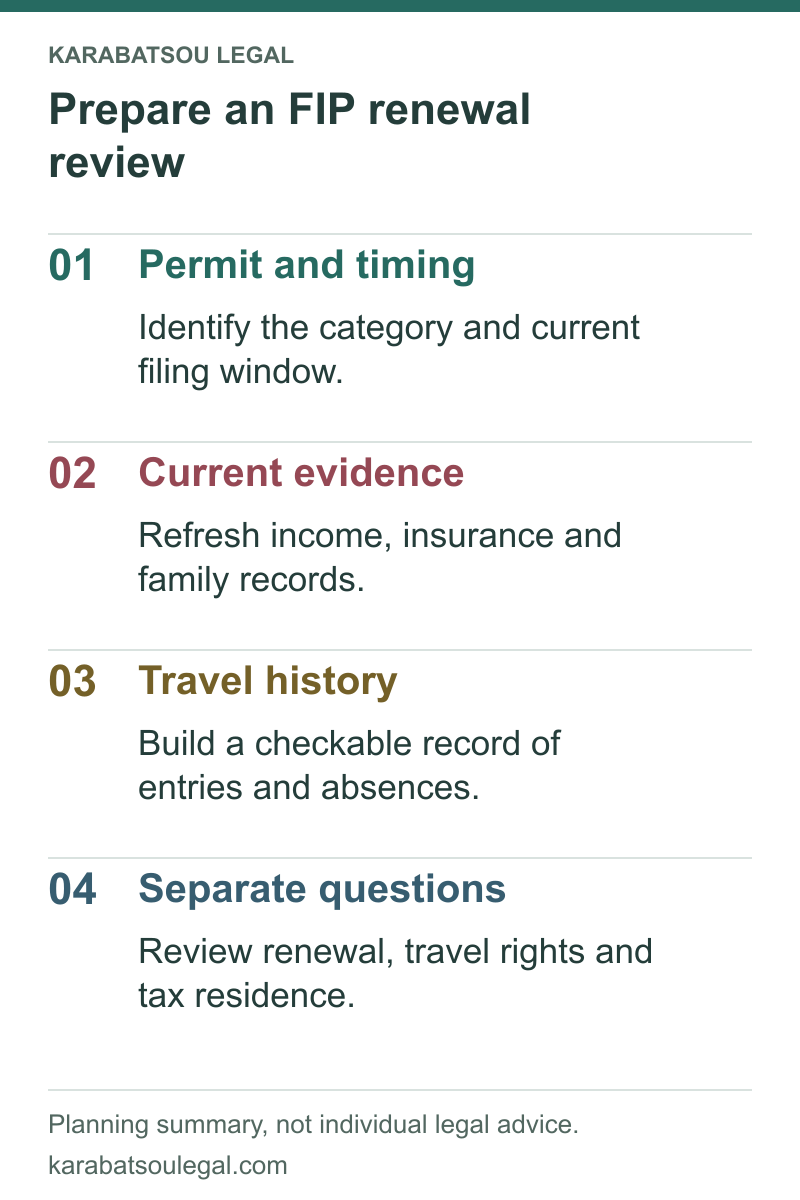
Infographic text
- Permit and timing: Identify the category and current filing window.
- Current evidence: Refresh income, insurance and family records.
- Travel history: Build a checkable record of entries and absences.
- Separate questions: Review renewal, travel rights and tax residence.
Audit insurance, family status and changes in activity
Check that insurance remains effective for each applicant and that the policy meets the applicable residence requirements. Read the coverage and exclusions, not only the renewal invoice. A replacement policy should be reviewed before the previous one ends so that any gap is identified and addressed.
Prepare a changes sheet covering marriage, divorce, births, custody, children's ages, new passports and changes of address. Keep the supporting records with each person's file. A family permit linked to the sponsor does not remove the need to demonstrate the individual's continuing eligibility.
Review activities as carefully as finances. Passive FIP does not grant employment or independent economic-activity rights in Greece. Starting online consultancy for a foreign business can raise a route problem even if the original pension remains unchanged. A larger income total does not cure incompatible work.
Disclose a proposed change before renewal preparation is finalised. Ask whether the current category still fits or whether a lawful category-change assessment is needed. Do not describe active earnings as passive simply to keep the documents looking similar to the first application.
What does the code say about temporary absences?
For an ordinary passive FIP permit, the starting point is the general rule in Article 18(6) of the Migration Code, subject to any applicable special provision. It states that permit validity is not affected by temporary absences not exceeding six months annually. This is not the same wording as a universal requirement to spend exactly 183 days in Greece.
The provision also addresses longer absence for compulsory military service and one absence of up to twelve consecutive months for specified serious reasons, including pregnancy and maternity, serious illness, studies or vocational training. An exception requires attention to its actual facts; it is not a discretionary holiday allowance.
Do not borrow absence concessions from Golden Visa, EU-family or other residence categories. Likewise, do not assume that a trip of less than six months is harmless when several trips together create the relevant annual total. The review must examine the whole travel pattern.
Ask how the authority applies the annual reference period and counts departure and return dates in your circumstances. Near a limit, obtain an individual assessment rather than treating a rough conversion between months and days as legal certainty.
Build a travel ledger that can be checked
Create one row for every departure from and return to Greece. Record the dates, destination, reason and supporting evidence. Include journeys within the Schengen area, where the absence of routine passport stamps does not mean the time was spent in Greece.
- Retain relevant passport pages and old passports covering the permit period.
- Keep boarding passes, tickets and other dated evidence where available.
- Flag an uncertain date instead of silently estimating it.
- Separate an ordinary trip from an absence for which a serious-reason exception may be claimed.
- Keep medical or other exceptional evidence securely and disclose only what the procedure requires.
Consider a hypothetical FIP holder who takes several lengthy trips in the same year. Reviewing only the longest trip would miss the cumulative picture. The ledger should allow the reviewer to see each period and determine which reference period applies before reaching a conclusion.
Now suppose one trip was extended by a documented serious illness. Preserve the contemporaneous records, the original itinerary and the actual return date. The explanation should show what happened and why, without asserting that the exception has already been accepted.
Distinguish renewal filing from permission to travel
The amended Article 11 provides for electronic submission through the Ministry's migration information system. Keep the submitted application, document list, payment evidence and confirmation. Check that the filing is actually completed; saved drafts and payment receipts are not substitutes for a lodged application.
Monitor the contact channel used for the application. A supplementary-document request should be logged with its deadline and assigned to someone who can act. Where a representative handles the file, agree how promptly official messages will be forwarded and who retains the authoritative copy.
Do not assume that an application certificate has the same international travel function as a valid residence card. Before departing while renewal is pending, obtain current guidance for departure, return, any transit country and the documents you actually hold. Carrier checks and border requirements can make an otherwise ordinary journey problematic.
Personal biometric steps may remain necessary despite electronic filing. Confirm the attendance instructions and avoid scheduling a long absence around an expected appointment. A lawyer's authority to submit documents does not generally replace the applicant at personal identity checks.
Keep renewal, tax residence and future status separate
An absence that does not affect a permit's validity does not necessarily preserve every later immigration objective. A future application for long-term status or citizenship has its own conditions and residence assessment. Do not build that plan by simply counting the number of FIP cards issued.
Tax residence is separate again. AADE's guidance examines permanent or principal residence, habitual abode and the centre of vital interests, alongside a presence rule exceeding 183 days in any twelve-month period and its qualifications. A tax adviser should assess those facts independently of the immigration absence calculation.
Keep three headings in your planning notes: current permit compliance, tax position and future status goals. Place the travel ledger under all three, but do not assume each adviser will apply the same legal test to it.
The Greek residence-permits guide explains the wider categories. For a focused renewal review through the residence-permit service, provide the permit decision, expiry date, resources summary and travel ledger. That gives the reviewer the facts needed to identify problems before submission.
Frequently Asked Questions
Does every FIP permit expire after two years?
No. The passive sufficient-resources provision specifies three years, with renewal for the same period. The digital-nomad framework contains a separate two-year permit provision. Check the legal basis and actual dates on your own decision, particularly for older cards or unusual issuance histories.
Can I spend most of the year outside Greece and renew?
Do not assume so. Review the general temporary-absence provision, any applicable special rule and the actual travel record. A valid card alone does not establish that an extended absence is protected. Obtain advice before a planned long absence, especially when approaching the statutory limits.
Does staying 183 days automatically satisfy FIP renewal?
No. Renewal also involves the continuing route conditions and supporting evidence. The immigration absence provision and tax-residence rules are different tests. A day count cannot replace the resources, insurance and category assessment, and it should not be used as a universal safe harbour.
Can an existing pensioner ever have a different resources rule?
Article 163(8)(d) contains a specific provision for certain people already lawfully resident who receive a pension from a Greek public insurance body. It should not be generalised to foreign pensions or every retiree. Ask whether that distinct legal basis applies to your documented circumstances.
What is the most useful first step before renewal?
Read the current decision and card, record expiry and identify the legal category. Then prepare a changes sheet, resources summary, insurance review and travel ledger. This exposes substantive issues early and lets the final document checklist be tailored to the application actually being renewed.
Author and Legal Review
Editorial author: Karabatsou Legal. Legal reviewer: Nadia Karabatsou.
This article was prepared with AI-assisted editorial support and legally reviewed before publication. Reading it does not create a lawyer-client relationship. For a correction or advice on your circumstances, contact the firm.
Sources and Further Reading
Discuss your circumstances
Get advice based on your documents, plans and deadlines.
Contact the firm