
General information, not advice for your individual circumstances. Requirements can change. Obtain case-specific advice before acting.
In this article
Greek long-term resident status and a Golden Visa are different legal permissions. Long-term resident status generally depends on qualifying lawful residence in Greece, resources, insurance and integration. A property-based Golden Visa depends on a qualifying investment and its continuing conditions. Holding an investor card for five years does not automatically establish five years of qualifying residence or produce long-term status.
The distinction affects employment, absences, renewal and a possible move elsewhere in Europe. This comparison concerns the property-investor permit under Article 100 and EU long-term resident status in Greece, not every investment category or every document described informally as permanent residence.
Start with the legal status, not the word permanent
The property-investor permit is called a permanent investor residence permit in Greek legislation, but it is issued for renewable five-year periods and remains connected to qualifying conditions. That terminology does not make it the EU long-term resident status governed by a different part of the Migration Code.
Under Directive 2003/109/EC, long-term resident status is permanent subject to specified loss or withdrawal grounds. The physical document nevertheless has a validity period. Permanent status and a card that never needs administrative renewal are not the same thing.
Greece also has other residence arrangements, including family-related and national long-duration categories. Do not assume that all cards with lengthy validity have the same employment or European mobility effects.
Neither status is Greek citizenship. Neither supplies a Greek passport, voting rights reserved to citizens or automatic EU citizenship rights. Any later nationality application must be assessed independently under its own route and requirements.
Compare the conditions that open each route
The Article 100 property-investor framework concerns a qualifying investment, not simply owning any Greek home. Location-dependent value bands, single-property and area conditions, payment evidence and special conversion or listed-building provisions require transaction-specific review.
The Ministry's April 2026 investor circular adds administrative guidance on applying the framework. A sales description should therefore be checked against the applicable law and current implementation guidance, especially where a property relies on a special category.
Long-term residence begins elsewhere: with a qualifying history of living lawfully in Greece. Buying an expensive home does not replace that history. Conversely, a person with sufficient qualifying residence does not need to purchase an investor property merely to be assessed for long-term status.
These routes answer different needs. Someone seeking an investment-linked Greek base and someone seeking settled residence with broader domestic work rights may reasonably require different plans.
Establish the five-year residence history carefully
Article 144, as restated by Article 179 of Law 5307/2026, starts with five years of lawful and uninterrupted residence immediately before the application. It contains specific counting rules, including half-counting of study or vocational-training periods and exclusions for certain categories.
The ordinary absence provision counts absences shorter than six consecutive months where total absences do not exceed ten months within the five-year period. Both limits matter. Several trips can remain individually short yet exceed the cumulative limit.
For a hypothetical calculation, three separate four-month absences total twelve months. Each trip is shorter than six consecutive months, but the combined absence exceeds ten months. That arithmetic does not decide every legal exception; it shows why checking only the longest trip produces an incomplete assessment of the ordinary rule.
Build a chronology of permits, applications, decisions, entries and departures. Where there was a pending renewal, a category change or a disputed gap, have the legal effect of that period checked. A collection of cards without the underlying dates may not explain the complete history.
An investor who mainly lived abroad cannot substitute the card's five-year validity for actual qualifying residence. The investment may support investor renewal while the proposed long-term application still lacks the necessary residence history. Assess each objective separately.
Infographic text
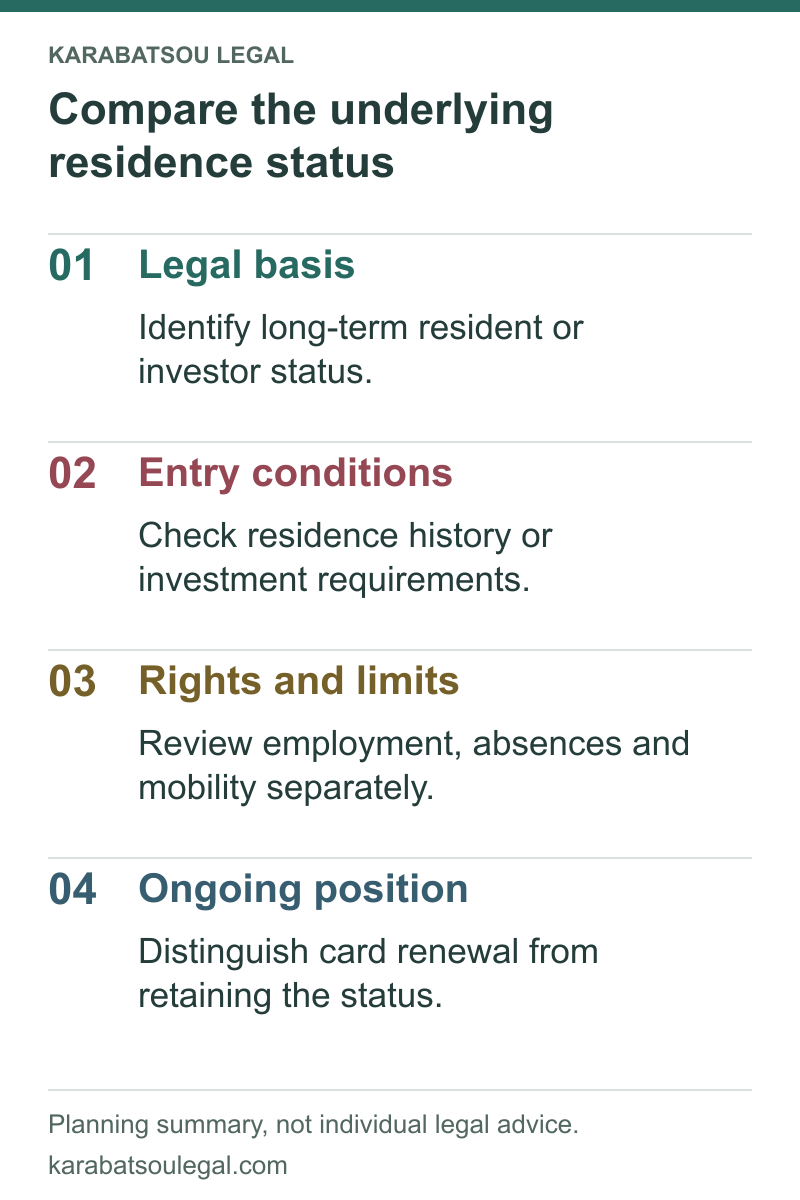
- Legal basis: Identify long-term resident or investor status.
- Entry conditions: Check residence history or investment requirements.
- Rights and limits: Review employment, absences and mobility separately.
- Ongoing position: Distinguish card renewal from retaining the status.
Check resources, insurance and integration as separate tests
Completing the residence period is not the whole long-term application. Article 144 also requires sufficient income, full sickness insurance and the applicable integration conditions. A property valuation does not by itself demonstrate an income stream or the required insurance coverage.
The income test is linked to annual minimum-wage earnings with the statutory family adjustment; it is not the FIP route's EUR3,500 monthly benchmark. The resources decision also addresses calculation and evidence. Have the current amount and relevant household contributions assessed rather than importing a figure from another residence programme.
Integration evidence must follow the current legal options. Law 5275/2026, Article 37, amended the recognised evidence under Article 160, including relevant education and Greek-language qualifications. Do not assume everyone needs the same examination, or that a commercially issued language-course certificate is sufficient.
Gather the evidence early enough to identify gaps. If a qualification needs recognition or a particular certificate must be obtained, treat that as a separate task. Length of residence alone does not justify asserting that every other condition has been satisfied.
Understand the difference in Greek employment rights
Article 100 states that its investor permits do not establish access to employment. The April 2026 circular repeats that the permanent investor permit does not provide access to the labour market. A person should not accept a Greek job merely because their card is described as permanent.
Long-term resident status has a different framework. Article 11 of Directive 2003/109 provides equal treatment in access to employed and self-employed activity, subject to its limits. Professional licensing, qualification recognition and restrictions involving public authority remain separate questions.
Distinguish passive ownership of an investment from personally operating a business. Share ownership, management duties, consulting services and employment may have different legal implications. Before undertaking activity, obtain an assessment of what you will actually do and which permission covers it.
Applying for a different status is not a reason to anticipate approval. If a certificate is issued while the application is pending, its domestic effects must be checked under the actual procedure. Do not start work based solely on a future eligibility prediction.
Separate European travel from residence in another country
A Greek investor residence permit does not give automatic rights to live or work throughout the EU. Short Schengen visits and immigration to another country are different legal questions. The absence of routine internal border checks does not convert a holiday into authorised settlement.
EU long-term resident status offers a structured possibility of residence in another participating Member State, but Chapter III of Directive 2003/109 makes that possibility conditional. The second state may require an application, resources, insurance and evidence of the proposed purpose, and may apply permitted labour-market conditions.
Someone considering a move for employment should therefore check the destination's procedure before accepting a start date. Family members' accompanying rights also require assessment. The Greek card is evidence relevant to that process, not a substitute for every destination-country permission.
Keep tax analysis separate from mobility planning. A residence document does not alone determine where a person becomes tax resident. AADE's tax-residence guidance explains the separate criteria. Moving a home, job or centre of personal and economic interests may create obligations even when the immigration paperwork is still being organised.
Distinguish card renewal from retaining the underlying status
For the property-investor permit, continued qualifying ownership or the relevant investment arrangement remains central to renewal. Article 100 provides that periods of absence do not obstruct renewal. This does not waive other conditions, and a sale or other material change requires review before assuming the permit remains unaffected.
For Greek long-term residents, Article 146 of the Migration Code provides five-year document renewal without repeating the Article 144 acquisition conditions. It also establishes a specific renewal procedure. The permanent status remains subject to the separate loss and withdrawal provisions.
Under Article 148, as amended in 2026, the ordinary loss grounds include absence from the EU for at least twelve consecutive months and absence from Greece exceeding six years, as well as acquiring long-term status in another Member State. Any applicable special provisions need individual examination before prolonged travel.
Those post-acquisition rules are not the same as the absence limits used to qualify initially. Keep separate calculations for investor renewal, initial long-term eligibility and retention of long-term status. One travel spreadsheet can support all three reviews, but one legal conclusion cannot.
Compare two hypothetical investors before choosing the next step
Consider a hypothetical investor who holds a five-year Greek card but visits for only a few weeks annually. If the qualifying investment and other conditions continue, investor renewal may be the relevant task. The card's anniversary alone does not support a conclusion that the investor has completed five years of qualifying Greek residence.
Now consider another hypothetical investor who has actually lived in Greece, maintained an accurate travel history and wants broader domestic work rights. A long-term status assessment may be worthwhile, but residence counting, resources, insurance and integration still need to be checked.
Neither person's family should be left out of the comparison. Review the legal basis and expiry of each family member's document before the principal applicant changes status or disposes of the investment. Do not assume that replacing the principal card automatically updates every dependent file or preserves every existing arrangement.
- Identify the current legal category from the card and granting decision.
- State the objective: keep an investment base, settle in Greece, work, or move elsewhere.
- Reconstruct lawful residence and every material absence before calculating eligibility.
- Separate investment value from income and insurance evidence.
- Check the current integration evidence options and any documents still missing.
- Assess each family member's position and any destination-country requirements.
The Greek residence permits guide supplies broader context. For the individual comparison, the residence permit service should receive the permit history, travel chronology and proposed activity. That information is more useful than asking which permanent permit is best in the abstract.
Frequently Asked Questions
Does a Golden Visa automatically become long-term residence?
No. Investor renewal and acquisition of long-term resident status are different procedures. The latter requires a qualifying residence history and additional conditions. Five years printed on an investor card do not establish five years of actual lawful and uninterrupted residence in Greece.
Does permanent mean that the card never expires?
No. The property-investor card and the Greek long-term resident document have renewable validity periods. For long-term residence, the enduring legal status is distinct from the document and remains subject to loss or withdrawal grounds. Check both the status and the administrative renewal obligation.
Can a Golden Visa holder work anywhere in the EU?
No. Greek property-investor residence does not itself provide Greek labour-market access and does not confer automatic employment or residence rights elsewhere in the EU. Short travel rights should not be interpreted as permission to accept employment or relocate to another country.
Can long-term residents move freely like EU citizens?
Not on the same basis. The long-term residence directive provides conditional mobility to participating states, with destination-country requirements and procedures. It is a separate framework from EU citizenship. Confirm the second country's approval process before moving or starting work.
Will either status guarantee Greek citizenship later?
No. Citizenship is a separate legal assessment with its own route, residence and other requirements. Investment, card renewals or long-term status should not be marketed as a guaranteed passport pathway. Any nationality planning must examine the applicant's actual circumstances independently.
Author and Legal Review
Editorial author: Karabatsou Legal. Legal reviewer: Nadia Karabatsou.
This article was prepared with AI-assisted editorial support and legally reviewed before publication. Reading it does not create a lawyer-client relationship. For a correction or advice on your circumstances, contact the firm.
Sources and Further Reading
Discuss your circumstances
Get advice based on your documents, plans and deadlines.
Contact the firm