
General information, not advice for your individual circumstances. Requirements can change. Obtain case-specific advice before acting.
In this article
A Greek national Visa D and a Greek residence permit perform different jobs. A Visa D authorises entry and a defined long stay for an approved purpose. A residence permit is the permission granted under the relevant residence category, usually following a separate application. Neither document should be confused with the certificate issued while a residence application is pending.
The right sequence depends on the route. Some applicants need a specific Visa D before applying for residence; certain categories have other lawful entry or in-country application arrangements. Before planning a move, identify the category, the document currently authorising your stay and the next required action.
What a national Visa D authorises
A national Visa D concerns a longer stay in Greece for a specified purpose, rather than an ordinary short visit. The Ministry of Foreign Affairs national visa page provides the official starting point for the application framework. The competent consular post applies both general requirements and the requirements of the particular category.
Read the issued visa itself. Check the holder's details, validity dates, permitted entries and any purpose or category notation. The fact that a document is labelled D does not mean every holder may work, stay for the same duration or make unlimited trips.
For routes leading to a residence permit, visa approval is not the final immigration step. Prepare the permit application while organising entry, so the relevant filing obligation does not become an unexpected task near the visa's expiry.
Some national-visa categories are designed around a defined temporary activity and have their own rules rather than an ordinary permit-conversion sequence. Ask what follows for your specific category; avoid the blanket assumption that every D visa must become the same residence card.
What the residence permit establishes
A residence permit identifies a category of permission to live in Greece. Its duration, renewal conditions and associated rights come from that category and the applicable law. A multi-year card does not create unrestricted rights simply because it lasts longer than a visa.
The Migration Code's provisions on permit categories and issuance distinguish the legal bases and provide for employment-related information on residence documents. Read the decision alongside the card when the printed description does not fully explain a condition.
For example, passive sufficient-resources residence and property-based investor residence should not be treated as ordinary employment permissions. A family member's rights must be assessed under the actual family category, rather than copied from the principal applicant's marketing description.
Keep the passport valid as a separate document. A residence card is not a substitute passport, and possessing a Greek tax number, bank account or registered lease does not replace immigration permission. Those records may support an application or daily administration, but they answer different questions.
If your plans change between visa approval and the residence application, disclose the change. A move originally organised around passive income may need reassessment if you accept employment. The existence of an issued visa does not make a different intended activity compatible with its original purpose.
Compare the three documents without mixing their effects
Use this comparison to identify what you have now. The final legal answer still depends on the category and whether the document remains valid.
| Document | Main function | Important limit |
|---|---|---|
| National Visa D | Authorises entry and the defined long stay for its purpose. | Does not automatically complete a separate residence application or authorise every type of work. |
| Residence permit | Records residence permission under the approved category. | Rights remain category-specific; renewal and continued compliance may still be required. |
| Statutory application certificate | Evidences the pending application and the domestic effects provided by the applicable procedure. | Is not automatically interchangeable with a residence card for international travel. |
A submission acknowledgment is another item again. It confirms that material was submitted, but should not be assumed to carry the statutory certificate's effects. Keep both documents and check their titles, identifying numbers and status.
These distinctions matter when speaking to an employer, airline or administrative office. Saying that you have a visa can leave the listener uncertain whether you mean a valid D sticker, an expired entry visa or a pending residence application.
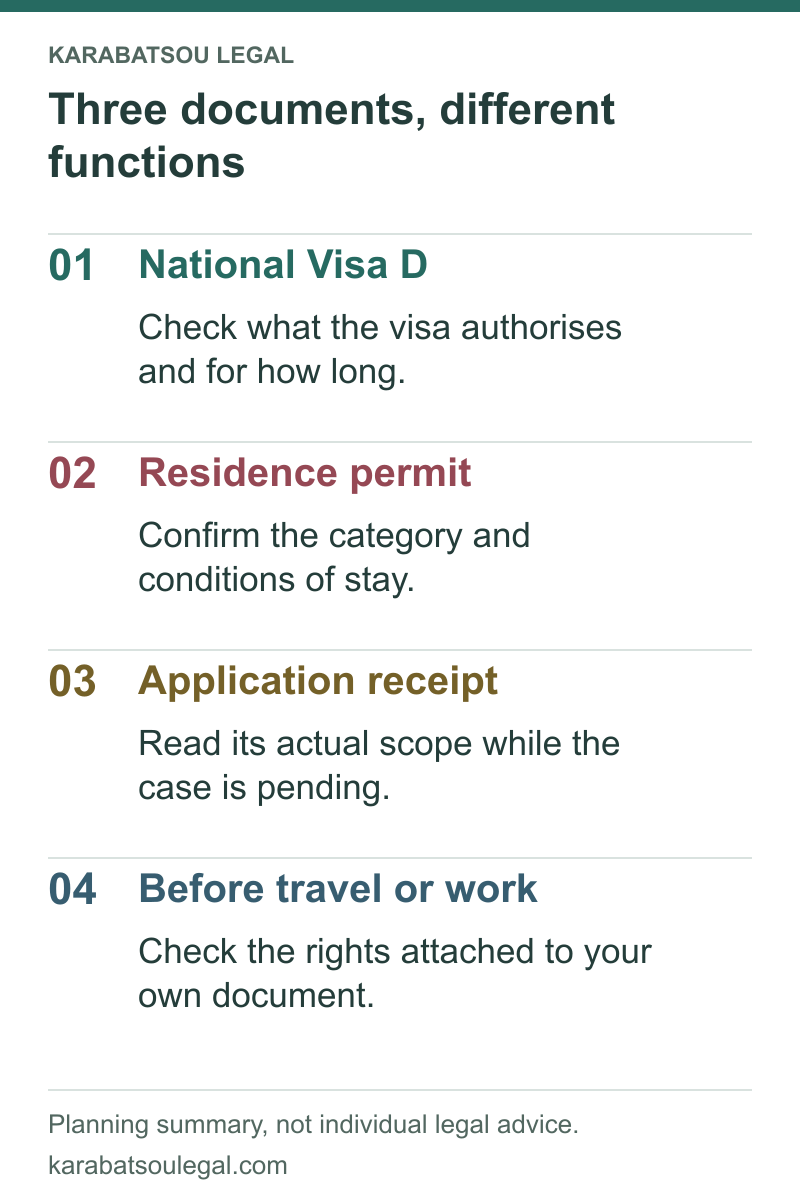
Infographic text
- National Visa D: Check what the visa authorises and for how long.
- Residence permit: Confirm the category and conditions of stay.
- Application receipt: Read its actual scope while the case is pending.
- Before travel or work: Check the rights attached to your own document.
Why the entry sequence changes between routes
For a new passive sufficient-resources permit, Article 66 of the official document decision includes the required national Visa D in the initial permit file. Someone arriving as a short-stay visitor should not assume that sufficient savings alone permit an in-country FIP application.
By contrast, the property-investor framework contains specific lawful-entry provisions. It should not be described as requiring the identical FIP visa sequence in every case. Digital-nomad arrangements also have their own provisions and must not be confused with passive sufficient-resources residence just because both involve financial evidence.
Existing lawful residents may face another question: whether they can change category without obtaining a new visa abroad. That depends on the current legal provisions and the status actually held. A theoretical alternative route is not permission to ignore the present document's expiry.
Write the sequence down before travel: legal basis for entry, legal basis for the application, filing deadline, responsible authority and attendance requirements. This prevents assumptions from one person's route being applied to another person's move.
Coordinate visa validity with the residence application
Where the route requires a permit application after entry, do not leave preparation until the visa is nearly expired. Identity documents, insurance, financial evidence or family certificates may need updating, and consular approval does not eliminate the residence authority's separate checks.
Distinguish four dates: when the visa becomes valid, when you actually enter, when the permit application must be submitted, and when any appointment takes place. The relationship between those dates is governed by the route, not by an assumed universal grace period.
Keep evidence of lawful entry where relevant, together with the complete visa and passport pages. If an entry stamp is absent or the travel record is unclear, ask what alternative evidence is accepted rather than reconstructing a convenient date from memory.
Do not promise an employer or landlord that the card will arrive on a fixed day. Processing, requests for additional evidence and biometric scheduling are different stages. Plan around the permission currently in force and the legal effect of a properly filed application, not an optimistic printing estimate.
Understand what happens while the permit is pending
For applications governed by the relevant Migration Code provisions, the statutory certificate can evidence lawful residence and the rights deriving from the permit sought pending the decision. Article 10(8) addresses initial applications, while Article 11(10) addresses renewals. Verify that the document issued in your case is that certificate and remains valid.
The certificate does not predetermine approval. You must still respond to requests, satisfy the substantive conditions and attend required appointments. Nor does it create work rights that are absent from the category being sought.
Keep the declared email address monitored. A change in the file can matter even if nobody has yet collected a physical card. The relevant statutory certificate ceases to apply when the granting or refusal decision is issued under these provisions.
If permission is refused, obtain advice about the notification, challenge deadline and present status immediately. Do not assume that an old certificate remains effective or that an appeal automatically provides the same protection as a pending first application.
Separate Greek residence, Schengen visits and work rights
A valid long-stay visa or residence permit issued by a Schengen country can support short visits to other Schengen countries, subject to the applicable conditions. The European Commission's guidance on moving between EU countries distinguishes those visits, generally limited to 90 days in a 180-day period, from moving to another country for longer.
That short-visit possibility is not a general right to take employment or establish residence elsewhere in the EU. The destination country's rules still govern a proposed move or job. Greek investor residence, in particular, is not EU citizenship or an EU-wide work permit.
Pending certificates require a separate travel review. Check current Greek re-entry arrangements, passport and nationality requirements, the certificate type and the whole itinerary. Returning directly to Greece and entering the Schengen area through another state can raise different questions.
Tax is separate too. Neither the visa label nor the residence card alone determines tax residence. Personal connections, presence, income and applicable tax rules need independent consideration when the stay becomes a move.
Use a document-by-document travel and filing check
Consider a hypothetical retiree with a valid FIP Visa D who enters Greece, files the residence application and later wants to attend a family event abroad. Their position should be assessed twice: first when arranging the permit filing, and again using the documents valid for the proposed departure and return.
If the visa will expire during the trip and only a pending certificate will remain, the earlier visa approval does not answer the return question. The itinerary should be checked before a non-refundable booking, including any transit through a different Schengen state.
- List every immigration document held, with its exact title and expiry date.
- Identify the category and the activities permitted at the present stage.
- Confirm whether a residence application is required and record the filing deadline.
- Distinguish final submission, statutory certification, biometrics and approval.
- Check each journey against the documents valid on the return date.
- Preserve official instructions and the application's complete evidence record.
The immigration guide explains the wider planning framework. For an individual document review, approach the immigration service with scans of the actual documents and a dated travel plan. Descriptions such as my visa is being renewed are often too imprecise to assess safely.
Frequently Asked Questions
Is a Visa D the same as a residence permit?
No. The visa authorises entry and the defined stay for its purpose. A residence permit is issued under a residence category, often after a separate application. Some temporary visa categories have different arrangements, so confirm the next step for the route actually granted.
Does every residence route require a Visa D first?
No universal rule covers every route. A new passive FIP permit has a specific national-visa requirement in its document framework, while investment and other categories may have different entry or in-country application provisions. Identify the legal basis before relying on visitor admission.
Can I work because my visa says D?
The letter D is not a general work authorisation. Employment rights depend on the approved purpose and applicable category. Passive FIP residence does not authorise remote employment simply because an employer is overseas, and investor residence should not be treated as unrestricted employment permission.
Can I travel while waiting for the residence card?
Check the documents you hold and the complete itinerary. A still-valid visa may present a different situation from an expired visa and pending certificate. Any Greek re-entry arrangement must be verified for your case; it should not be assumed to cover another country's entry or transit requirements.
Does a lawyer's power of attorney remove personal appointments?
No. Representation can support preparation, filing and authorised communication, but it does not replace your biometric data or any required personal interview. Clarify attendance points before leaving Greece or making commitments that would prevent you attending an appointment.
Author and Legal Review
Editorial author: Karabatsou Legal. Legal reviewer: Nadia Karabatsou.
This article was prepared with AI-assisted editorial support and legally reviewed before publication. Reading it does not create a lawyer-client relationship. For a correction or advice on your circumstances, contact the firm.
Sources and Further Reading
Discuss your circumstances
Get advice based on your documents, plans and deadlines.
Contact the firm