
General information, not advice for your individual circumstances. Requirements can change. Obtain case-specific advice before acting.
In this article
To renew a Greek residence permit, identify the exact category, confirm that you still meet its conditions, and submit the required application within the applicable filing window. Renewing is not simply replacing an expiring plastic card. The authority may need current evidence about your resources, insurance, investment, employment or family circumstances.
This checklist focuses on ordinary third-country residence permits under the Migration Code. EU-family residence documents, Withdrawal Agreement status, international protection and other special regimes require their own checks. An online procedure shared by several categories does not mean their eligibility, deadlines or travel rights are identical.
Identify the legal category before collecting documents
Read both sides of the existing card and locate the decision granting it. Record the category, legal basis, validity dates and any restriction on employment. An informal description such as retirement, permanent or family visa may conceal materially different permissions.
Then decide whether the task is renewal, replacement of a lost card, correction of details, or an application for a different status. A replacement document does not extend the underlying permission. An application to change category may require evidence that an ordinary renewal would not.
For a household, create an individual entry for each person. Family cards may depend on a sponsor, but each applicant still has identity records, an application and potentially a separate appointment. A child's age or a changed relationship can affect the appropriate next step.
Use the residence permits guide for orientation, then match the checklist to the actual title held rather than a similar-sounding category.
Calculate the filing window under the current rule
For renewals governed by Article 11 of the Migration Code, the general rule is to file within the two months before expiry. Article 12 of Law 5275/2026 amended the late-filing provision: an application may be submitted up to three months after expiry, with a EUR100 fine for each month of delay. Beyond that period, the stated exception concerns proven force majeure.
This is not a recommendation to wait until the card expires, nor a general permission to remain or travel during an unfiled period. It does not establish the filing rules for every residence document issued by every authority.
A concrete exception is the long-term resident document: Article 146 requires its renewal application before expiry and expressly disapplies Article 11(1). A holder should therefore not assume that the general late-filing provision applies to that document. This is why checking the legal category must precede calculating a deadline.
Begin preparation before the filing window opens. Passport renewal, foreign certificates and insurance changes may take longer than the actual upload. Record separately the earliest appropriate filing date, card expiry and any document-specific deadline.
If already late, seek prompt assessment with the exact dates and supporting evidence. Do not assume that paying a fee resolves every consequence, or that an explanation automatically meets the legal test for force majeure.
Assemble a clean identity and administrative file
Start with the passport, existing permit, previous decision and any current application certificate. Check name spelling, birth date, nationality and passport number across the records. Where a passport has changed, preserve the old identification page and explain the connection rather than leaving the authority to infer it.
Use the current official checklist for the exact renewal category. A practical administrative file usually needs clear contact details, the relevant identification material, prescribed supporting documents and the correct paid fee where required. Do not assume that every category has the same fee or every person must pay it.
Confirm whether foreign documents require authentication and accepted translations. Existing documents may remain useful, but a previous application's accepted scan does not establish that it is sufficient or current for the next one.
Keep originals available and name electronic files descriptively. Separate complete documents instead of uploading a mixed collection of photographs. Check that every page is readable, including stamps, reverse sides and the dates that establish validity.
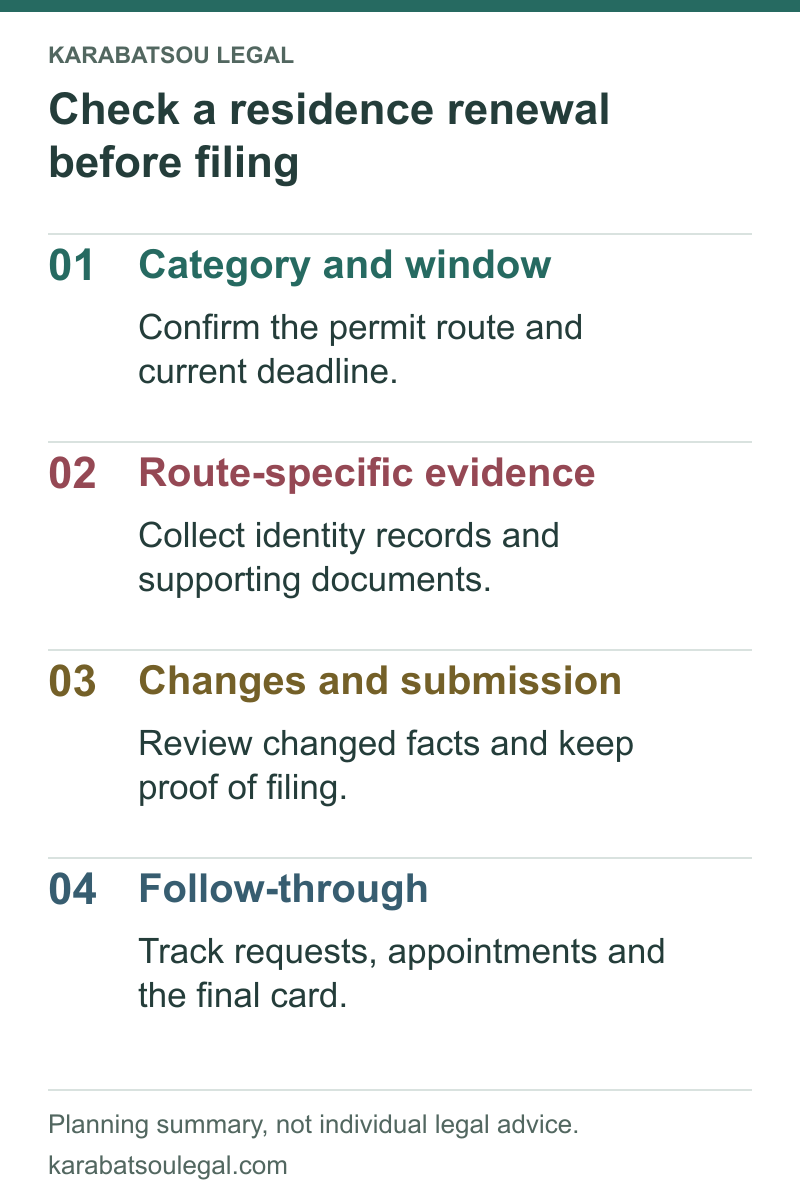
Infographic text
- Category and window: Confirm the permit route and current deadline.
- Route-specific evidence: Collect identity records and supporting documents.
- Changes and submission: Review changed facts and keep proof of filing.
- Follow-through: Track requests, appointments and the final card.
Add the evidence that belongs to your route
The official category-specific document decision separates initial applications and renewals. That distinction matters: evidence of initial entry and evidence that conditions continue are not interchangeable. Check subsequent amendments as well as the original decision.
- For passive sufficient-resources residence, review continuing resources and the required insurance evidence. Current financial records must explain availability, not merely repeat an old balance.
- For property-based investor residence, review continued qualifying ownership or investment arrangements and the compliance conditions attached to that investment.
- For employment-related permits, identify the specific employment category and its current employment, insurance and tax-related requirements; do not borrow an investor checklist.
- For family-based residence, review the sponsor's position, the qualifying relationship and any relevant age, dependency or independent-status provisions.
- For study-related residence, confirm the applicable enrolment or progress evidence and the rules governing continuation of studies.
This is an evidence map, not an exhaustive filing list. Place each requirement beside its document and mark whether it is available, requires updating or needs legal clarification.
Review changes before repeating last time's answers
Compare current circumstances with the facts supporting the existing permit. Has employment ended, a property been sold, income changed, a marriage ended or a dependent become an adult? Has the applicant begun work that the existing category does not permit? These questions affect substance, not just form completion.
Disclose extended absences with dates and reasons. Absence rules are route-specific. A provision allowing absences for investor renewal should not be transplanted into another category or into the calculation for long-term resident status.
Keep tax matters distinct but coordinated. A residence renewal does not itself establish tax residence, while tax or insurance compliance can be relevant evidence for particular categories. Make sure factual statements about addresses, work and travel are consistent across professional advisers.
If the current route no longer fits, examine lawful alternatives before submitting inaccurate continuity statements. A category change has its own conditions and timing. Do not assume it is available merely because the portal displays another option in a menu.
Complete the online filing and preserve proof
The gov.gr renewal service describes electronic submission, including filing by an authorised lawyer. Its operational guidance calls for contact details, the paid fee code where applicable and the required attachments. Verify the current platform instructions when filing.
A saved draft is not a filed application. Review the final summary, confirm that the correct person and category are selected, and check that the uploaded documents open properly. Once submission succeeds, preserve the confirmation, reference number, complete application and issued certificate.
Check the receiving service shown in the file. The 2026 amendment permits electronic allocation between competent one-stop services to distribute workload; an assumption based solely on the applicant's address may not identify the office processing the case.
If the platform fails, document the error and seek help immediately through the official channel and your representative. Screenshots can explain a problem, but do not assume they create a valid filing or automatically extend the deadline.
Read the certificate before relying on residence or travel rights
Article 11(10) of the Migration Code distinguishes proof of submission from the statutory application certificate. For the procedure it governs, the certificate evidences lawful residence and the rights deriving from the permit sought while the application is pending. Its validity ends when the relevant granting or refusal decision is issued.
Those effects do not make every email acknowledgment a residence certificate. Verify the document's identity, category, status and authenticity. A certificate for a non-working category does not create work rights that the category lacks.
Travel requires a separate assessment. A pending certificate should not be assumed equivalent to a valid residence card for Schengen travel or re-entry. Check the current Greek arrangement, your nationality, passport, certificate type, departure and return dates, and all transit countries.
Ask specifically about the full itinerary. A rule permitting a particular return to Greece may not authorise entry through another Schengen state. Airline document checks also need attention; an informal assurance from a booking agent is not legal confirmation.
Track requests, appointments and the final card
Assign responsibility for checking the declared email address and online file. Read every authority message promptly and record its date, required action and response deadline. A representative's involvement should produce a clear communication arrangement, not uncertainty about who is watching the file.
Biometric appointments and requests for additional evidence require follow-through. A power of attorney does not allow someone else to provide your fingerprints. Keep passport availability and travel commitments aligned with any personal attendance required.
For a supplementary request, prepare a response matching each numbered item to its attachment. Explain any document you cannot obtain and seek advice before the response deadline. Uploading unrelated material without addressing the actual request can leave the underlying issue unresolved.
Consider a hypothetical applicant who files a complete investor renewal, then books a trip after the old card expires. Filing may address their Greek residence position, but it does not independently answer whether their return itinerary is permitted. The practical response is to check travel documents before departure, while continuing to monitor the renewal.
- Confirm that the application is finalised and the statutory certificate has been issued.
- Calendar every request and retain proof of the response submitted.
- Attend required appointments with the documents specified in the notice.
- Check the decision and collection instructions rather than relying on silence.
- Inspect the new card's identity details, category and validity dates immediately.
For a refusal or disputed status, obtain advice promptly about the actual notification and available remedy. Do not assume that challenging a decision automatically preserves residence or travel rights. The residence permit service should receive the decision and notification evidence, not only a summary of the problem.
Frequently Asked Questions
How early should I prepare my renewal?
Start preparation before the filing window, particularly if passports or foreign records need renewal. For the general Article 11 procedure, the application window is the two months before expiry. Check the rule for your exact document rather than treating this as a universal timetable.
Can I renew after my permit has expired?
The amended general Article 11 rule allows filing up to three months late with a EUR100 fine for each month of delay, subject to its terms. Beyond that period, proven force majeure is the stated exception. Seek immediate advice; late-filing availability is not a blanket assurance about lawful stay.
Does the application receipt allow international travel?
There is no universal answer for all receipts and routes. Identify whether you hold the statutory certificate, then verify the current re-entry arrangements and the requirements of each transit and destination country. Do not substitute a pending application for a valid travel permission without checking.
Will renewal take the same time as my first application?
Not necessarily. Category, evidence, supplementary requests and the processing authority can affect the sequence. Distinguish a legal decision period from an estimate and from actual card collection. A previous applicant's experience does not establish a reliable completion date for your file.
Can my lawyer handle renewal without me attending?
An authorised lawyer may handle electronic preparation, filing and communication where permitted. Personal biometric or other attendance requirements remain separate. Confirm those requirements before arranging travel, and agree who receives notices and how quickly they will be forwarded.
Author and Legal Review
Editorial author: Karabatsou Legal. Legal reviewer: Nadia Karabatsou.
This article was prepared with AI-assisted editorial support and legally reviewed before publication. Reading it does not create a lawyer-client relationship. For a correction or advice on your circumstances, contact the firm.
Sources and Further Reading
Discuss your circumstances
Get advice based on your documents, plans and deadlines.
Contact the firm