
General information, not advice for your individual circumstances. Requirements can change. Obtain case-specific advice before acting.
In this article
Before paying a deposit on Greek property, establish that the seller can transfer the exact rights offered, that the building and its intended use are legally supportable, and that the reservation terms protect you if material problems emerge. A viewing, an agent's assurance and a tax declaration are not substitutes for those checks.
Due diligence should produce a decision, not merely a folder of certificates. Ask your lawyer, engineer and tax adviser to identify unresolved issues, the evidence needed to resolve them, the responsible party and whether the purchase should proceed. For an overseas buyer, that written account is particularly important because many decisions will be made without another site visit.
Define exactly what you intend to buy and do
Start with a short purchase brief: location, price, property type, intended occupation, planned works, rental expectations and any residence-permit objective. Include financing requirements and your preferred ownership structure. A holiday home, development plot and investor-residence property create different questions even where the advertised prices are similar.
Identify the apartment or parcel, cadastral reference where available, floor, area and included ancillary spaces. Ask whether parking, storage, garden and terrace areas are separate properties, part of the title or rights of exclusive use. The sales description may combine these categories, but your legal rights will depend on the documents.
Do not leave intended changes until after purchase. A planned extension, subdivision, roof terrace, pool or conversion should be part of the initial engineering brief. The question is not only whether the existing building can be transferred, but whether the property can lawfully support the purpose for which you are paying.
Verify the seller's title and authority to sign
The lawyer should examine how the seller acquired the property and the relevant registration history. Establish whether you are being offered full ownership, bare ownership, usufruct or a share. These are not interchangeable. A person who receives the rent or holds the keys may not hold every right needed for the proposed sale.
For inherited property, confirm that the necessary succession and registration steps support the seller's title. For a company, review the legal entity, representation and approvals required for the transaction. If someone signs under a power of attorney, check the document's scope, form and continuing effectiveness rather than relying on a scanned signature page.
Match the seller's name and identifiers across the deed, registry records, tax documentation and proposed agreement. Multiple owners require particular care: establish who owns each share and who must sign. A family member's assurance that the others agree is not a replacement for their participation or valid authority to act.
Request a written report that states what was examined and any limitations. For example, distinguish a completed registry search from a search awaiting an archived deed, and an engineer's visual inspection from a specialist structural investigation. If a key document was unavailable, the report should say so expressly. An unresolved item should remain open until evidence closes it, not disappear because the seller is pressing for a signing date.
Search for charges, claims and registration discrepancies
A title search should address registered mortgages, prenotations, seizures, claims and other rights affecting the property. The Hellenic Cadastre's certificate guidance explains the different certificates and extracts available, including information corresponding to encumbrances and claims. Ask the lawyer which searches and records are appropriate for the particular registration system and location.
A search result needs interpretation. If a charge is to be discharged using sale proceeds, the contract and payment arrangements should specify how that will happen and what evidence confirms removal. Do not treat an undertaking to clear the title later as equivalent to a completed discharge.
Compare the registered property with the deed and survey: identifier, boundaries, ownership shares and description. An administrative discrepancy may be repairable, but the correction procedure, cost and timing should be understood before a deposit becomes irreversible. Arrange an appropriately timed final search before completion, since a satisfactory early investigation is not a guarantee that nothing changes before signing.
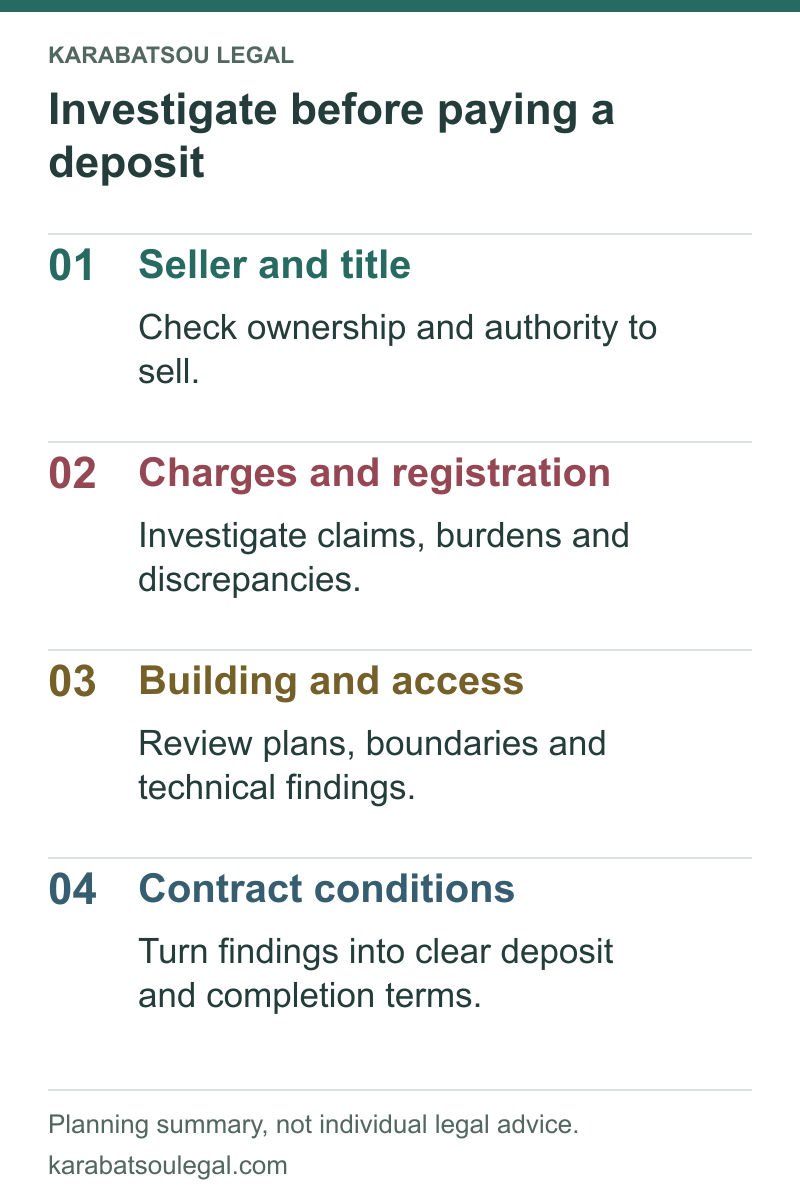
Infographic text
- Seller and title: Check ownership and authority to sell.
- Charges and registration: Investigate claims, burdens and discrepancies.
- Building and access: Review plans, boundaries and technical findings.
- Contract conditions: Turn findings into clear deposit and completion terms.
Inspect the building against its legal documents
An independent engineer should compare the actual property with approved plans, permits, revisions and any regularisation documentation. Ask about enclosed balconies, converted basements, additional rooms and altered layouts. A usable space is not necessarily an authorised main residential space, and advertised floor area may include categories that matter differently for your purpose.
The Environment Ministry's explanation of the Electronic Building Identity describes its role in recording the building's existing condition, permissions and changes. Have the engineer examine the relevant identity documentation and completeness certificate together with the underlying records. The existence of a document should not replace scrutiny of what it actually describes.
Separate planning legality from physical condition. Ask for the scope of the inspection: structure, moisture, roof, utilities, installations and any specialist investigations needed. An energy certificate provides different information from a structural assessment. Agree which findings must be resolved before signing and which defects you are prepared to accept with an informed repair budget.
Check boundaries, access and location-specific constraints
For a house or land purchase, establish legal access rather than relying only on the road used during a viewing. Ask whether access crosses another property and what documented right supports it. Compare the site survey with the cadastral map, visible fences and any neighbouring claims.
Location can introduce additional constraints. Ask the engineer and lawyer to examine applicable forest, coastal, archaeological, protected-area, planning and building restrictions. For an undeveloped parcel, require a specific assessment of buildability for the intended project. A large area or proximity to existing houses does not by itself establish permission to build.
Also check whether the buyer's nationality and the property's location trigger a special acquisition-permission issue, including relevant border-area restrictions. Avoid general statements that every foreign buyer can purchase every property without approval. The correct question is whether this buyer, acquiring these rights in this location, needs an additional step before a valid and usable transaction can be completed.
Review tenants, shared areas and operating restrictions
Inspect existing leases and occupation arrangements, including deposits, arrears, side agreements and any promised vacant possession. Confirm who actually occupies the property. Buying a property should not be assumed to make a tenant disappear on the seller's preferred date. The lawyer should explain the specific position and align the sale terms with it.
For apartments and shared developments, read the co-ownership deed and building regulations. Ask about restrictions affecting residential or business use, rentals, alterations and common areas. Establish how common expenses are allocated, whether major repairs have been approved and whether there are disputes about roofs, lifts, parking or service connections.
Where rental income matters, review the operating model before accepting a forecast. Investor-residence restrictions, tax treatment and tourism licensing are separate from the building's private rules. Approval in one area does not resolve the others. Obtain the relevant lease or management agreement in draft and assess any restrictions on terminating or replacing the operator.
Keep transaction taxes and residence eligibility separate
Ask for an itemised budget covering price, transaction tax, notarial and legal fees, engineering, registration, translations and any finance costs. AADE's real estate transfer tax guidance explains the tax framework and the separate conditions for primary-residence relief. Do not assume an overseas buyer qualifies for that relief simply because the purchase will be their only Greek home.
For new or converted property, obtain transaction-specific advice about VAT, any applicable suspension and transfer tax. It is inaccurate to treat every new building as automatically VAT-exempt. Also distinguish your Greek tax number and property reporting duties from tax residence; neither property ownership nor an AFM settles the whole tax-residence analysis.
If the purchase is intended for a Golden Visa, add a separate immigration assessment. Standard regional thresholds, the one-property rule and the 120 square metre requirement must be distinguished from special conversion or listed-building conditions. A legally transferable property may still fail the intended residence route. Eligibility should be checked before the buyer becomes contractually committed.
Turn the findings into deposit and completion conditions
A reservation payment is not automatically refundable because the buyer later discovers a concern. Have the proposed document reviewed before signing. Clarify the recipient, purpose of the payment, review period, permitted withdrawal grounds, refund timing and treatment of third-party costs. Avoid a broad waiver that defeats the protection you thought you negotiated.
- Proceed only when the property and rights being acquired are clearly identified.
- Require a documented solution for charges, title defects and essential corrections.
- Set technical conditions for unlawful works, missing permissions or material inspection findings.
- Include the required residence-route assessment where immigration eligibility is central.
- Specify the condition of delivery, included items and any vacant-possession obligation.
- Verify bank details independently before every significant transfer.
- Assign responsibility for signing, filing, registration and evidence of completion.
In a hypothetical apartment purchase, the title search is satisfactory but the advertised extra bedroom occupies an enclosed balcony not reflected consistently in the technical documents. The buyer should ask the engineer what can be lawfully resolved and the lawyer what contractual condition is appropriate. A price reduction alone does not answer legality or future resale risk.
The Gov.gr property-transfer service concerns the formal transaction workflow; it is not a substitute for the buyer's investigations. Keep the signed deed, payment evidence and final registration record in the completion file. For broader preparation, read the buying property in Greece guide and use the property-purchase service to define an independent review before paying a deposit.
Frequently Asked Questions
Is the seller's E9 enough to prove ownership?
No. An E9 is a tax property declaration, not a replacement for the deed and relevant registration evidence. It is useful for cross-checking descriptions and reporting, but the title investigation must establish the seller's actual rights and the encumbrances or claims affecting them.
Does the notary carry out all the buyer's due diligence?
The notary's role in preparing the formal transaction should not be assumed to include every independent legal, technical and commercial investigation you need. Agree professional responsibilities expressly. In particular, a physical building inspection and advice on whether the property suits your intended project require appropriate expertise and a defined scope.
Can I buy remotely using a power of attorney?
Properly drafted representation can support a remote property purchase, subject to the required form and scope. Establish clear instructions about price, property and payment authority. Separate immigration procedures may still require personal attendance, including biometrics; a property power of attorney does not remove those obligations.
Should every defect make me abandon the purchase?
No. Some issues can be resolved before completion or accepted with a clear understanding of their consequences. Others undermine title, lawful use or the purpose of the investment. Ask for a written classification: resolved, condition to completion, accepted risk or reason not to proceed. Avoid accepting an unexplained list of certificates as the conclusion.
When is the due-diligence process finished?
Most substantive checks should inform the decision before an irreversible commitment, but the process continues through final searches, signing and registration. After completion, confirm that the registration was accepted and retain the final evidence. A signed deed and a receipt for filing are not the same as confirmation that registration has been completed.
Author and Legal Review
Editorial author: Karabatsou Legal. Legal reviewer: Nadia Karabatsou.
This article was prepared with AI-assisted editorial support and legally reviewed before publication. Reading it does not create a lawyer-client relationship. For a correction or advice on your circumstances, contact the firm.
Sources and Further Reading
Discuss your circumstances
Get advice based on your documents, plans and deadlines.
Contact the firm