
General information, not advice for your individual circumstances. Requirements can change. Obtain case-specific advice before acting.
In this article
You can arrange a Greek power of attorney while living abroad, usually by signing a transaction-specific document before the competent Greek consular authority. A foreign notarial route may also be appropriate, but its form, authentication and translation must be approved for the intended use in Greece before you sign. The important question is not simply where a signature can be witnessed: it is whether the resulting document gives the right person legally effective authority for the exact task.
Start with the Greek lawyer, notary or institution that will receive the document. Ask them to identify the required form and prepare or approve the wording. This prevents an overseas appointment producing a beautifully certified document that cannot complete the transaction. The following approach is intended for adults arranging property or administrative representation, not emergency decisions about another person's capacity.
Choose a notarial power or a simpler authorisation
A power of attorney and a signature-certified authorisation are not interchangeable. The Greek consular FAQ for the United Kingdom distinguishes a notarial power used for transactions such as property sales from a private authorisation used for simpler affairs. The receiving professional should identify which instrument your particular act requires.
Describe the task using an action and an object. “Collect my municipal certificate” is a different instruction from “sign the sale of my apartment,” even if the same representative handles both. A request to obtain tax registration may need a narrower authorisation than a property purchase. Do not buy a broad notarial package merely because several unrelated administrative tasks are anticipated.
Ask whether one document should cover several connected steps or whether separating them gives better control. Research authority can be granted before deciding whether to sell, accept an inheritance or settle a dispute. Keep the instruction to investigate distinct from permission to make the final legal commitment.
Keep a second list of tasks that may still need your own participation. Where representation accompanies an immigration or identity procedure, do not assume the power removes personal interview, signature or biometric requirements. Ask the relevant authority to identify attendance points before arranging travel. Likewise, have a bank confirm its own identity checks instead of assuming the transaction's notary can approve them.
Define the powers before arranging an appointment
Prepare a short instruction sheet for the drafter. Identify yourself and the proposed representative from current identity documents, including any names used differently in Greek records. For a property transaction, supply the existing deed and available property identifiers. A street address alone may not distinguish an apartment, storage space, parking right and ownership share.
List the intended steps individually: requesting certificates, dealing with tax registration, signing a particular deed, correcting clerical details, submitting registration documents and collecting completed records. Ask the drafter to explain which powers are necessary and which are optional. Language allowing borrowing, granting security, making gifts or settling claims deserves separate consideration, not automatic inclusion in a standard template.
Decide how instructions will be confirmed during the transaction. A minimum sale price, maximum purchase price or approved bank account may be useful, but the lawyer must explain whether a restriction belongs in the power itself, in separate instructions, or both. A private email instruction should not be assumed to limit what a third party can rely upon from a broader signed instrument.
Prepare for signing before a Greek consular authority
The MFA guidance for the United States calls for a Greek-law draft sent to the competent consulate before the appointment, identity and residential-address evidence, and an interpreter where the principal does not know Greek. Its document list also includes evidence of lawful US residence. These are instructions for that consular network, not a universal checklist for every country.
Confirm jurisdiction, appointment category, accepted identification, draft format and interpreter arrangements directly with the office serving your location. The London power-of-attorney page, for example, requires personal attendance and advance contact from certain third-country nationals. Nationality and residence can therefore affect appointment planning.
Allow time for the consulate and Greek drafter to resolve wording before travel. Bring the identity document used in the draft and flag any replacement passport. Ask about accessibility or signing difficulties in advance. Neither a relative's explanation nor pressure from an approaching transaction deadline should replace your own understanding of the powers being granted.
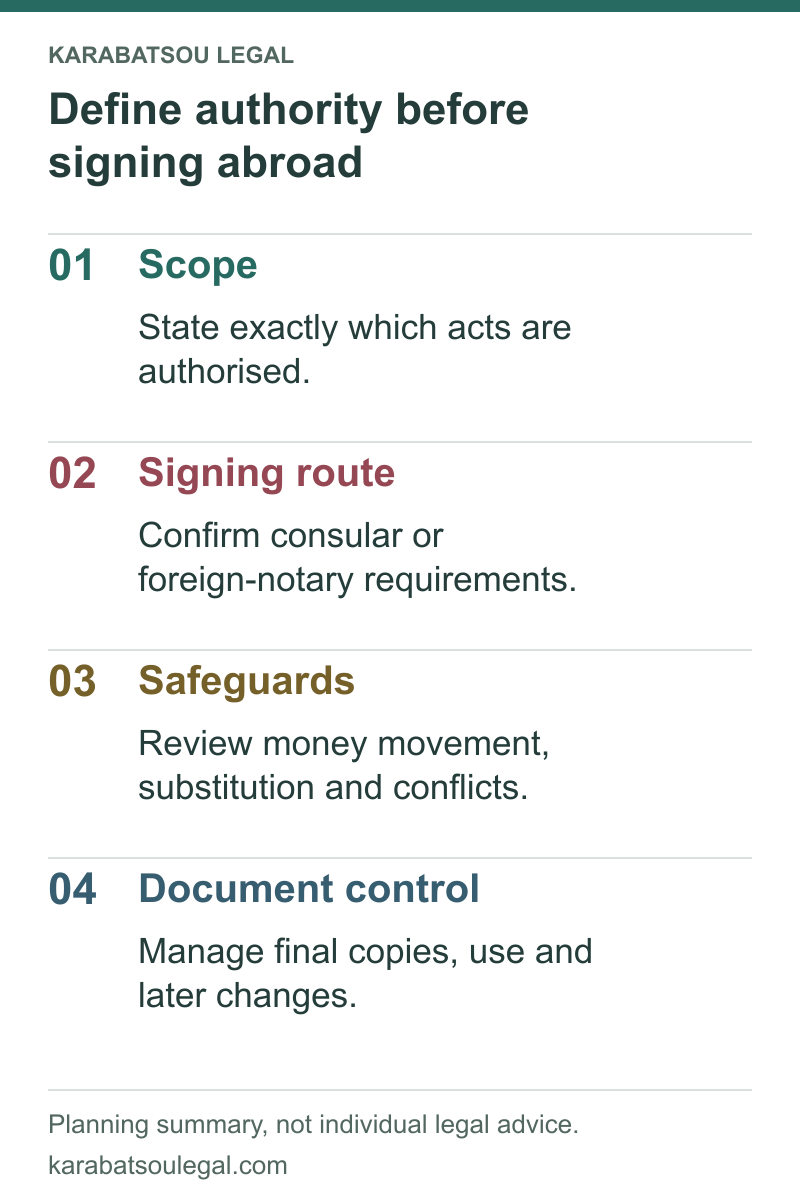
Infographic text
- Scope: State exactly which acts are authorised.
- Signing route: Confirm consular or foreign-notary requirements.
- Safeguards: Review money movement, substitution and conflicts.
- Document control: Manage final copies, use and later changes.
Check a foreign-notary route before paying for it
If consular signing is impractical, ask the receiving Greek notary whether a locally executed instrument will be accepted for this transaction. Send the proposed document and details of the foreign notarial procedure first. A local professional's authority to witness a signature does not, by itself, establish that the resulting instrument meets the Greek transaction's requirements.
Authentication is a separate question. The HCCH Apostille framework provides the relevant country and competent-authority information where the Convention applies. An apostille authenticates the public document's origin; it does not approve the powers granted or cure an unsuitable legal form. Where that framework does not apply, establish the required legalisation chain.
Agree who obtains authentication, who prepares the accepted Greek translation and whether the receiving office needs an original or certified copy. Do not assume a remotely notarised document, electronic apostille or emailed scan will be accepted simply because it is valid locally. Obtain confirmation for the specific format before commissioning it. Avoid detaching authentication pages or treating the translation as a replacement for the underlying signed document.
Control substitution, conflicts and movement of money
Read the parts dealing with substitution carefully. Ask whether the appointed representative can appoint another person, for which acts, and with what reporting obligations. Substitution can be useful when offices or appointments require different professionals, but it should reflect a considered arrangement rather than wording nobody discussed.
Identify possible conflicts. Is the representative also connected to the buyer, seller, lender or another heir? Does the draft permit contracting with themselves or acting for both sides? Request a plain-English explanation of such clauses and independent advice where interests diverge. An efficient transaction does not require you to accept unexplained conflict language.
For money, distinguish signing a deed, acknowledging payment and actually receiving funds. Agree the intended receiving account and how payment will be verified. Consider requiring direct payment to the owner's verified account where the transaction structure permits it. Confirm changed bank details through an independently known contact method. Keep copies of payment evidence, invoices and the final settlement statement outside the representative's own records.
Set a reporting rhythm as well: which proposed documents need your approval, who can approve additional expenses and when you receive copies. These are practical controls, not a substitute for properly drafted legal limits.
Use this pre-signing checklist on the final version
Review the version actually scheduled for signature, not just an early draft. A useful final check pairs every power with a reason and every restriction with an explanation of how it operates.
- Identity: names, passport details and representative information match the supporting records.
- Asset: the property, share or administrative file is identifiable without relying on family shorthand.
- Authority: essential preliminary steps and the intended final act are covered separately.
- Limits: price, payment arrangements and excluded transactions reflect your instructions.
- Delegation: any substitution or multiple-representative clause has been explained.
- Language: you understand the operative text and have arranged any required interpreter.
- Delivery: the recipient has confirmed the copy, authentication and translation requirements.
- Closure: you know how completion, expiry or revocation will be documented.
Record unresolved points beside the relevant paragraph and send one consolidated list to the drafter. Do not manually alter a signed copy or ask a translator to insert missing powers. A substantive change may require a new instrument, so the inexpensive moment to fix ambiguity is before execution.


A hypothetical overseas seller's decision
Consider a hypothetical owner in Canada preparing to sell a Greek apartment. The owner initially asks a cousin to “handle everything.” On review, the apartment deed includes a separate storage interest, the proposed sale price is still under negotiation, and the owner wants proceeds paid directly to a personal bank account.
A practical first instruction is to collect the title and tax documents and obtain the technical assessment. The sale authority is then drafted against the verified property description and agreed commercial limits. The owner asks whether the cousin needs any right to receive money, appoint substitutes or settle unrelated claims. Each additional power is justified or removed.
This hypothetical is about scope, not a recommended template. Different title issues or institutional requirements can change the drafting. The wider Greek property guide explains the transaction context; the property legal service is a relevant starting point for coordinating the receiving lawyer and notary before signing abroad.
Manage copies, completion and later changes
Ask who retains the signed original and what you will receive. The London consular notarial guidance says the consulate retains its original and provides a certified copy for use in Greece, without further legalisation or translation. That is different from the authentication process for a foreign public document.
Keep a register of copies sent, recipients and delivery dates. Before any major signature, request confirmation that the professional has checked the instrument's continued suitability and scope. An old document should not be treated as either automatically expired or permanently usable without reading its terms and checking intervening events.
If your instructions change, contact the drafter promptly about amendment or revocation and the notifications needed to make that effective. Do not assume deleting an emailed scan withdraws authority. After completion, obtain the final deed, relevant filing receipts and an expense account. Decide whether any remaining powers should continue, especially if the original instruction included ongoing property management.
Frequently Asked Questions
Can I complete the power of attorney entirely online?
Do not assume so. The consular routes discussed here require personal signing, while a digital authorisation is a different instrument. Ask the receiving Greek professional whether the exact act and proposed remote procedure are acceptable before paying for an online notarisation service.
Does every overseas power need an apostille?
No. A Greek consular notarial instrument and a foreign public document follow different authentication paths. For a foreign document, the issuing country, treaty position and document type matter. An apostille, where required, is only one part of the form and acceptance review.
Can a family member translate at the appointment?
Check with the specific consulate before booking. Offices set interpreter requirements, and some require an accredited professional who also signs the deed. Understanding conversational Greek is not the same as understanding clauses about settlement, substitution or receipt of money.
Does a property power also cover tax registration?
Only if the wording and required form cover the relevant tax act. Ask the drafter to check AFM registration, account-access permissions and any ongoing tax representation separately. Permission to purchase an apartment should not be treated as unlimited authority over every tax matter.
What happens if the transaction changes after signing?
Send the change to the receiving lawyer or notary before the representative acts. A different asset, price arrangement or additional transaction may exceed the existing authority. They should determine whether the original scope suffices or whether a replacement or supplementary instrument is necessary.
Author and Legal Review
Editorial author: Karabatsou Legal. Legal reviewer: Nadia Karabatsou.
This article was prepared with AI-assisted editorial support and legally reviewed before publication. Reading it does not create a lawyer-client relationship. For a correction or advice on your circumstances, contact the firm.
Sources and Further Reading
Discuss your circumstances
Get advice based on your documents, plans and deadlines.
Contact the firm