
General information, not advice for your individual circumstances. Requirements can change. Obtain case-specific advice before acting.
In this article
If you may have inherited property in Greece while living abroad, your first task is to establish your legal position and deadlines, not immediately sign an acceptance or advertise the property. Collect the death details, possible wills, family information, asset records and evidence of debts. Arrange an early review of whether you inherit, which succession law applies and what steps preserve your options.
Keep three workstreams separate: deciding your position as an heir, meeting tax obligations and documenting title to the property. They interact, but one does not automatically complete the others. In particular, inheritance-tax filing deadlines are not renunciation deadlines, and postponing a property acceptance deed is not a reliable way to postpone becoming an heir.
Record the death date before using any checklist
The death date now has particular importance. AADE's notification of Law 5303/2026 identifies a major succession reform. Its commencement provisions generally apply the new succession framework to deaths on or after 16 September 2026, while transitional rules deal with specified earlier situations.
Do not apply a current checklist automatically to a relative who died years ago. Equally, an older online explanation of personal liability for inherited debts may not describe a recent death correctly. Ask the lawyer to record the applicable version of the law and any transitional provision before recommending an acceptance, declaration, disposal or debt-protection step.
Prepare a chronology with the date and place of death, the deceased's last residence, your residence when relevant events occurred, when you learned you were called to inherit, and any will-publication date. Preserve the messages or documents supporting those entries. A family recollection can start the investigation, but a deadline calculation needs identifiable facts.
Identify succession law without confusing it with taxation
Property in Greece does not mean every succession question is automatically governed by Greek substantive law. EU Regulation 650/2012, relevant to deaths from 17 August 2015 within its scope, generally uses the deceased's habitual residence and permits a qualifying choice of nationality law. Exceptions and non-EU connections can require further analysis.
The Regulation does not decide inheritance tax or replace Greek land-registration requirements. Treat applicable succession law, the competent authority, recognition of foreign documents and Greek property registration as connected but distinct questions. A foreign probate document may be important evidence without being the last document needed for a Greek title file.
Give the lawyer all nationalities, the countries where the deceased lived and the complete will, including any choice-of-law clause. Do not extract only the paragraph mentioning the Greek house. A clause elsewhere may affect the analysis. Where professionals in two countries are involved, ask them to agree which questions each will answer and how their conclusions fit together.
Calculate renunciation separately and urgently
Where Greek renunciation rules govern, the ordinary period is four months from learning of the succession and the basis on which you are called. The one-year period applies where the deceased's last domicile was abroad or the heir was residing abroad at the relevant start of the period. For succession under a will, the period does not begin before publication. The parliamentary text of the 2026 reform sets this out in new Civil Code Article 1845; older estates require the corresponding earlier provisions.
The location of the house is not the trigger. Nor should every family member assume their time started on the same day: a prior heir's renunciation may change who is called next. Ask for a written calculation identifying the start event, evidence and deadline for each person.
Minors, capacity issues, suspension grounds, disputed knowledge and successive deaths require individual treatment. These are reasons for prompt advice, not automatic extensions. Renunciation is a formal act; telling relatives that you do not want the property is insufficient. Under the applicable Greek rules, expiry can produce deemed acceptance, and earlier conduct may also affect the option to renounce. Do not wait for every debt search to finish before addressing the deadline.
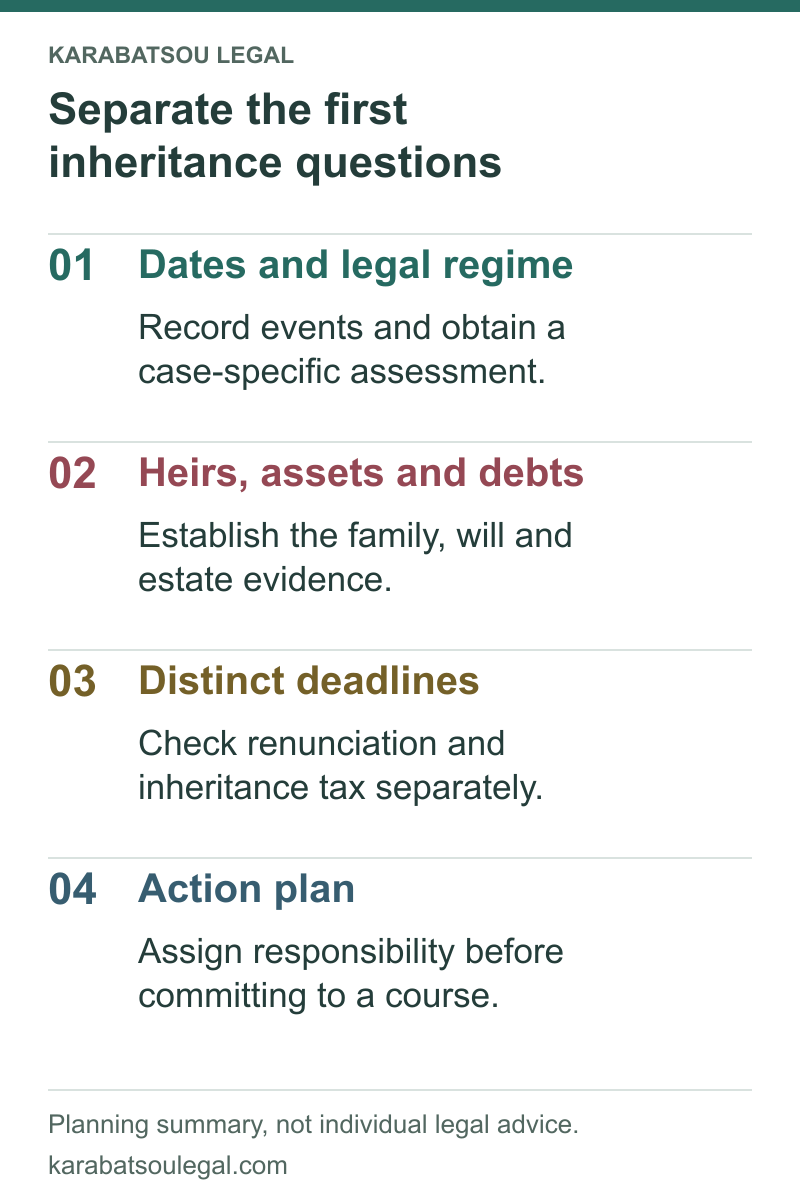
Infographic text
- Dates and legal regime: Record events and obtain a case-specific assessment.
- Heirs, assets and debts: Establish the family, will and estate evidence.
- Distinct deadlines: Check renunciation and inheritance tax separately.
- Action plan: Assign responsibility before committing to a course.
Diary the inheritance-tax return on its own facts
AADE currently states a nine-month filing period where the deceased died in Greece, and one year where the deceased died abroad or the heirs or legatees resided abroad at death. These tax criteria differ from the renunciation criteria. In particular, residence at death and residence when learning of succession are not interchangeable facts.
The usual tax starting event is death for intestate succession and publication of the will for testamentary heirs. Statutory deferrals or other exceptional events can alter the calculation. Ask the tax adviser to identify both the applicable period and its start, not simply write “one year” beside the file.
Do not assume that a disputed title, missing certificate or delay in signing the acceptance deed automatically stops tax time. Identify what can be filed, which evidence is outstanding and whether a legally available exception applies. Request a submission receipt and a separate payment schedule where relevant. Filing a return and paying any assessed tax are different tasks, and neither proves that the property has been registered in your name.
Locate wills and build evidence of the family relationship
Search deliberately for the original will, later wills, codicils and existing probate papers. Ask who holds each document and whether any publication or other succession procedure has already occurred. Keep an untouched scan and record the location of the original. Do not annotate, staple new material to or discard an apparently superseded document.
A useful initial bundle includes the death certificate, the deceased's identity details, your own identification, records establishing the relevant family connections and copies of Greek property deeds. List former surnames and variations between Greek and foreign documents. Mark missing records clearly rather than substituting an unsupported family-tree entry.
Have the Greek professional identify the current authority and procedure for will publication and certificates. Administrative arrangements have changed; an old instruction naming a particular court may no longer be usable. Before ordering foreign certificates, confirm the required form, legalisation or treaty exemption, and accepted translation. The goal is evidence that fits the procedure, not the largest possible collection of paperwork.
Investigate debts before committing to a course of action
Create a provisional balance sheet covering property, bank accounts and other known assets alongside loans, tax demands, guarantees, litigation and unpaid property expenses. Distinguish a confirmed liability from an unverified family report. Record the creditor, reference number, supporting evidence and who will investigate it.
For older estates governed by the earlier Greek regime, unrestricted acceptance could expose personal assets, while benefit-of-inventory procedures offered protection subject to requirements. The European e-Justice Greek succession overview describes that earlier framework. It must be read with the 2026 reform, not treated as a timeless description of every estate.
The new regime generally protects personal assets from estate obligations, but free-administration declarations and prohibited disposals can change that position. The AADE circular and attached legislation should be checked for the relevant provisions. Ask which actions change your exposure before distributing money or promising a sale. Separately identify urgent preservation work, such as securing an empty building, and request instructions about authorisation and recording the expense.
Check what the deceased actually owned
Locate the title deed and registration evidence, not just a property-tax statement. Ask a lawyer to check the ownership interest, co-owners, charges, claims and the property's identification in the competent registry. A family may refer to “the house” when the recorded interest is only a share or bare ownership.
For Greek immovable rights, the e-Justice explanation of registration distinguishes succession from registration of the acceptance instrument or inheritance certificate. Ask which instrument and registration route are appropriate for the actual file. A tax return is not a substitute for that title work.
If the deceased inherited the same property but never completed their own paperwork, identify each link in the chain. There may be multiple deaths, separate declarations and different legal regimes to address. Obtain a staged plan rather than assuming one new deed can omit the missing history. Technical condition and planning status can be investigated alongside title once authority to do so is established.
Use a first-actions checklist with named responsibilities
Assign one coordinator, but keep legal, tax and technical responsibilities visible. An overseas heir needs to know who is acting and what evidence will demonstrate completion.
- Send the death chronology and possible will to a Greek succession lawyer for urgent deadline triage.
- Request separate written renunciation and tax-filing calculations, including the supporting assumptions.
- Identify the death-date regime, applicable succession law and any protective procedure requiring action.
- Commission targeted searches for debts and title, with a defined scope and reporting date.
- Confirm required certificates, foreign-document formalities and the holder of each original.
- Arrange any necessary AFM, digital access and narrowly drafted representative authority.
- Set an early decision meeting before the first deadline, even if searches remain incomplete.
For background, use the Greek inheritance guide. For individual coordination, the inheritance legal service is the relevant contact point. Send an indexed initial bundle through an agreed secure method and request a written scope before sending irreplaceable originals.
A hypothetical heir who learns after another renunciation
Consider a hypothetical adult living in Australia who learns that an aunt died in Greece and a closer relative has renounced. The family says the adult now inherits an apartment, but provides no copy of the renunciation and no reliable account of the aunt's debts.
The initial task is to obtain the death and renunciation evidence, establish whether this person is actually called and record when the relevant information became known. The lawyer examines the renunciation deadline and applicable law; the tax adviser separately checks the tax start event and overseas-residence facts. Neither calculation should simply be copied from the closer relative's file.
Meanwhile, a title search tests the description of the apartment and a debt search tests the financial position. The example illustrates why administrative progress should run alongside urgent legal decisions. It does not establish that every later-called heir receives a fresh tax period or that all overseas heirs have identical options.
Frequently Asked Questions
Do I always have one year because I live abroad?
No single rule answers every deadline. Tax filing examines specified facts at death; renunciation examines its own triggering facts and applicable succession law. Give the reviewer your residence history and chronology so each deadline is calculated independently.
Can I wait until I visit Greece to decide?
Not safely without checking the deadlines immediately. Postponing travel or a notarial deed does not necessarily preserve renunciation rights. Representation may allow steps from abroad, but obtaining the correct authority also takes preparation.
Does a foreign will settle the Greek property automatically?
No. Its validity, applicable law, effect and required recognition or publication steps need examination. Greek tax and title-registration tasks remain distinct. Provide the complete will and any foreign court documents rather than only the passage describing the property.
Should I pay every bill addressed to the deceased?
First obtain advice on authority, liability and the legal consequences of the proposed payment. Preserve urgent notices and identify any action deadline. A genuine expense still needs to be handled within the correct estate process rather than paid or ignored indiscriminately.
What if the death occurred before September 2026?
Ask for the earlier regime and relevant transitional provisions to be checked. The 2026 law does not make every older inheritance subject to one new universal procedure. Debt protection, partition and existing proceedings can require different treatment.
Author and Legal Review
Editorial author: Karabatsou Legal. Legal reviewer: Nadia Karabatsou.
This article was prepared with AI-assisted editorial support and legally reviewed before publication. Reading it does not create a lawyer-client relationship. For a correction or advice on your circumstances, contact the firm.
Sources and Further Reading
Discuss your circumstances
Get advice based on your documents, plans and deadlines.
Contact the firm