
General information, not advice for your individual circumstances. Requirements can change. Obtain case-specific advice before acting.
In this article
You can prepare and, with appropriate representation, complete a sale of inherited Greek property while living abroad. Before accepting a binding offer, establish who owns the property, whether the inheritance title is registrable and whether the person proposing the sale has authority to dispose of it. Then coordinate tax records, technical documents, signing arrangements and payment controls.
An inherited property is not automatically ready to sell because the family agrees on a price. Missing succession paperwork, an unregistered share, a planning discrepancy or restrictions linked to estate debts can change the sequence. The useful first deliverable is a sale-readiness assessment, with each obstacle assigned an owner and next action.
Check the inheritance regime and authority to sell
Begin with the death date and applicable succession law. Greece's Law 5303/2026 generally applies its new succession framework to deaths from 16 September 2026, subject to transitional provisions. An older acceptance document and a recent inheritance should not be assumed to have the same debt and disposal consequences.
The reform text, particularly new Civil Code Articles 1892 and 1895, links protection of personal assets with restrictions on disposing of estate assets. A declaration to administer and dispose freely can change personal liability; disposal without the required legal basis can have serious consequences. A sale is therefore not merely a documentation exercise.
Ask the lawyer to confirm the lawful route for this sale, including any court permission, declaration, liquidation or other condition. Do not sign a broad instruction to “complete whatever is necessary” without understanding its debt implications. For an older estate, ask whether benefit-of-inventory restrictions or existing proceedings affect the transaction. A power of attorney cannot supply substantive authority that the principal does not have.
Establish the sellers and the precise interests
Create an ownership table listing each proposed seller, their interest and the evidence supporting it. Distinguish full ownership, bare ownership, usufruct and an undivided share. A family agreement about who uses a bedroom or tends a garden does not itself define a separately saleable property.
Review the will and any relevant foreign succession documents in full. The European Commission's succession guidance explains the cross-border framework and the role of a European Certificate of Succession. Such evidence can help establish status, but it does not replace national tax requirements or all property formalities.
Where several people have interests, agree what is actually being sold and who must participate. If one person is unwilling, unavailable, a minor or subject to a capacity restriction, stop treating the transaction as a routine whole-property sale. Ask for the appropriate legal options. Record who has authority to approve the price, instruct the estate agent and approve any changes to commercial terms.
Complete the title chain and check registration
Obtain the deceased's acquisition deed, registration evidence and the inheritance instrument relevant to the sellers. Ask for a current registry investigation covering ownership, registered burdens and claims. The e-Justice Greek succession overview distinguishes inheritance from the registration required for rights over immovable property. Treat it as background alongside the current law.
Compare the deed description, cadastral identification and actual property. Note differences in areas, floors, boundaries, storage spaces and ownership percentages. Ask whether an inconsistency is a clerical correction, a title problem or a matter requiring technical evidence. Each category has different dependencies and should have a named person responsible for resolving it.
If a parent inherited from a grandparent but never completed the earlier registration, show the complete chain to the notary. Do not hide an unfinished earlier succession because the latest death appears easier to document. Ask which instruments must be completed and registered first, and whether any closely coordinated sequence is legally and operationally possible before promising a completion date.
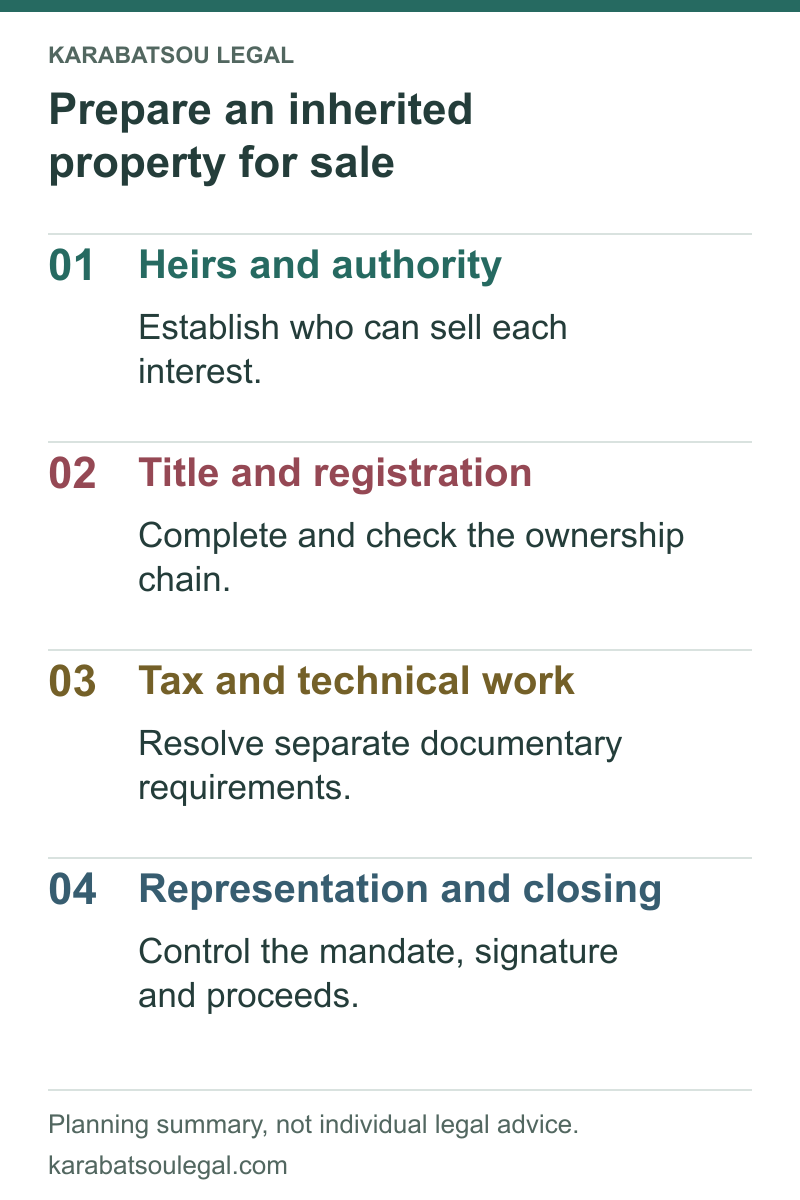
Infographic text
- Heirs and authority: Establish who can sell each interest.
- Title and registration: Complete and check the ownership chain.
- Tax and technical work: Resolve separate documentary requirements.
- Representation and closing: Control the mandate, signature and proceeds.
Separate inheritance tax, property records and sale taxes
AADE's inheritance-tax filing guidance currently gives nine months where death occurred in Greece and one year where death occurred abroad or heirs resided abroad at death. The usual start is death for intestate heirs or will publication for testamentary heirs, with statutory exceptions. These are not renunciation periods, and waiting for a buyer does not itself defer filing.
Ask the accountant and notary to reconcile the inheritance return, the sellers' property records and the certificates required for the proposed deed. E9 is a property-tax record, not independent proof of ownership. Check shares and property identifiers rather than assuming a tax assessment demonstrates that the title is complete.
For Greek renunciation, the ordinary four months run from knowledge of succession and its basis; the period is one year if the deceased's last domicile was abroad or the heir resided abroad at the relevant start. Testamentary succession does not start that clock before publication. Capacity, minors, suspension and later-called heirs need individual assessment. Check the death-date regime and do not use delayed acceptance paperwork as a way to wait indefinitely.
Request a transaction-specific tax summary covering outstanding inheritance liabilities, property taxes, any seller-side taxation and the position in your country of residence. Do not assume a sale is tax-free because the property was inherited. Ask how debts or required withholding affect the amount you will actually receive. Avoid relying on a temporary tax suspension without checking its scope and the scheduled signing date.
Commission the technical review before marketing promises
Give an engineer the deed, available plans, building permits and any regularisation records, then arrange access for inspection. The question is whether the legal description and permitted configuration correspond to the property being offered. Photographs sent by relatives are useful preparation but cannot answer every technical issue.
The gov.gr Building Identity service identifies authorised engineers as the professionals handling the electronic register. Ask the engineer and notary which Building Identity documents, energy-performance evidence, plans and other technical items are required for this specific transfer.
Request a written distinction between documents already available, discrepancies requiring investigation and defects that may prevent the intended sale. Do not promise that an enclosed balcony or extra room can always be regularised. For land, ask about boundaries, access and the proposed use instead of advertising it as buildable on family assurances. Price and marketing descriptions should reflect verified characteristics, not optimistic assumptions.
Set up overseas representation and document control
Agree the roles of the lawyer, notary, accountant, engineer and estate agent. Use one shared issue list, but avoid assuming the estate agent is responsible for resolving succession law or the accountant for clearing title. Confirm fees, third-party expenses and approval thresholds for additional work.
A sale power of attorney should be prepared against the actual property and transaction. Decide whether it authorises preliminary steps, the final deed, receipt of money, substitution and corrections. The Greek MFA's consular power-of-attorney guidance describes advance drafting and personal signing requirements in the United States. Check the competent consulate's own instructions for your location.
Keep a document tracker with issuing authority, date, original holder and intended recipient. Delay ordering short-validity certificates until the notary confirms when they are needed, while starting difficult foreign records early. For the wider succession background, use the inheritance guide; individual legal preparation belongs with the inheritance service.
Run a sale-readiness check before taking a deposit
Use the following checklist as a meeting agenda. A “pending” answer is not necessarily fatal, but it should become a disclosed condition with responsibility and timing, not an assumption buried in correspondence.
- Sellers: every interest being transferred and every required signatory has been identified.
- Authority: the succession regime, disposal restrictions and representation have been checked.
- Title: the acquisition chain, registration position and material burdens are understood.
- Tax: required returns, property records, certificates and payment issues have an agreed plan.
- Technical: the engineer has assessed the actual property and identified outstanding work.
- Occupation: tenants, occupants, keys and the promised handover condition are recorded.
- Money: the price, deposit terms, deductions and payment destination have been agreed.
- Timing: the proposed completion date reflects unresolved dependencies and overseas signing.
Have a lawyer review any reservation or preliminary agreement before it is signed or money is accepted. Establish who holds the deposit, when it is refundable and what happens if a title or technical issue cannot be resolved. Calling a payment a reservation does not explain the legal obligations attached to it.
Coordinate the digital file, signature and proceeds
The gov.gr property-transfer workflow describes a notary-led electronic file, party authorisations, document collection, tax information and subsequent registration submission. Its standard description still includes physical signing. Digital preparation should not be presented as automatic permission for an overseas owner to sign every element remotely.
Have the notary approve the representative's authority before scheduling completion. Obtain the final draft and a settlement statement showing the gross price, agreed deductions and expected net proceeds. Verify the receiving bank account using a previously established contact channel. Treat last-minute emailed account changes as requiring independent confirmation.
After signing, retain the executed deed, payment evidence and information about registration submission and completion. Ask the accountant to check the post-sale property record and remaining reporting obligations. Agree a documented handover of keys, occupation, meters and retained possessions. Do not close the file simply because a buyer's transfer has reached your account.
A hypothetical sale with two heirs and an altered apartment
Consider a hypothetical pair of siblings living abroad who inherit an apartment and agree to sell. Their documents show equal shares, but one sibling's passport uses a changed surname and the apartment includes an enclosed balcony absent from the available plan. A buyer proposes an immediate deposit and a short signing deadline.
The useful response is to resolve the identity link, check the inheritance and disposal position, and commission the engineer's assessment before promising an unconditional date. The notary identifies outstanding title and tax documents. The siblings agree how decisions and expenses will be approved, then ask their lawyer to frame any preliminary commitment around the verified position.
This example illustrates preparation, not an assurance that the balcony can be legalised or that the sale should proceed. A clear statement of the unresolved issue lets the parties evaluate timing and price honestly, while avoiding a contract built around an undocumented assumption.
Frequently Asked Questions
Can I sell before signing an inheritance acceptance deed?
Ask the notary which title instrument and registration steps are necessary and whether the sequence can be coordinated. Do not assume you can bypass the inheritance chain. Also check disposal authority under the applicable succession regime, which is separate from having the documents ready.
Must all heirs agree to sell?
A sale of the entire property requires the appropriate participation of those holding the interests being transferred. Selling only a share is a different proposal. Where interests conflict, obtain advice on available options before marketing the whole property as freely available.
Will a power of attorney let me avoid travelling?
It may allow a representative to perform the agreed sale acts, subject to adequate wording and acceptance by the receiving professionals. You still need a valid signing route for the power itself. Verify bank and identity requirements separately rather than promising a wholly remote transaction.
Does paying inheritance tax make the property saleable?
No. Tax compliance does not establish clear title, resolve planning problems or remove restrictions on disposal. Treat tax, succession authority, registration and technical readiness as separate checks that must fit together before completion.
Does the 2026 reform make inherited debts irrelevant to a sale?
No. The applicable death-date regime, creditor protections and consequences of disposal still matter. Ask for a written explanation before making a declaration that changes liability or committing estate assets. Older estates and transitional situations need their own review.
Author and Legal Review
Editorial author: Karabatsou Legal. Legal reviewer: Nadia Karabatsou.
This article was prepared with AI-assisted editorial support and legally reviewed before publication. Reading it does not create a lawyer-client relationship. For a correction or advice on your circumstances, contact the firm.
Sources and Further Reading
Discuss your circumstances
Get advice based on your documents, plans and deadlines.
Contact the firm