
General information, not advice for your individual circumstances. Requirements can change. Obtain case-specific advice before acting.
In this article
To find a Greek ancestor's municipal records, begin with an identification brief: full names, parents, approximate birth date, family relationships, and every known place of residence or registration. Ask the likely municipality to search the relevant register using those details. If nothing is located, establish exactly what was searched before expanding to successor offices, related family entries or archives.
A missing search result is not automatically proof that the ancestor was never Greek, but neither does family tradition establish citizenship. The objective is to locate reliable evidence and understand its limits. This guide explains how to make a focused search, distinguish different Greek records, and decide when the problem requires legal assessment rather than more genealogy.
Identify the record you actually need
The municipal citizens' register, commonly called the dimotologio, and the civil registry, or lixiarchio, serve different functions. A civil birth record concerns a birth event; a municipal citizenship entry addresses registration as a citizen. The Greek MFA's citizenship guidance expressly warns that a Greek birth certificate does not by itself establish municipal registration or citizenship.
Ask the receiving authority which certificate is needed, and give that wording to the office conducting the search. A request for a birth certificate can be misunderstood if one person means a civil event and another means a municipal certificate. Include any Greek document title already supplied by the consulate or lawyer.
Other records can provide leads. An old passport, male-register entry, citizenship decision or relative's family certificate may identify an office or registration reference. Do not rename such a document as municipal proof in your index. Record exactly what it is so its evidential role remains clear.
Prepare an identification brief before contacting offices
Use one page per ancestor. Start with the most reliable facts and attach only the documents supporting them. A search officer should not have to reconstruct an entire family history from a long email chain. Separate verified information from family recollection and from conclusions drawn by a genealogy website.
- List the birth name, later surnames, nicknames and known Greek spellings without presenting them as interchangeable legal names.
- Record the father's and mother's names, including the mother's maiden surname when known.
- Give a birth date or a clearly labelled estimated range, with the source of the estimate.
- Identify spouses, siblings and children who might help distinguish the ancestor from a namesake.
- Separate birthplace, childhood home, last Greek residence and suspected citizenship municipality.
- Include document numbers, issuing offices, family-entry references and copies of legible stamps.
Keep an unedited image of each source. If handwriting is unclear, transcribe the uncertain part with a note rather than guessing. One wrongly read father's name can narrow a search in the wrong direction. Ask a competent reader to examine difficult Greek handwriting before treating your transcription as settled.
Resolve village names without inventing a birthplace
Families often preserve a village name while losing the surrounding administrative details. Ask which region, nearby town, island or former community is meant. A surname associated with a place is a research clue, not proof that the individual was registered there. Likewise, a port listed on a passenger record may describe departure rather than birth.
Build a place table with the historical spelling, modern spelling, region, source and likely current custodian. Where municipal boundaries or responsibilities have changed, ask the present office who holds the earlier books. Request a referral rather than assuming every old register is physically stored at the modern municipality's central office.
Keep competing locations open until evidence resolves them. If one American record says Sparta and a family letter names a nearby village, preserve both statements and their dates. A broad regional description may coexist with a more precise local one; the right response is investigation, not editing one source to match the other.
Prioritise locations supported by official documents over unsupported map guesses. If several places share a name, compare relatives, travel dates and other identifiers before commissioning searches in all of them.
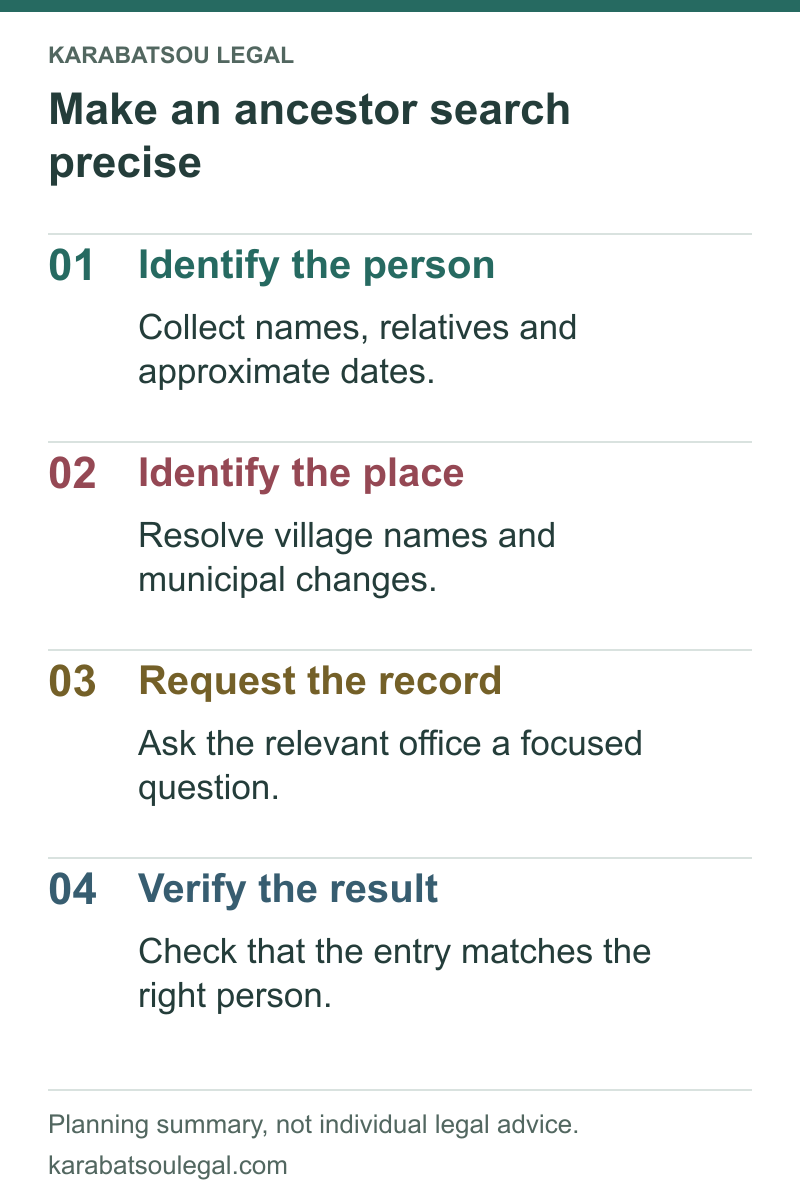
Infographic text
- Identify the person: Collect names, relatives and approximate dates.
- Identify the place: Resolve village names and municipal changes.
- Request the record: Ask the relevant office a focused question.
- Verify the result: Check that the entry matches the right person.
Send a narrow, answerable municipal request
State the purpose of the search and your relationship to the person. Ask what identity, relationship evidence or authorisation is required before requesting copies containing other people's personal data. A researcher or lawyer should use the proper authority to act, not assume that every family record is open to anyone who asks.
Specify the person, register sought, date range and alternative spellings. Attach a relevant old certificate or passport page when it supplies a useful identifier. Ask the office to confirm whether it holds the relevant period and whether a located entry can support issuance of the requested certificate.
Request a written reply that identifies the scope of any unsuccessful search. Useful detail includes the books or system checked, names used, years covered and whether another office may hold related material. A brief response saying no record found is difficult to interpret without that context.
Track the date sent, recipient, reference number and next follow-up. Avoid sending slightly different versions of the same request through several relatives without coordination. Conflicting spellings or dates in parallel enquiries can make it harder to tell whether the offices searched for the same person.
Classify a negative result before changing direction
There are several distinct reasons a search can fail. The office may not hold the relevant register, the available identifiers may be insufficient, the name may be indexed differently, or the person may not appear in the records searched. Ask which explanation the response actually supports.
Make the next action conditional. If the register is elsewhere, obtain the custodian's details. If identity is uncertain, strengthen the brief. If a book is unavailable, ask whether an index, duplicate, transfer record or archive reference survives. If the correct records were searched without a match, preserve that result and seek advice on the evidential gap.
Do not infer destruction merely from age, wartime history or an unanswered email. A statement that records were destroyed should be attributed to the responsible custodian and describe the affected material where possible. Unsupported explanations can become repeated family facts and distract from records that still exist.
Set a stopping point for each research stage. After the agreed offices and name variants have been checked, review the findings before funding another round. A transparent negative result can be useful even when it does not produce the certificate you hoped for.
Use relatives and archives as targeted leads
A sibling's entry may help locate a family record, particularly where the ancestor's own name changed abroad. Compare parents and other identifiers carefully. Sharing a surname and village is not enough to establish that two people belong to the same family, and a sibling's citizenship is not automatically proof of your ancestor's status.
The National Archives Inventory maintained by Greece's General State Archives provides a way to explore archival descriptions and holding institutions. Use a catalogue result to identify a collection and ask its custodian about access, date coverage and copies. A collection description is not the same as finding the ancestor's entry.
School, community, church, military or migration material may help identify a person or location, depending on what survives. Treat such material according to its content and provenance. A baptism entry might support a research lead, but do not assume it replaces a civil record or establishes citizenship for the intended procedure.
When a promising page is found, record the archive, collection, file and page reference. Ask how an official copy can be obtained if needed. Preserve the surrounding context where it explains abbreviations or column headings; an isolated cropped name can lose the information required to interpret it.
Check a located entry before calling the search complete
Compare the record against the identification brief. Check parents, spouse, date, locality and annotations, not just the name. Where differences remain, describe them and explain which independent facts support the match. Do not conceal a conflicting date because the rest of the entry looks promising.
Ask what kind of registration appears. Current MFA nationality-determination guidance distinguishes a standard Greek-citizen registration from an indicative entry. The mere appearance of a relative on a family document should therefore not be treated as a completed citizenship finding.
Keep research and legal conclusions separate. Your research report can say that a particular entry was located and provide its certified copy. The reviewing lawyer must assess what that entry establishes for the proposed route, including any historical or parentage issues. For context on that wider analysis, consult the Greek citizenship-by-descent guide.
A hypothetical search with a clear decision point
Imagine an applicant whose grandfather used an anglicised name abroad. A family story identifies one village, but an old passport names another municipality. The first village office finds nothing under the English spelling. That response does not yet test the passport lead or establish that no Greek registration exists.
The next research stage uses the passport's Greek name and registration details, includes the grandfather's parents, and asks the named municipality about its earlier registers. A sibling's certificate is reviewed only to clarify identity. If a matching entry emerges, the applicant requests the appropriate certificate and checks how it connects to the next generation.
If the targeted searches still fail, the deliverable should be a search log, source copies and a defined list of unresolved facts. Take that package to the Greek citizenship service for advice on additional evidence or another legally available procedure. More searching should follow a reasoned question, not a promise that every missing record can eventually be found.
Frequently Asked Questions
Can I search by surname alone?
A surname can start informal research, but it is rarely a strong identification brief. Add parents, approximate dates, spouses and locations wherever possible. The aim is to distinguish your ancestor from namesakes and give the custodian a realistic, bounded search rather than an undefined family-history request.
Does no online result mean the record is missing?
No. An online search tests only the material available through that service and the terms used. Ask the relevant custodian about older books, indexes and non-digital material. Record the coverage of the online collection before interpreting an unsuccessful search as evidence about the underlying registers.
Can a male-register record replace the municipal certificate?
Do not assume automatic substitution. It can be an important source, but the authority must assess what it proves and whether it meets the requirements of your particular file. Preserve its exact description and reference, then ask whether further municipal or citizenship evidence is needed.
What if the ancestor was never registered?
First distinguish a proven absence of registration from an incomplete search. If the absence is established, obtain a legal assessment of the available evidence and possible procedure. Registering an event, determining citizenship and applying through an ethnic-origin route are different tasks, with different requirements.
What should a paid records search deliver?
Agree the target person, offices, date range, budget and stopping point in advance. Request copies of findings, full archival references and a log of unsuccessful enquiries. The report should identify unresolved questions without describing a research match as a guarantee of citizenship eligibility.
Author and Legal Review
Editorial author: Karabatsou Legal. Legal reviewer: Nadia Karabatsou.
This article was prepared with AI-assisted editorial support and legally reviewed before publication. Reading it does not create a lawyer-client relationship. For a correction or advice on your circumstances, contact the firm.
Sources and Further Reading
Discuss your circumstances
Get advice based on your documents, plans and deadlines.
Contact the firm