
General information, not advice for your individual circumstances. Requirements can change. Obtain case-specific advice before acting.
In this article
A Greek citizenship document checklist should establish three things: the relevant ancestor's citizenship, the legal family relationship in every generation, and the applicant's identity today. Start with records already available, confirm the legal route, then order the missing certified documents. Buying translations and apostilles before that review can leave you with an expensive file that answers the wrong questions.
This checklist is for organising a descent-based assessment, not a universal filing list. A child of a registered Greek parent, an adult tracing a grandparent, and someone whose parent acquired citizenship later may need different procedures. Use each section to identify what you have, what remains uncertain, and which authority must resolve it.
Confirm the procedure before ordering certificates
Write a short chronology covering births, marriages, changes of name, adoption or acknowledgment of parentage, and any known citizenship decisions. Include the dates even when the underlying documents are missing. Mark estimates as estimates. Ask the reviewing lawyer to identify the proposed legal basis and any preliminary registration work.
Separate evidence needed for initial assessment from documents required for filing. A clear scan may let someone identify a municipal reference or an error, while the authority may later require an authenticated certified copy. This distinction allows useful review before you spend money on a document that needs correction.
Ask for the checklist to identify the receiving office, acceptable document version, translation requirements, and any issue-date requirement. Do not apply one consulate's administrative list indiscriminately to every application. The firm's broader Greek citizenship-by-descent guide provides orientation; the working document list should reflect your particular family.
Collect evidence of Greek citizenship and registration
Locate the municipality associated with the Greek parent or ancestor and request the appropriate municipal certificate. The Greek MFA citizenship guidance distinguishes municipal citizenship registration from a civil birth record: birth in Greece alone does not establish Greek citizenship. Check what a document actually certifies, not merely whether its English heading says birth certificate.
If an old Greek passport, family certificate or citizenship decision survives, scan every relevant page, including annotations and reference numbers. Record the issuing office and date. An ancestor's paperwork may identify a register that the family no longer remembers, but its usefulness must be assessed rather than assumed.
For an ancestor who became Greek later in life, obtain the actual decision where possible. A recent certificate may establish present registration without explaining the original legal basis or effective citizenship date. Those details can matter more than the date on which a passport was issued. Preserve any evidence of citizenship loss or reacquisition as well.
Build a document checklist for each generation
Create one folder for each person in the proposed line. Keep certificates in event order so that the relationship to the next generation is visible. The following is a preparation checklist; a checked box means the document has been located, not that an authority has accepted it.
- Birth: a record identifying the person and parents, with all available annotations. Note whether your copy omits information shown on a fuller version.
- Marriage: the civil marriage record relevant to the family relationship, plus any religious record specifically requested for historical review.
- Family changes: divorce, adoption, acknowledgment, parentage judgment or other document that changes or clarifies legal family status.
- Identity changes: marriage evidence, a name-change order or another official record connecting successive names.
- Citizenship history: municipal evidence and relevant acquisition, recognition, loss or reacquisition decisions.
- Current identification: the applicant's valid passport and the identity documents requested for the chosen procedure.
Do not order every document about every relative. Records for a sibling or spouse may solve an identification question, but that is different from making all collateral relatives part of the citizenship chain. Give each proposed purchase a purpose, such as identifying a municipality, proving parentage or explaining a surname.
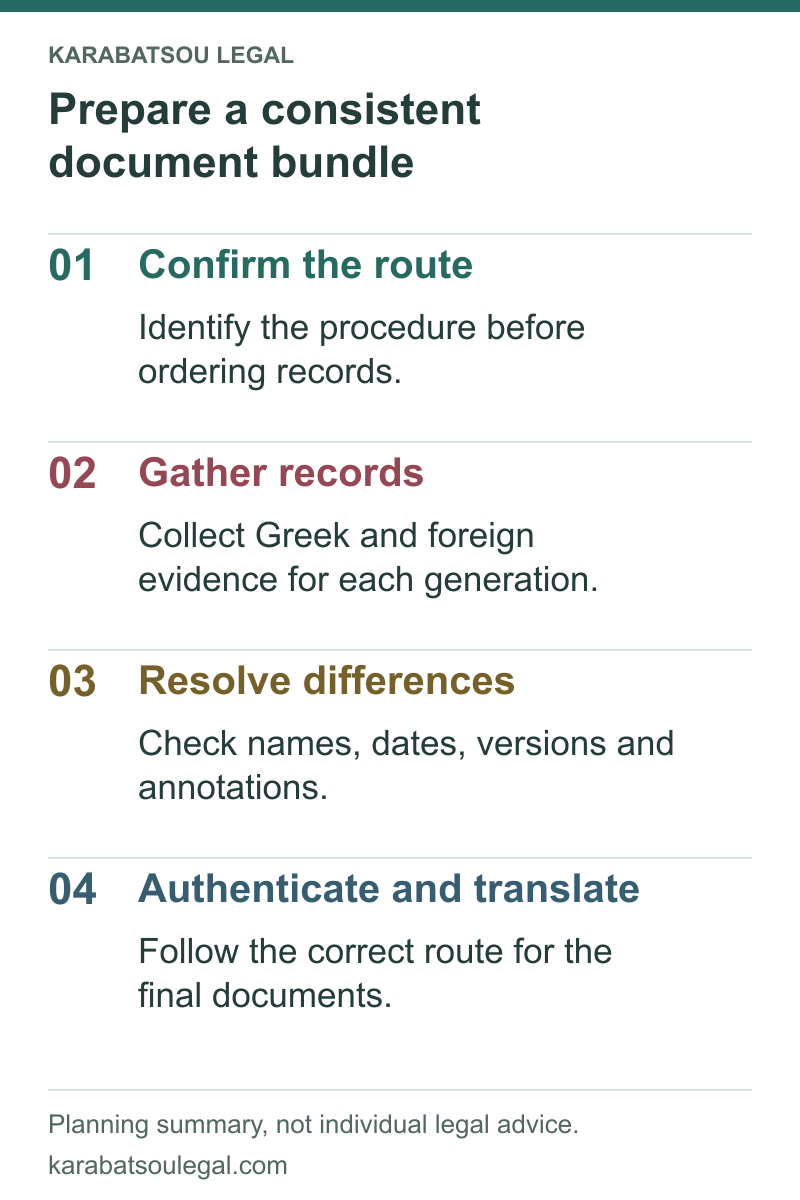
Infographic text
- Confirm the route: Identify the procedure before ordering records.
- Gather records: Collect Greek and foreign evidence for each generation.
- Resolve differences: Check names, dates, versions and annotations.
- Authenticate and translate: Follow the correct route for the final documents.
Check versions, annotations and name differences
Read each certificate against its neighbours. Does the parent's name on a child's birth record match the earlier marriage and birth records? Are dates written in a different national order? Does a marriage record use a maiden surname while later documents use a married surname? These are review questions, not automatic reasons for rejection.
Make a discrepancy table with four columns: document reference, exact wording, competing wording, and proposed evidence explaining the difference. Do not silently standardise the originals in your notes. A missing middle name and a conflicting parent are not equivalent problems, even if both appear as one mismatched field.
Ask the issuer what certified versions exist before ordering. Terms such as full, long-form, extract and certified copy are not used identically everywhere. Explain that the document will support a Greek citizenship procedure and specify the information needed. Where a record has been amended, ask whether the supplied version shows the amendment and whether supporting documentation can be obtained.
Keep event dates separate from issue dates in the register. A certificate issued this year may describe a birth decades earlier, and a recently supplied copy may still reproduce an older error. Note whether you are holding a fresh copy of the same entry, an amended entry or a different document entirely. This prevents an apparent update from being mistaken for a correction and helps the reviewer explain why one version was selected for submission while another remains in the background evidence.
Choose the correct authentication route
Authentication concerns a document's official origin, not whether every family fact in it is correct. The HCCH Apostille Convention resources identify the framework and competent authorities. Check the issuing country, document type and Convention relationship before commissioning an apostille. Documents outside that framework may require a different legalisation procedure.
There is an important EU exception. The European Commission explains that Regulation 2016/1191 removes apostille requirements for covered public documents issued in one EU Member State and presented in another. It also simplifies certain translation formalities. This does not automatically determine the document's legal effects or citizenship eligibility.
Keep the authenticated document and its attached certificate together. Before sending originals anywhere, make a complete colour scan showing seals, signatures, reverse pages and attachments. Record tracking numbers and the recipient. Never assume an apostille service also checked whether the certificate is the correct version for your Greek file.
Translate the final documents without rewriting them
Confirm the receiving authority's accepted translation arrangements before placing an order. The official Greek certified-translator register is one starting point for finding registered professionals. Do not treat an online machine translation, a relative's fluent Greek or a commercial agency's marketing claim as confirmation that a translation will be accepted.
Give the translator clear copies of the final documents, including authentication attachments, and a reference sheet showing established Greek spellings. Ask how inconsistent foreign names will be represented faithfully. Consistency is desirable where the source allows it; concealing an actual difference is not. Corrections to underlying records belong with the competent authority.
Review the finished work against the originals before filing. Check numbers, dates, parents' names, place names, marginal notes and references to attached pages. If you cannot read Greek, arrange an independent check of critical identity fields. A mistake discovered before submission is easier to address than competing versions circulating between offices.
Use a readiness register and a controlled filing bundle
A practical register needs more than a yes-or-no document column. Give every item a reference number and track its issuer, event date, issue date, legalisation status, translation status, unresolved questions and next action. Record the person responsible for that action so work does not stall between relatives and advisers.
Use four preparation labels: available for assessment, replacement required, awaiting clarification, and ready for proposed submission. The last label should follow a real check. A document can be genuine and translated yet still fail to identify the parent whose relationship matters.
Before filing, reconcile the index with the physical or electronic bundle. Keep a full submission copy and a separate record of what originals were handed over. Ask which documents will be retained and whether additional certified copies are sensible. Keep personal data out of shared public family trees and use the agreed secure channel for legal intake.
A hypothetical checklist in the right order
Suppose an applicant has a grandmother's Greek municipal certificate, a parent's abbreviated foreign birth certificate, and the applicant's own full birth record. The parent later changed surname by court order. The grandmother's marriage document exists only as a photograph, and nobody has checked whether the family events appear in Greek records.
The first review should identify the legal route and the missing evidence of the parent's relationship. Next, the applicant confirms which fuller birth record and certified name-change order can be obtained. The marriage record is sourced from its issuer. Those documents are compared before authentication and translation, preventing an avoidable second round if a material error is found.
The result is a targeted set of tasks, not a prediction of approval. Ask the Greek citizenship service to assess the timeline, existing scans and discrepancy register together. Request a written explanation of any unresolved legal question, the document that could answer it, and whether further spending should wait for that answer.
Set a review point before the largest document orders. At that point, check whether the proposed route has changed, whether an office has requested a different certificate, and whether any relative has found a previous decision. This keeps a useful checklist from becoming a fixed shopping list that nobody updates.
Frequently Asked Questions
Should I obtain apostilles for everything immediately?
No. First confirm that each document is needed, accurate and in the accepted form. Then establish the applicable authentication regime. Some covered EU documents do not need an apostille, while other records require specific certification steps. Premature authentication can multiply costs when a document must be replaced.
Is a Greek civil birth certificate enough to prove citizenship?
Not by itself. A civil record establishes a recorded birth event; the file must also address citizenship and municipal registration. Ask for the precise certificate required for the identified procedure. Do not substitute a document simply because both versions are described informally as birth certificates.
Must every certificate have been issued within six months?
Do not assume a universal six-month rule for every record. Confirm issue-date requirements with the receiving authority for each document category and procedure. Record those instructions in your checklist, including when they were obtained, so an older family document is not confused with a filing-ready copy.
Can I submit scans instead of certified originals?
Scans are useful for preliminary review, but final submission requirements are procedure-specific. Ask which originals, certified copies or accepted digital documents are needed and which will be retained. Keep your own complete copy even when the receiving office accepts an electronic submission.
What if one generation's records are incomplete?
Identify the precise missing fact before commissioning broad research. A missing marriage certificate, unclear legal parentage and an unlocated municipal entry require different investigations. Document unsuccessful searches and ask what evidence or procedure could address the gap. Extra certificates about unrelated relatives will not necessarily solve it.
Author and Legal Review
Editorial author: Karabatsou Legal. Legal reviewer: Nadia Karabatsou.
This article was prepared with AI-assisted editorial support and legally reviewed before publication. Reading it does not create a lawyer-client relationship. For a correction or advice on your circumstances, contact the firm.
Sources and Further Reading
Discuss your circumstances
Get advice based on your documents, plans and deadlines.
Contact the firm