
General information, not advice for your individual circumstances. Requirements can change. Obtain case-specific advice before acting.
In this article
American applicants should begin a Greek citizenship file by connecting a documented Greek ancestor to themselves through official family records, then confirming the applicable citizenship procedure. A United States passport, a Greek surname or a relative's Greek birthplace does not answer that legal question. The practical work usually spans Greek registration evidence, American record-issuing offices and the Greek consulate responsible for the applicant's residence.
The most effective preparation is a two-country records plan. Identify the Greek evidence already available, list each American family event by state and locality, and resolve identity differences before paying for authentication and translation. This guide concentrates on those American administrative tasks rather than assuming every person with Greek ancestry uses the same route.
Start with your residence and the Greek consular district
Find the competent consular office using the Greek MFA's United States citizenship page. Its jurisdiction table is more useful than choosing whichever consulate has the shortest journey or an attractive appointment date. Some districts divide states geographically, so check your actual address against current guidance.
Prepare a concise first enquiry: current residence, applicant's birth details, the Greek ancestor's identity, known municipality, and the intervening generations. Mention previous citizenship applications or decisions. Ask how to obtain an initial route assessment and which copies the office wants to see before an appointment.
A consulate's document review is not a citizenship grant. MFA guidance explains that consular authorities receive, examine and forward files, while the competent authorities in Greece decide citizenship matters. Keep that distinction in mind when interpreting an appointment confirmation, acknowledgement email or statement that a file has been sent onward.
Establish the Greek starting record before expanding research
Ask relatives for municipal certificates, family-registration details, citizenship decisions and old Greek identity documents. Capture the exact Greek spelling wherever available. A family's remembered village, an emigration port and a citizenship municipality may be different places; entering all three as one location can send a search in the wrong direction.
Do not build the case solely around an American certificate stating that someone was born in Greece. Ask what Greek citizenship evidence supports the ancestor's status and what needs investigation. If a parent was registered only recently, obtain the underlying decision rather than assuming that the registration date is the date citizenship began.
Use the firm's citizenship-by-descent guide to understand the overall assessment. For your working file, keep the Greek questions separate from the American collection tasks. A complete US birth-and-marriage chain can still leave an unresolved Greek nationality question.
Order American vital records from the right office
The CDC's Where to Write for Vital Records directory directs applicants to state and territorial sources. It explains that the federal government does not distribute individual identifying vital-record certificates or indexes. Start with where the event occurred, not where the family lives now.
List births, marriages, divorces and deaths separately because their custodians may differ. Ask for the version containing the information needed for the Greek review, particularly parents' names. A keepsake certificate, hospital record, database image or shortened extract should not be presumed equivalent to an official certified record.
Check who is entitled to order each record and what proof of relationship or authority is required. Older records and records of deceased people may follow different access rules from recent certificates. Keep the agency's instructions and your application copy with the order receipt. If access is refused, obtain the reason before trying a paid intermediary.
For a marriage, distinguish a licence application from evidence that the marriage occurred. For a divorce, ask which final court document and certification are needed. A docket screenshot can help locate the case, but it may not contain the operative terms or satisfy the receiving authority.
If an American family member was born outside the United States, identify both the local foreign birth record and any US Consular Report of Birth Abroad. The CDC's foreign-record guidance treats these separately. Ask which document the Greek file requires; American citizenship does not turn every record concerning that person into a state-issued US document or give it the same authentication route.
Infographic text
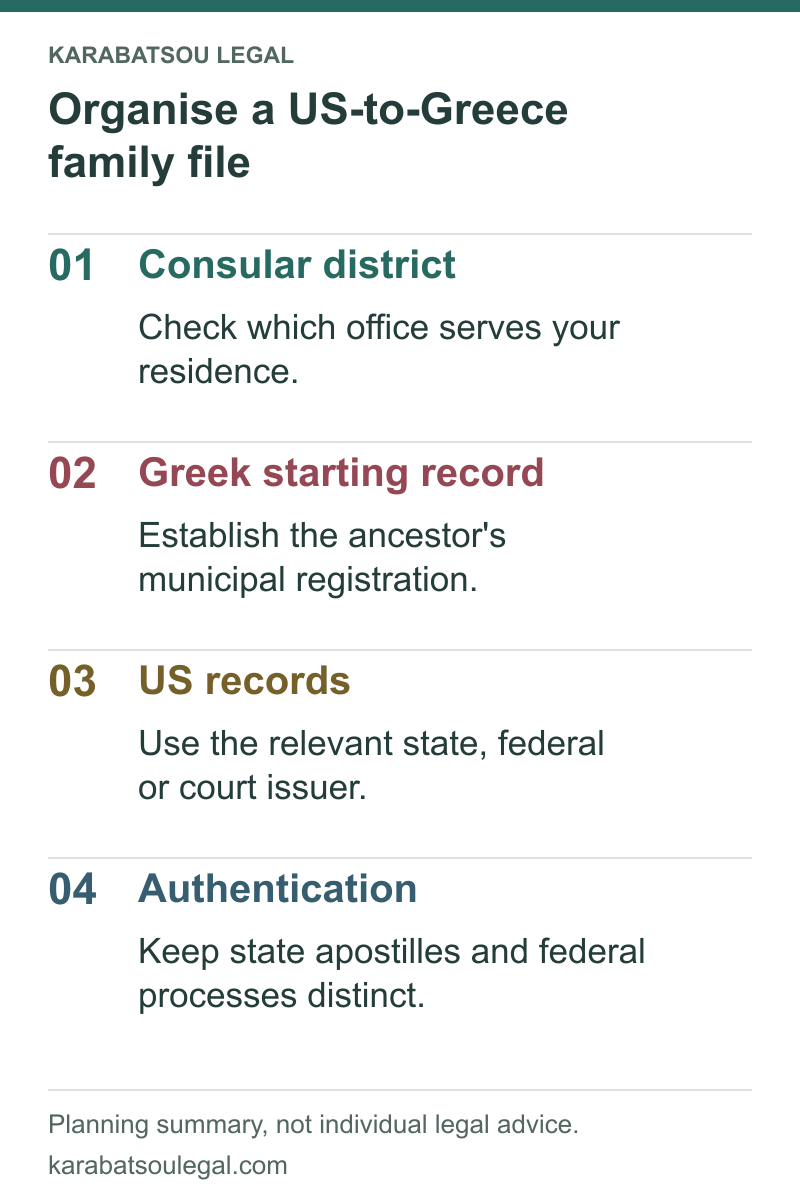
- Consular district: Check which office serves your residence.
- Greek starting record: Establish the ancestor's municipal registration.
- US records: Use the relevant state, federal or court issuer.
- Authentication: Keep state apostilles and federal processes distinct.
Separate state apostilles from federal authentication
American authentication is not one nationwide mailing process. USAGov's official authentication guidance distinguishes state documents, which generally require the issuing state's apostille authority, from federal documents handled through the US Department of State. The classification follows the document's issuer, not the applicant's current home address.
Check the issuing state's requirements before ordering certificates. For example, New York's Department of State distinguishes specified state-issued vital records from documents needing county-clerk certification first. A New York workflow should not be copied automatically for California, Illinois or another jurisdiction.
Ask the office handling your record whether an intermediate certification is necessary, which signature must appear and how the destination country should be identified. Do not have a notary stamp an official certificate merely because someone says every foreign-use document must be notarised. Follow the issuer's and authentication authority's instructions for that exact document.
Track each original through collection, correction, certification, apostille and translation. Retain a complete scan before dispatch and after the document returns. If several states are involved, maintain separate order packets and return addresses so one missing enclosure does not delay the entire family file.
Use naturalisation and court records for the question they answer
An ancestor's US naturalisation records may help establish dates, previous names or a place of origin. The National Archives naturalisation research guidance explains that relevant records may be held by different courts, archives or USCIS depending on the period and record type. An unsuccessful search in one collection is not a nationwide negative result.
Before ordering an archival file, write down its intended purpose. Are you trying to identify the Greek village, document a formal name change or establish when US citizenship was acquired? The answer affects which record matters and whether a research reproduction or an officially certified document will eventually be needed.
Do not import another country's descent rules into the Greek assessment. Neither a US naturalisation date nor an oath's wording should be treated, without Greek legal analysis, as conclusive proof that a Greek line ended. Give the reviewer the actual records and any Greek decisions affecting nationality.
Anglicised names need a similarly careful approach. A court-ordered change provides a different kind of evidence from a nickname repeated in census entries. Preserve both the Greek and American forms, identify the earliest appearance of each, and ask whether the file needs an official connecting record or correction.
A practical checklist for a multi-state family file
Consider this hypothetical: an applicant lives in Massachusetts, was born in New York, and has a parent born in Pennsylvania to a Greek grandmother. The grandparents married in Illinois. The grandmother used a shortened surname after emigration. The sensible plan follows events and evidence, not the applicant's current state.
- Confirm consular jurisdiction using the applicant's Massachusetts address and disclose the complete family chronology.
- Locate the grandmother's Greek citizenship and registration evidence before commissioning unrestricted archival research.
- Identify the correct New York and Pennsylvania birth-record offices and the Illinois marriage-record custodian.
- Compare names and parental details across the available copies; locate evidence explaining the shortened surname.
- Obtain route-specific advice on any maternal-line historical issue before treating all generations as a registration exercise.
- Order the approved certified versions, complete the relevant authentication steps and translate the final documents.
- Index the filing bundle and retain a copy showing exactly what was submitted and to which office.
This example describes an organisational method, not an eligibility finding. The same states and relationships could produce a different legal route if the grandmother's citizenship history or the parent's legal family circumstances differed.


Plan fees and attendance around actual dependencies
Divide your budget into record searches, certified copies, corrections, authentication, translation, legal work and appointments. Ask which costs are fixed and which depend on discoveries. Request approval before an open-ended search expands to additional municipalities, courts or archives.
Do not order time-sensitive supporting records simply because they appear on a naturalisation checklist online. First establish that your procedure requires them and ask about acceptable issue dates. A family-register investigation may need to finish before an appointment-ready bundle can be assembled.
Clarify which steps can be handled by a representative and which require your attendance. A power of attorney is not a blanket substitute for personal declarations, interviews or later passport requirements. Ask the consulate about attendance before making travel commitments, and keep any appointment instructions with the file.
Separate the citizenship outcome from passport and US obligations
Once the citizenship procedure is complete, check the resulting Greek records for accurate names, dates and family details. Passport preparation is a later task, not evidence that the earlier legal assessment can be skipped. Avoid booking a move or promising an employer a start date based solely on an expected citizenship decision.
The US Department of State's dual-nationality guidance explains that dual nationals must use a US passport to enter and leave the United States and remain subject to relevant US obligations. A Greek passport is not an alternative US entry document for an American citizen. Obtain separate advice on tax and any military-service questions relevant to your plans.
For an individual review, send the Greek citizenship service a family timeline, a list of American issuing offices and copies of existing Greek evidence through the agreed intake channel. Ask for the legal route and remaining evidence questions to be identified before committing to the full document budget.
Frequently Asked Questions
Do Americans use a special Greek ancestry application?
US residence affects consular jurisdiction and document preparation, but it does not replace the Greek legal eligibility analysis. The relevant procedure depends on citizenship history, legal parentage and dates. Two American siblings may share much of the same evidence while still needing separate applicant documents and individual procedural checks.
Can I request every US certificate from Washington?
No. Ordinary state and local vital records are obtained through the relevant state or local system. Federal records have different custodians. Use the event location and record type to identify the office, then verify access and certification requirements before paying for an order.
Does US naturalisation automatically disqualify my Greek ancestor?
Do not reach that conclusion from the US document alone. Ask a Greek nationality lawyer to examine the relevant historical law, dates and any Greek loss or reacquisition decision. The useful first step is obtaining accurate evidence, not borrowing a rule from another country's citizenship programme.
Can I choose a different Greek consulate to avoid a wait?
Start with the consulate responsible for your actual residence. Ask that office about its current submission arrangements rather than assuming another office can accept your file. If you move while the matter is pending, obtain instructions on updating your address and handling any transfer.
Does Greek ancestry guarantee exemption from language requirements?
No blanket promise is appropriate. Citizenship determination, an Article 14 declaration and ethnic-origin naturalisation are distinct procedures. Ask which interview, language or knowledge requirements apply to the route actually identified for you. An exemption described for one category should not be extended to every ancestry case.
Author and Legal Review
Editorial author: Karabatsou Legal. Legal reviewer: Nadia Karabatsou.
This article was prepared with AI-assisted editorial support and legally reviewed before publication. Reading it does not create a lawyer-client relationship. For a correction or advice on your circumstances, contact the firm.
Sources and Further Reading
Discuss your circumstances
Get advice based on your documents, plans and deadlines.
Contact the firm