
General information, not advice for your individual circumstances. Requirements can change. Obtain case-specific advice before acting.
In this article
A Greek grandparent can be the starting point for a citizenship application, but ancestry alone does not settle eligibility. The essential questions are whether that ancestor was a Greek citizen, how citizenship and family status developed in each generation, and which records support the route available to you. A family tree is useful evidence organisation; it is not a legal determination.
The most productive first step is therefore a documented eligibility review, not ordering every certificate you can find. This guide explains how to prepare that review, distinguish a missing registration from a legal obstacle, and avoid paying for the wrong procedure. It is intended for adults living abroad whose connection to Greece runs through a grandmother or grandfather.
What must a grandparent-based assessment establish?
Start with the ancestor's legal status, rather than their birthplace or language. A person born in Greece was not necessarily a Greek citizen, while a Greek citizen may have been born elsewhere. The Greek Ministry of Foreign Affairs citizenship guidance distinguishes municipal registration from a birth record and explains the role of the competent Greek authorities.
Next, connect that person to your parent and your parent to you. Birth and marriage records usually form the backbone of the evidence, but divorces, acknowledgments of parentage, adoption, name changes or later citizenship decisions may change what is needed. The dates matter because the applicable rules may differ across generations.
Finally, identify the legal procedure. Some files concern recognition and registration of citizenship already held under the applicable law. Others require a different citizenship procedure, including a route for people of Greek ethnic origin. Those routes should not be marketed as interchangeable versions of one automatic entitlement.
Why your parent's position matters
When people describe an application as “through my grandfather,” they often overlook their parent's legal and registration history. Was your parent already recorded in a Greek municipality? Were their birth and marriage registered? Did they acquire citizenship later, and if so, by which decision and on what date? These questions can determine the next procedural step.
An unregistered parent is not necessarily proof that the family connection is unusable. Equally, it is not safe to assume that registering that parent today automatically resolves an adult child's position. A recognition decision and a naturalisation decision can have different consequences. Ask for the reasoning to be explained against your actual chronology.
The Greek consular guidance on naturalisation for people of Greek ethnic origin describes circumstances involving an unregistered parent or a parent who acquired citizenship after the applicant's birth. It is a useful warning against treating every grandparent case as the same registration exercise.
Build a three-generation evidence map
A one-page table helps a lawyer see what is known and what needs investigation. Use a separate row for your grandparent, parent and yourself. Record the full birth name, later names, birth date and place, spouse's name, marriage details and any known Greek municipality. List the document supporting each entry rather than relying on memory.
- For the grandparent, record any Greek municipal certificate, old passport, citizenship decision, civil record or military-register reference.
- For the parent, identify the birth record connecting them to that grandparent and any later change in legal family status.
- For yourself, provide the full birth certificate, current identity document and evidence linking any different names.
- For each event abroad, note the issuing authority, language and whether a certified copy is available.
- Flag uncertainty explicitly: an estimated birth year should not be entered as an established date.
This preparation does not replace official forms. Its purpose is to prevent a costly false start. A small, clearly indexed file is more useful for an initial review than hundreds of photographs with no explanation of whose records they show.
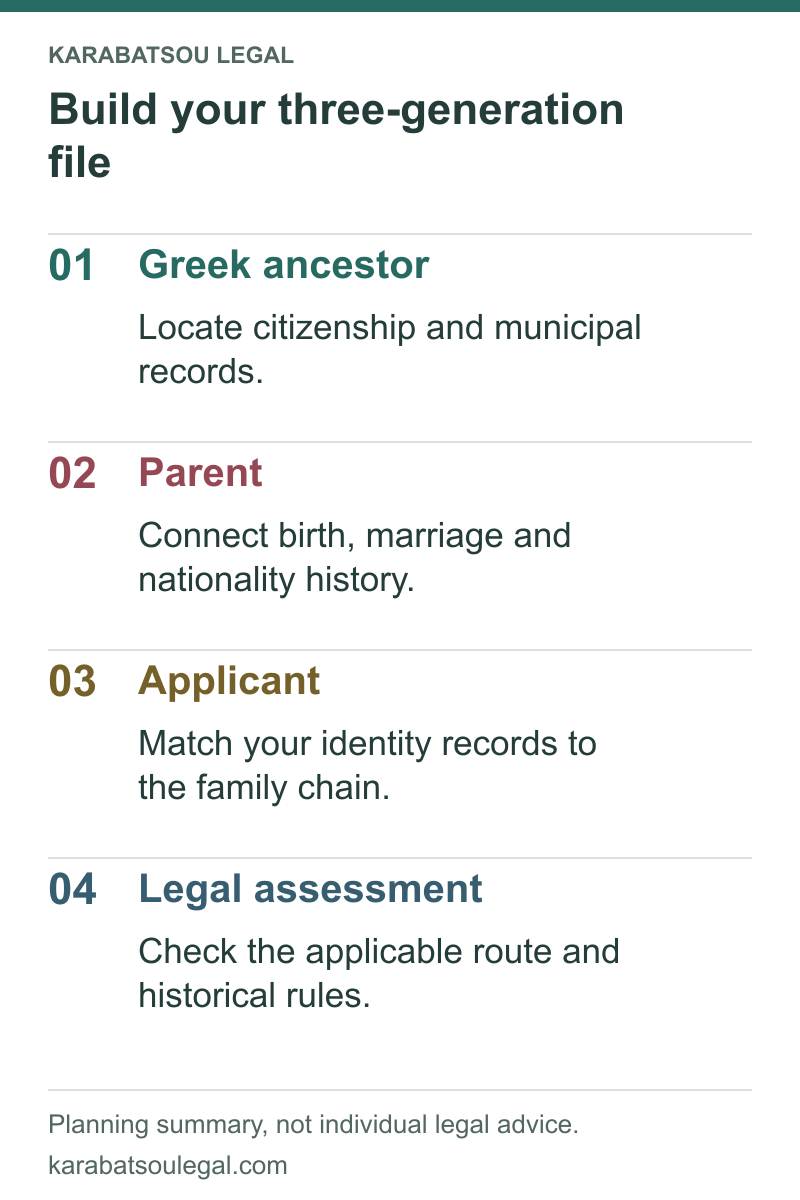
Infographic text
- Greek ancestor: Locate citizenship and municipal records.
- Parent: Connect birth, marriage and nationality history.
- Applicant: Match your identity records to the family chain.
- Legal assessment: Check the applicable route and historical rules.
Locate the right Greek records
The family may remember a village, but the records may now sit with a successor municipality following administrative changes. The place where an ancestor lived, the place of birth and the municipality of citizenship registration may differ. Preserve all three possibilities until the search establishes which is relevant.
An old passport, a sibling's certificate or a marriage record may provide clues to a municipal family entry. Treat these as leads, not interchangeable proof. A search should record which office was contacted, the identifiers used and the response received. A negative response from one office does not demonstrate that no record exists anywhere in Greece.
Ask the professional handling the search to define the first research stage and its deliverable. That might be locating a municipal entry, obtaining a certified extract, or explaining why the available material does not yet identify the ancestor confidently. Avoid an open-ended research instruction without a budget or a stopping point.
Treat historical family circumstances carefully
Older maternal-line cases deserve individual examination. Broad statements that citizenship could never pass through a Greek woman before a particular year are not a reliable substitute for analysing the historical rules, family circumstances and later remedial provisions. A grandmother in the family line is a reason to examine the dates, not an automatic reason to abandon the case.
The same discipline applies to births outside marriage, adoption and changes in parentage. A record may prove a biological or social relationship without establishing the legal relationship required for a particular nationality procedure. The reviewing lawyer should explain what the authority needs and whether a registration, correction or recognition step must come first.
Do not omit an inconvenient document because it makes the family history less straightforward. A later discovery can force the file to be rebuilt. Full disclosure at the assessment stage helps distinguish a solvable documentation problem from a different legal route or a claim that cannot presently be supported.
Order foreign documents in the right sequence
Once the route is identified, ask for a tailored document list. Confirm whether the receiving authority needs a full record, a certified copy, an extract or a recent issue. A short birth certificate that omits parents' details may not establish the relationship the file needs, even though it is valid for other purposes.
Authentication and translation are separate tasks. Under the HCCH Apostille framework, the competent authority in the document's place of origin authenticates its public origin where the Convention applies. An apostille does not establish that the family facts are correct, and it does not replace a translation.
For certain documents moving between EU Member States, separate EU rules remove the apostille requirement. Ask which regime applies before purchasing a service package. Agree the spelling of names and places with the Greek file coordinator, while keeping translations faithful to the originals. A translator should not silently repair a genuine discrepancy.
An illustrative family-file review
Consider a hypothetical applicant in the United States whose grandfather emigrated from Messinia. The applicant has an old Greek passport and their own birth certificate, but their parent's birth certificate uses an anglicised surname. The grandfather's marriage took place abroad and has not yet been located in the family's records.
The sensible starting point is not a promise of a passport within a fixed number of months. It is a municipal-record search, a review of the marriage evidence and a documented explanation of the surname change. The lawyer then assesses the parent's status and the procedure available to the applicant. Each unresolved question is assigned to an office, document or legal review.
This example illustrates sequencing only. Another applicant with the same country of residence and a Greek grandfather may need a different route because the relevant citizenship decisions, family events or registrations occurred at different times.
Plan around stages rather than promises
Separate research, document collection, legalisation, translation, filing, authority review and later passport preparation. Each stage has different dependencies. A consular appointment does not necessarily start the decision-making clock in Greece, and a submission receipt is not a citizenship decision.
Request a written scope explaining which stages are included in the legal fee and which third-party costs are additional. Ask how supplementary requests are handled, who keeps originals and what happens if the initial route proves unsuitable. A useful engagement gives you visibility into the work without guaranteeing a government outcome.
Keep a simple progress register after engagement: document requested, responsible person, request date, response received and next action. This makes it easier to distinguish an authority's waiting period from a missing item that you can supply. Agree how often you will receive an update and which developments require immediate attention. A clear record also helps a second professional understand the file if responsibility changes later.
For the wider framework, read the firm's citizenship-by-descent guide. For an individual assessment, use the Greek citizenship service and begin with a concise family timeline. Avoid sending sensitive originals until the firm has confirmed a secure intake method.
Frequently Asked Questions
Does having a Greek grandparent automatically make me eligible?
No conclusion should be reached from that fact alone. The ancestor's citizenship, the intervening family relationships, relevant dates and available registration evidence all matter. A grandparent may support a viable application, but the appropriate procedure must be identified before anyone promises recognition or a passport.
Must my parent obtain a Greek passport first?
A passport is not the starting legal test. Your parent's citizenship and municipal-registration position are the relevant issues. Some cases require steps involving the parent before the applicant can proceed; others need a different procedure. Ask for a route-specific explanation rather than treating a passport purchase as a prerequisite.
Can an old Greek passport replace municipal records?
It can be an important lead and supporting evidence, but it should not be assumed to replace the official records required by the competent authority. Preserve clear copies of every page with identity or registration information and use them to guide the search for the relevant entry.
Can a lawyer complete the whole process without my involvement?
A lawyer may handle research, preparation and authorised representation, but some procedures require your signature, personal attendance, interview or oath. Passport applications also involve separate identity requirements. Clarify the attendance points at the beginning so your travel and consular appointments reflect the actual route.
What should I prepare before asking for an assessment?
Prepare a three-generation timeline, scans of the records already available, current country of residence, known Greek municipality and a list of unresolved name or date differences. State whether anyone in the family has already applied or received a decision. This gives the reviewer a usable starting point without unnecessary document spending.
Author and Legal Review
Editorial author: Karabatsou Legal. Legal reviewer: Nadia Karabatsou.
This article was prepared with AI-assisted editorial support and legally reviewed before publication. Reading it does not create a lawyer-client relationship. For a correction or advice on your circumstances, contact the firm.
Sources and Further Reading
Discuss your circumstances
Get advice based on your documents, plans and deadlines.
Contact the firm