
General information, not advice for your individual circumstances. Requirements can change. Obtain case-specific advice before acting.
In this article
A Greek Golden Visa purchase at EUR250,000 can qualify through a genuine change of use to residential accommodation, but the price and a developer's description are not enough. The property must satisfy the conversion route, the required change must be completed before the residence application, and the purchase and payment evidence must support the investment. An attractive finished apartment can still fail this legal test.
Before paying a reservation deposit, obtain a coordinated review by a property lawyer and an independent engineer. Their task is to establish what legally existed, what changed, when it changed and exactly what you will own. This guide focuses on that review rather than repeating the general investment thresholds.
Identify the conversion route before comparing prices
Article 100(2)(c) of the Migration Code, introduced by Article 64 of Law 5100/2024, sets a EUR250,000 acquisition threshold where the property's main spaces change to residential use. The investment must concern one property. The seller may carry out the conversion, but completion must precede the residence application.
This is distinct from the standard EUR800,000 and EUR400,000 routes. The higher standard threshold covers Attica, the Thessaloniki, Mykonos and Thira regional units, and islands exceeding 3,100 residents under the latest census. For standard purchases of built property, or property with a building permit, the single-property and minimum 120 square metres of main-space requirements apply. The conversion provision does not import that 120 square metre minimum.
That distinction is not permission to ignore residential building standards. A smaller converted unit still needs lawful residential status. The separate listed-building route also has different conditions, including restoration obligations. If a project potentially fits both special routes, the application basis and its continuing obligations should be chosen expressly.
Later planning changes, including Law 5322/2026, also belong in the engineer's review. Permission to convert under planning law does not itself establish that the purchase satisfies the separate immigration concession.
Prove the previous use and the project's history
Ask for the original building permit, approved plans, amendments and the documents recording the previous lawful use. An old shop sign or commercial electricity account is not a complete planning history. The engineer should explain whether the spaces were legally non-residential, whether alterations were authorised and how the present unit corresponds to the historic plans.
The Ministry's April 2026 Circular 1, clarification 5 addresses artificial conversions. An existing residence cannot qualify by being changed to another use and then back to residential use to obtain the lower threshold. The circular also rejects a newly planned non-residential project whose permit is subsequently changed to residential where the required pre-existing property or project was absent.
For industrial buildings, the legislation adds a five-year condition concerning the absence of an installed and operating industry. Obtain the engineer's supporting records rather than accepting a seller's statement that the factory closed long ago. Correct classification matters: the circular distinguishes industrial buildings from craft or workshop buildings.
Check what establishes completed change of use
The practical evidence framework is in Joint Ministerial Decision 214926/2025. It requires an engineer's technical report identifying the change of the main spaces to residential use and the relevant planning act. Depending on the case, that act may be a building permit, small-scale works approval, file update or permit revision.
The decision connects the timing evidence to 5 April 2024 onwards. It also expressly addresses an older change-of-use permit subsequently updated or revised after the law's publication. Therefore, neither an old permit date nor a newly issued certificate should be evaluated in isolation. Have the engineer explain the complete sequence and why the specific documents meet the rule.
Separate legal change of use from construction delivery. A furnished show apartment does not establish the former; a planning document does not answer whether all promised construction has been delivered. Use separate milestones for the immigration evidence and the physical handover. An application timetable should depend on verified documents, not a sales team's projected completion month.
Request a unit-specific evidence schedule with columns for document, issuing professional or authority, property identifier, date and outstanding action. If the developer provides one technical report for the whole building, ask how it identifies the apartment you are buying. Where several permits or revisions exist, retain the earlier versions as well as the latest one. This makes it possible to explain the history without reconstructing it from sales emails later. Have the lawyer and engineer confirm that they are reviewing the same unit and the same final version of the proposed deed.
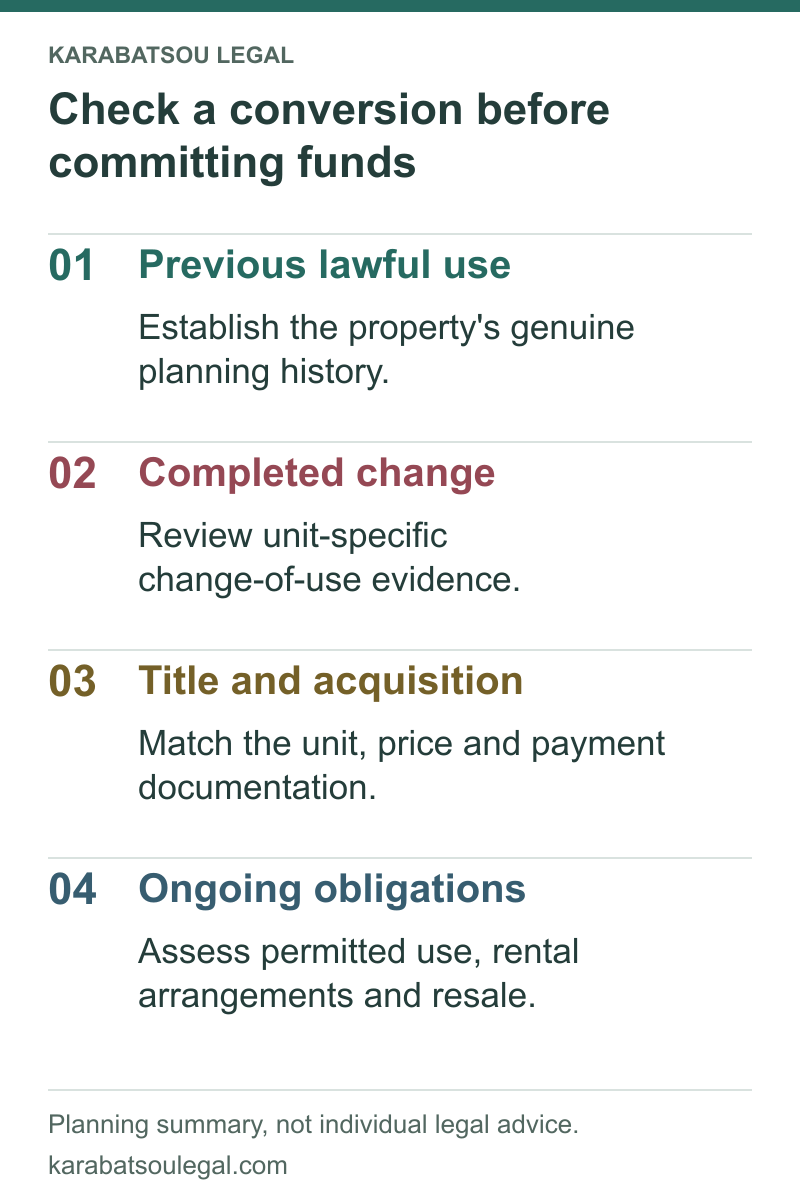
Infographic text
- Previous lawful use: Establish the property's genuine planning history.
- Completed change: Review unit-specific change-of-use evidence.
- Title and acquisition: Match the unit, price and payment documentation.
- Ongoing obligations: Assess permitted use, rental arrangements and resale.
Match the converted space to the title being sold
The immigration application concerns your property, not the development's overall reputation. Confirm the unit number, floor, ownership share, cadastral identifiers and description in the proposed deed. Check whether storage, parking and terraces are owned separately, included as appurtenances or available only through exclusive-use arrangements.
A development may contain several independently owned apartments after conversion. That does not mean any collection of units purchased together satisfies the one-property requirement. Ask the lawyer to identify the actual legal object of the purchase and assess any subdivision or consolidation documents. One invoice or one marketing package does not resolve that question.
Review the building's co-ownership rules alongside planning permission. Permissions involving common entrances, service connections, external alterations or shared areas may need additional investigation. A technical approval should not be treated as an answer to every private-law restriction. Record outstanding consents and title corrections as closing conditions, with the responsible party and completion evidence specified.
Separate the qualifying price from the total project budget
The conversion threshold concerns acquisition value. Do not assume that furniture, professional fees, taxes, management charges or a separate renovation contract can make up a shortfall in the qualifying purchase price. Request an itemised commercial offer and have the notary confirm how the acquisition consideration will be recorded.
The agreed consideration must be fully paid before the residence application using the permitted payment arrangements. The statutory framework requires detailed identification of the payer, beneficiary and transaction. Where a permitted relative funds the purchase, the relationship and payment trail also need proper documentation. Agree the funding route with the lawyer and notary before moving money.
Budget separately for works, insurance, registration, translations and ongoing ownership costs. Ask the tax adviser which transaction taxes apply to this particular sale. A recently converted or newly built property is not automatically VAT-exempt merely because it is marketed to investors. A price comparison is meaningful only when the tax treatment and excluded costs are clear.
Use a document-led reservation checklist
A reservation agreement should explain what happens if the proposal fails the legal or technical checks. A clause saying simply that the property is suitable for a Golden Visa leaves important questions unanswered. Have your own adviser review the agreement before signing or transferring funds.
- Identify the exact unit and seller, including who is authorised to receive the deposit.
- List the title, permit-history and conversion documents the seller must provide.
- Make the review period long enough for independent legal and engineering checks.
- Specify which adverse findings permit withdrawal and how the refund is calculated.
- Separate the deadline for planning evidence from the deadline for physical delivery.
- Allocate responsibility for correcting discrepancies in the title, plans and property description.
- State who bears costs if conversion or registration cannot be completed as promised.
- Confirm the payment instructions independently through an established communication channel.
These are negotiating points, not automatic rights that arise from every deposit. The signed terms determine your contractual position. Avoid relying on reassuring emails that are contradicted by the formal agreement's refund or liability clauses.
Assess rental use and resale before committing
Conversion properties carry continuing obligations. Their main spaces must remain residential, and they cannot be used as a business headquarters or branch. The new-regime restrictions on short-term letting and subletting also require attention. A guaranteed-rent offer should be reviewed together with the intended occupation, management agreement and renewal declarations.
Do not accept a proposal to use a management company as a way around the restriction. The actual use matters. Ordinary residential letting can be considered, but the lease should be reviewed against both immigration requirements and tenancy law. There is no reliable substitute for examining the proposed arrangement itself.
Resale is another important limitation. Circular 1 of 2026 explains that a property already used to obtain an investor permit through the special conversion concession cannot simply provide the next purchaser with the same EUR250,000 concession. Ask for the property's previous immigration use to be documented. Your eventual buyer pool should not be modelled on an indefinitely reusable conversion benefit.
A hypothetical purchase decision and application sequence
Consider a hypothetical EUR270,000 converted office apartment in Attica. The offer includes furniture and a rent guarantee. Before treating it as eligible, the buyer separates the property's acquisition price from the extras, obtains the previous-use documents and commissions a technical review of the change-of-use act. The lawyer also checks whether a previous owner already used the special concession.
If the planning history is sound but the manager proposes short tourist stays, the rental model must change before the buyer relies on its income forecast. If the unit was already residential and the conversion history is artificial, a revised management contract cannot cure that eligibility defect. Different findings require different decisions.
After satisfactory checks, coordinate purchase, payment evidence, registration documentation, insurance and filing. Representation through a power of attorney can assist, but it does not remove personal biometric requirements. Use the Greek Golden Visa guide for the wider process and the Golden Visa service for a property-specific assessment before committing funds.
Frequently Asked Questions
Can a conversion below 120 square metres qualify?
The conversion provision does not impose the standard routes' 120 square metre minimum. That does not make every small apartment eligible. The lawful previous use, genuine conversion, single-property requirement, acquisition price and supporting documents still need verification, together with applicable residential planning standards.
Must I personally arrange the conversion works?
No. The legislation allows the seller to complete the change of use. Your application still needs satisfactory evidence that the statutory requirements are met. A seller's promise to convert later is different from a completed, documented conversion available when the residence application is filed.
Does buying a former shop automatically qualify?
No. The physical appearance and advertised history are insufficient. The engineer must examine its lawful use and planning acts, while the lawyer checks the title, investment structure and prior immigration use. A shop converted without adequate legal documentation creates a different risk from an eligible completed conversion.
Can renovation spending count toward EUR250,000?
Do not assume separate renovation expenditure counts as acquisition value under this route. Ask for the qualifying consideration to be identified in the proposed transaction documents. Fees, furnishings and other project expenses belong in your overall budget, but should not be used casually to fill a purchase-price gap.
Can the entire process be completed without visiting Greece?
Some purchase and filing steps can be handled through properly authorised representation. Personal biometric attendance remains a separate requirement, subject to applicable individual exemptions. Confirm that appointment, lawful entry arrangements and any other required personal steps before accepting a completely remote timetable.
Author and Legal Review
Editorial author: Karabatsou Legal. Legal reviewer: Nadia Karabatsou.
This article was prepared with AI-assisted editorial support and legally reviewed before publication. Reading it does not create a lawyer-client relationship. For a correction or advice on your circumstances, contact the firm.
Sources and Further Reading
Discuss your circumstances
Get advice based on your documents, plans and deadlines.
Contact the firm