
General information, not advice for your individual circumstances. Requirements can change. Obtain case-specific advice before acting.
In this article
A Greek Golden Visa investor can be joined by qualifying family members, but each person needs an individual residence application and evidence of the relevant relationship. Eligibility extends beyond a spouse and minor children, yet it does not include every financially dependent relative. The family's ages, legal relationships and existing immigration status should be checked before the property purchase is treated as a complete relocation plan.
The useful starting point is a family application map: who will invest, who will apply as a family member, which documents prove each link and which birthdays or personal appointments affect the timetable. That preparation prevents an otherwise suitable investment from leaving one person's residence position unresolved.
Which relatives fall within the investor-family rules?
The controlling provision is Article 95(2) of the Migration Code, as amended by Article 29 of Law 5275/2026. It includes the investor's spouse or civil partner, unmarried common children under 21, qualifying unmarried children of either spouse or partner under 21 subject to the custody conditions, and direct ascendants of the spouses or partners.
Parents are therefore an important category to consider. For a more remote direct ascendant, identify every generation in the relationship chain and obtain confirmation of the required evidence. Siblings, aunts, uncles and cousins are not direct ascendants. Paying someone's living expenses does not, by itself, place them within the statutory list.
The 2026 amendment also adds a specific category for certain adult children lacking legal capacity. That is not a general extension for all dependent adult children. The applicable legal condition, shared household, maintenance and formal evidence must be considered separately rather than inferred from a diagnosis or financial dependence.
Document spouses and civil partners accurately
For a married couple, start with the marriage record and documents connecting any changed names to current passports. Earlier marriages, divorce decisions and later corrections may be relevant where they affect the validity or identification of the present relationship. Do not assume that a short certificate accepted for travel will establish every fact needed for residence.
The Ministry's Circular 1 of April 2026, clarification 10 states that a civil partnership may have been concluded in Greece or before a foreign authority. The precise foreign instrument still needs review. An informal relationship, shared address or private agreement should not be described as equivalent to a qualifying civil partnership without legal analysis.
The same clarification explains that qualifying children or ascendants of the other spouse or partner derive their entitlement directly from the investor. That spouse or partner does not necessarily need to apply personally. This is useful in mixed-nationality families, but the marriage or partnership connection must still be proved and maintained where the relative's eligibility depends on it.
Map children's ages, parentage and custody
Prepare a separate record for each child showing date of birth, marital status, legal parents, current nationality and passport expiry. Distinguish common children from children of one spouse or partner. The latter category includes a specific lawful-custody condition; a birth certificate alone may not answer it.
Where parents are separated, collect the relevant court decisions, agreements and evidence of their legal effect. Ask whether a foreign decision requires recognition or additional authentication for the intended purpose. Consent to travel and legal custody are different questions. A travel-consent letter should not be treated as proof that custody has been assigned.
Adoption and guardianship arrangements deserve their own review. Identify the legal relationship created by the document rather than assuming that every arrangement described as care or guardianship is parentage. Give the adviser the complete order, including later variations. This allows the family to identify missing evidence while there is still time to obtain it, rather than at the filing stage.
Infographic text
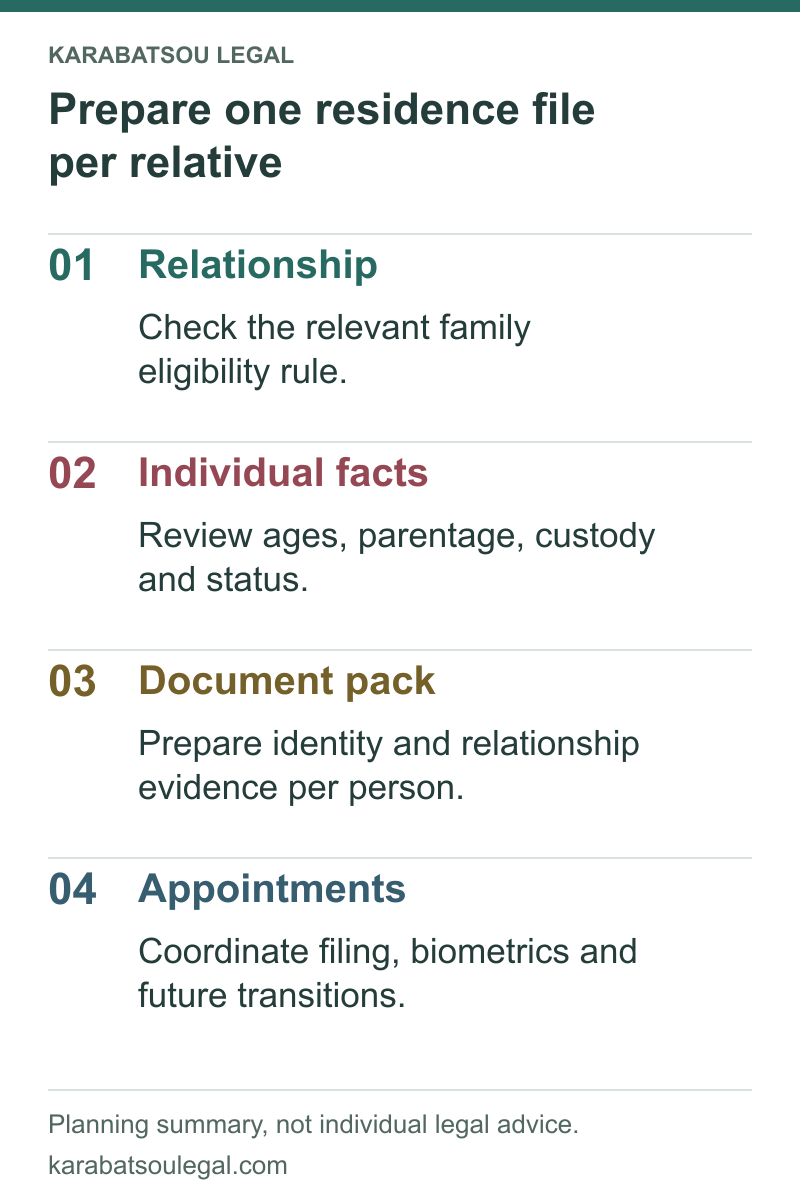
- Relationship: Check the relevant family eligibility rule.
- Individual facts: Review ages, parentage, custody and status.
- Document pack: Prepare identity and relationship evidence per person.
- Appointments: Coordinate filing, biometrics and future transitions.
Plan the transition at age 21 before it arrives
For children in the ordinary under-21 categories, Article 95(2) provides a separate three-year residence permit when they reach 21, using the previous family-reunification permit as the specified supporting basis. This is a transition for an existing qualifying family member, not a promise that any new 23-year-old applicant can join under the initial child category.
The April 2026 circular describes this permit as a bridge to another immigration status and identifies the office that issued the child's latest family permit as the competent office for the transition. Diary the birthday as well as the card expiry. Do not assume the parent's five-year renewal cycle resolves the child's age-related change automatically.
Discuss the next stage early if the young adult expects to study, work or settle elsewhere. A transition permit should not be presented as an indefinite extension of parental sponsorship. Equally, do not make citizenship promises based on the number of years a family has held investor cards: nationality is a different assessment with its own requirements.
Understand the specific 2026 adult-child provision
The new category covers an investor's, spouse's or partner's adult child who is a third-country national, lacks legal capacity, lives with the sponsor and is maintained by them, regardless of age. The law specifies formal evidence: a final Greek judgment, a foreign judgment recognised within the Greek legal order, or an equivalent document from the competent authority in the country of origin or habitual residence, lawfully authenticated and translated.
This wording is narrower than everyday descriptions such as needing support or having a disability. A medical report may be relevant background, but should not be assumed to replace the legal evidence identified in the provision. Obtain advice about the existing documents and any recognition procedure before promising that the category applies.
Also establish who can lawfully sign or instruct on the adult child's behalf. Residence eligibility, authority to act, healthcare consent and financial arrangements are related practical issues but not the same legal question. Handle sensitive records through a secure channel and disclose only what the responsible professional actually needs.
Build one document pack per person
A shared family file is helpful, but each applicant should have an indexed pack. Include passport details, the investor's application or permit reference, relationship evidence, the applicable insurance documentation and any additional category-specific records. Mark which documents are shared originals and which need separate certified copies.
Authentication requirements depend on the issuing country and document. The HCCH Apostille framework concerns authentication of public documents where the Convention applies. An apostille does not correct a name discrepancy, prove the underlying relationship is legally sufficient or replace translation. Some EU public documents benefit from separate simplification rules, so check the appropriate route first.
Use a discrepancy table for different spellings, changed surnames and inconsistent dates. Translators should preserve the source accurately, not silently reconcile conflicting facts. Ask the receiving authority's requirements before ordering a large batch of certificates. A record with complete parentage information may be more useful than a shorter version issued recently but missing the essential relationship link.
For parents living in different countries, allow for separate issuing offices, authentication procedures and courier arrangements. Keep a log showing who holds each original and when a certified copy was requested. Review insurance quotations individually, particularly where age or existing conditions affect the offered cover. The immigration document requirement and the family's practical healthcare needs should both be discussed; a policy selected solely because it produces a certificate may leave important questions about access, exclusions and out-of-pocket costs unanswered.
Coordinate filing, biometrics and existing status
Agree whether applications will be submitted together or in stages, and what evidence links each family application to the investor. Under Article 95(2), the family permit expires with the sponsor's permit. A relative applying later should not assume they will receive an entirely new five-year period running independently of the investor.
A power of attorney may support preparation and authorised filing, but it does not remove personal biometric attendance. Confirm the requirements for every person, including the age-based handling of children and any applicable exemptions. Book travel against the actual appointment instructions and lawful entry arrangements, not against a claim that representation makes every step remote.
Maintain any existing residence status until the legal consequences of the new application are clear. An upload confirmation, application certificate and residence card do different jobs. Ask separately about travel during processing. Do not infer permission to work from family membership or property ownership; review the person's exact permit category and planned activity before employment or business commitments.
A practical family planning checklist
Use this checklist before linking the property timetable to school admissions, leases or retirement plans. It is an organisational tool, not an authority's application form.
- Name the investor and identify the proposed legal category for every relative.
- Record birthdays, passport expiry dates and existing permit deadlines individually.
- Trace each relationship through official records, including the spouse's side where relevant.
- Flag custody, adoption, partnership recognition and adult-capacity questions for early review.
- Confirm authentication, translations and whether original documents must be presented.
- Identify personal appointments and avoid assuming one person's biometrics cover the family.
- Record who monitors official messages and supplementary document requests.
- Reassess the plan after marriage, divorce, death or a change in the investor's qualifying investment.
In a hypothetical family, the investor's partner does not seek a Greek permit, but the partner's mother does, while the investor's child will soon turn 21. The mother's file needs the relationship chain through the partnership; the child's file needs an age-transition plan. Treating everyone as a single dependent application would obscure both issues.
Use the Golden Visa guide for the investment framework and the Golden Visa service to request a coordinated family review before irreversible commitments.
Frequently Asked Questions
Does each family member need to buy property?
A qualifying family member applies on the basis of the relationship to the investor, rather than making a separate qualifying property investment. They still need their own application and supporting evidence. A relative outside the statutory categories must consider an independent residence route instead of assuming financial support is sufficient.
Can my spouse's parents apply if my spouse does not?
The April 2026 circular expressly addresses this possibility: qualifying family members derive their right directly from the investor. The relationship chain still has to be demonstrated. Obtain advice about the specific family documents and any later event that could end the relevant relationship to the investor.
Can a 22-year-old child join for the first time?
The ordinary child categories require an unmarried child under 21. The three-year transition is not a general first-application category for older children. The specific adult-child provision introduced in 2026 or another independent residence route may need assessment, depending on the actual circumstances.
Does a disability automatically bring an adult child within the rules?
No. The 2026 provision uses specific conditions concerning legal capacity, shared residence and maintenance, with prescribed formal evidence. Disability and lack of legal capacity are not interchangeable concepts. The documents and their recognition in Greece require individual legal review.
Will all family cards have the same expiry date?
The ordinary family permits are tied to the sponsor's permit expiry, but children's age transitions and other individual circumstances need separate attention. Track every issued card and decision. Do not calculate a relative's deadline solely from when their application was submitted or when their card was collected.
Author and Legal Review
Editorial author: Karabatsou Legal. Legal reviewer: Nadia Karabatsou.
This article was prepared with AI-assisted editorial support and legally reviewed before publication. Reading it does not create a lawyer-client relationship. For a correction or advice on your circumstances, contact the firm.
Sources and Further Reading
Discuss your circumstances
Get advice based on your documents, plans and deadlines.
Contact the firm