
General information, not advice for your individual circumstances. Requirements can change. Obtain case-specific advice before acting.
In this article
Renewing a Greek Golden Visa requires more than replacing an expiring card. You must still satisfy the conditions attached to your investment, provide current personal and insurance evidence, and address any property-use or family changes since the previous application. A valid title is central, but it is not the whole renewal file.
Begin with the original approval decision and the precise investment route. Then compare the current position with what was approved: ownership, property description, permitted use and family relationships. This approach distinguishes a straightforward renewal from a case needing corrective work or a different residence strategy before a deadline is missed.
Set the filing deadline from the actual permit
Use the expiry shown on the current permit and decision, not an anniversary calculated from the purchase, application or card collection. The general renewal rule was amended by Article 12 of Law 5275/2026: the application is to be submitted within the two months before expiry. The law permits a late application up to three months afterwards, with a EUR100 fine for each month of delay.
Beyond that period, late renewal applications are not accepted unless proven force majeure applies. This is not a recommended grace period. A person already late should obtain immediate advice about filing eligibility, legal status and travel rather than simply budget for a fine.
As a practical planning measure, review the file several months before the filing window. That earlier preparation is not an instruction to submit prematurely. It gives time to locate registration evidence, resolve passport issues and obtain family documents. Track each person's deadline separately, especially children approaching an age transition.
Keep a simple correspondence log after filing: date received, document requested, response deadline, person responsible and proof of response. Agree who monitors the registered email address when you or your representative are away. Where an authority asks for clarification, retain the question and the exact answer together with the supporting attachment. This prevents different family files from receiving inconsistent explanations and makes it easier to establish what was submitted if the case later moves to another responsible office.
Identify the rules attached to the original investment
Do not assume that today's purchase threshold automatically replaces the conditions under which an older permit was granted. Article 64 of Law 5100/2024 preserves qualifying earlier investor permits and their renewal where the applicable original conditions continue to be met. Evidence of the original regime therefore belongs in the renewal file.
Keep the purchase deed, payment records, initial notarial certificate, approval decision and any documents establishing transitional treatment together. Record whether the investment involved an ordinary purchase, a conversion, a listed building or another permitted structure. These categories have different ongoing requirements and should not be collapsed into a generic property-owner checklist.
A change of investment can produce a different assessment from continued ownership of the same qualifying asset. If you intend to sell, transfer a share, reorganise a company or replace the property, obtain advice before the transaction. An old investment threshold should not be assumed to travel automatically to a newly acquired asset.
Prove continuing ownership and completed registration
Joint Ministerial Decision 214926/2025 specifies evidence that the property remains in the applicant's ownership and possession, or that the relevant qualifying lease remains effective. It also identifies the investor's E9 property declaration among the renewal documents for applicable ownership cases. Reconcile the tax description with the deed and cadastral records.
Where the initial residence application relied on evidence that registration had merely been requested, the outstanding proof of completed registration must be supplied for renewal. Do not assume that an initial immigration approval means the land-registration process has finished. Ask for the final certificate or the prescribed lawyer's confirmation and resolve any rejected or suspended registration request.
For a qualifying company-owned investment, check that the ownership structure still meets the route's conditions. Changes to shares, legal form or the underlying asset should be disclosed for assessment. Keep an explanation of any revised cadastral identifier, corrected address or new deed so an administrative change is not mistaken for a different property.
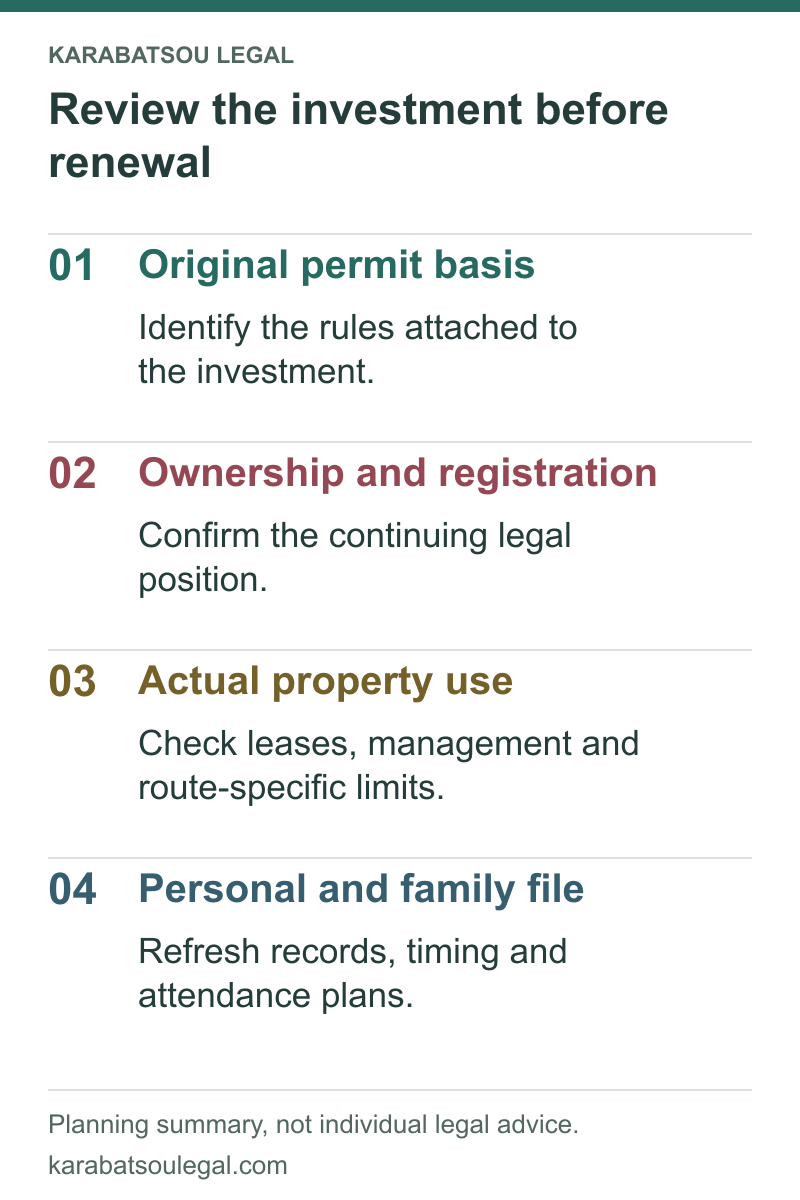
Infographic text
- Original permit basis: Identify the rules attached to the investment.
- Ownership and registration: Confirm the continuing legal position.
- Actual property use: Check leases, management and route-specific limits.
- Personal and family file: Refresh records, timing and attendance plans.
Audit the property's actual use throughout the period
The 2025 decision requires a declaration concerning prohibited short-term letting or subletting for properties within the new regime, while distinguishing protected earlier and transitional investments. This is a statement about conduct, not just about whether an online listing happens to be active on the day of renewal.
Review leases, management agreements, tax filings, booking records and correspondence with the manager. If the property has been advertised through several channels, establish who controlled each account and what occupation actually occurred. A contract describing the arrangement as long-term does not answer what a tenant or operator did downstream.
The Ministry's April 2026 Circular 1, clarification 7 explains the scope of the rental restriction and its treatment of older investments. Have the adviser classify your case before preparing the declaration. If the history reveals a potential breach, disclose it promptly. Removing an advertisement does not justify declaring that a past prohibited use never occurred.
Apply the extra checks for conversions and listed buildings
For the conversion route, the renewal declaration must confirm that the property's main spaces remain residential and that the property is not used as a business headquarters or branch. Review any tenant's registered address, alterations and operational use. A property acquired as a converted residence should not quietly become an office between permit applications.
For the listed-building route, the first renewal requires the prescribed engineer's report confirming completion of full restoration or reconstruction. It is not enough to demonstrate that work began or that the owner paid a contractor. Compare the remaining works with the route's completion condition well before the renewal window opens.
These obligations are not interchangeable. A property that could originally have fitted both categories must be assessed by reference to the basis actually used and any lawful subsequent change. Ask the engineer and lawyer to review the same plans, certificates and approval decision. This avoids a technically complete project being presented with the wrong immigration explanation.
Refresh personal records and reassess each family member
Check passports, names, nationality details, current contact information and the insurance required for the category. A changed passport number is ordinary, but it still needs to be connected correctly to the existing file. Address discrepancies before submission rather than expecting the authority to infer that two different spellings identify the same person.
Family applications need their own review. Marriage, partnership, divorce, death, custody changes and children's birthdays may affect the underlying entitlement. Law 5275/2026 confirms the three-year autonomous transition for qualifying children reaching 21 and adds a specific adult-child category involving lack of legal capacity, co-residence, maintenance and formal evidence. Neither should be treated as an automatic standard renewal.
Ordinary family permits are linked to the sponsor's expiry, but individual transitions need separate tracking. Assign a document owner and deadline for every applicant. The fact that all cards arrived in the same envelope does not mean that every family member has identical eligibility or can use an unchanged document pack.
Separate absence rules, biometrics and travel documents
Article 100 provides that absence from Greece does not itself prevent investor-permit renewal. That is different from an unconditional renewal right: continued investment, lawful use and the other applicable conditions remain relevant. It also does not determine tax residence or satisfy the separate conditions for a future citizenship or long-term residence application.
Plan any personal biometric appointment independently from the filing work. A representative can carry out authorised administrative steps, but a power of attorney does not replace your fingerprints or other required personal identity procedures. Confirm whether fresh attendance is required for the particular renewal and how any exemption is documented.
Before international travel, distinguish the application certificate from the physical residence card. Confirm the rules that apply to departure, re-entry and transit for your nationality and documents. Do not rely on a scanned upload confirmation or an assurance from a property manager. Keep copies of the submission and official communications accessible while travelling, without treating them as universally valid travel authorisations.
Use a staged renewal checklist and decision example
Organise the work around dependencies rather than gathering everything in the final week. The following sequence is a planning recommendation; the legally applicable filing window still controls.
- First review: confirm every expiry, the original investment category and any intended sale or family change.
- Property review: obtain current ownership evidence and close any outstanding registration issue.
- Compliance review: reconcile actual rental use with leases, tax records and the manager's reports.
- Technical review: obtain conversion-use evidence or the listed-building completion report where required.
- Personal review: update passports, insurance and relationship documents for each applicant.
- Filing review: check the current official document list, applicable fee and submission authority.
- After submission: retain the receipt, monitor requests and arrange any personal appointment.
- After decision: check names, category and expiry, then set the next review reminders.
In a hypothetical renewal, the investor still owns the original apartment, but registration was never completed and a child has turned 21. These are two separate workstreams. A fresh insurance policy does not cure the registration issue, and renewing the parent does not replace the child's transition application. The useful response is an assigned action plan, not a generic statement that ownership remains unchanged.
For the programme context, consult the Greek Golden Visa guide. A review through the Golden Visa service should begin with the previous decision, current cards and a short account of everything that has changed.
Frequently Asked Questions
Must I increase an older investment to today's threshold?
Not simply because the general thresholds have increased. Protected earlier permits can be renewed while their applicable conditions continue to be satisfied. However, selling or replacing the qualifying investment is a separate issue. Retain the original documents and obtain advice before assuming grandfathered treatment applies to a new transaction.
Does living outside Greece prevent renewal?
Absence alone is not a barrier under the investor provisions. You must still meet the investment and other renewal conditions and complete required personal procedures. Do not confuse this rule with the tests for tax residence, citizenship or another residence category, which require separate analysis.
Can I renew after the card expires?
The general rule amended in 2026 permits a late application within three months, with a monthly fine. Beyond that, proven force majeure is required for acceptance of a late renewal. Seek immediate individual advice if already late; the rule should not be used as a planned extension of the card's validity.
What if my property manager breached the rental restriction?
Obtain the complete booking and contract history and disclose it to the lawyer reviewing the renewal. The owner's compliance cannot safely be inferred from delegating management. Do not sign an inaccurate declaration or assume cancelling future bookings erases earlier conduct. The consequences require a fact-specific assessment.
Does renewal create a route to a Greek passport?
A renewed investor permit remains a residence document. It does not itself establish citizenship eligibility or prove the residence and other conditions relevant to a nationality application. Anyone considering that longer-term objective should obtain a separate assessment based on actual residence history and personal circumstances.
Author and Legal Review
Editorial author: Karabatsou Legal. Legal reviewer: Nadia Karabatsou.
This article was prepared with AI-assisted editorial support and legally reviewed before publication. Reading it does not create a lawyer-client relationship. For a correction or advice on your circumstances, contact the firm.
Sources and Further Reading
Discuss your circumstances
Get advice based on your documents, plans and deadlines.
Contact the firm