
General information, not advice for your individual circumstances. Requirements can change. Obtain case-specific advice before acting.
In this article
Greek citizenship by descent and naturalisation are not interchangeable applications. A descent assessment asks whether citizenship follows from a Greek parent under the law applicable to the family history, and what recognition or registration is needed. Naturalisation is a procedure for acquiring citizenship. Greek ancestry may be relevant to either assessment, so a grandparent's birthplace alone cannot identify your route.
Before ordering certificates, establish three things: the citizenship position of each generation, the dates of any citizenship decisions, and your own circumstances. The practical aim is a written route assessment that explains what the authority must decide. This guide focuses on choosing that procedure, rather than promising a passport from a particular family connection.
Recognition and registration answer different questions
Recognition concerns the legal basis on which a person is considered Greek. Registration concerns recording the person and relevant family events in the appropriate Greek records. These steps can be connected, but they should not be collapsed into a single administrative task. A birth certificate records an event; it is not necessarily proof of citizenship.
The Greek Ministry of Foreign Affairs citizenship guidance identifies descent from a Greek parent as a principal basis of citizenship and explains the importance of municipal registration. That makes a municipal certificate a useful starting point, while leaving the competent authority to assess the actual case.
Ask what your existing document establishes. An ancestor's passport may support a records search. A municipality's family entry may establish registration. A citizenship decision may identify a legal basis and effective date. None should be described simply as your family's “citizenship papers” when the distinction changes the procedure.
Keep the decision, certificate and civil record separately indexed. This prevents a receiving office from having to infer why a document was supplied.
The decisive comparison is between dates and generations
Start with the nearest parent through whom citizenship is claimed. Record their birth, the applicant's birth, any marriage or legally relevant parentage event, and any citizenship acquisition or determination. Then extend the same timeline backwards to the Greek ancestor. The resulting sequence is more informative than counting how many generations separate you from Greece.
A parent's registration completed recently does not, by itself, tell you when that parent became a citizen. It may document an existing status, or follow a later acquisition procedure. Obtain the underlying explanation before assuming the parent's certificate automatically resolves an adult child's application.
The MFA's guidance on naturalisation for people of Greek ethnic origin specifically discusses cases involving an unregistered parent and cases where a parent acquired citizenship after the applicant's birth. This demonstrates why ancestry does not always lead to a straightforward registration procedure.
Where a date is unknown, mark it unknown. Do not substitute the date a certificate was printed for the date citizenship was acquired.
Naturalisation based on Greek ethnic origin is a distinct route
A person of Greek ethnic origin living abroad may need the relevant naturalisation procedure rather than recognition through a registered Greek parent. Its evidence can include the family connection and material supporting Greek ethnic origin and national identification. A genealogical connection and the requirements of that application should be assessed together, not assumed to be identical.
The UK consular guidance describes an interview and requests documents beyond a simple ancestor certificate, including the applicant's criminal-record evidence. Those instructions are useful for understanding the procedure, but UK-specific issuing authorities and appointment arrangements are not universal rules for applicants elsewhere.
Ask the competent consulate which documents apply in your country of residence. A professional should distinguish the substantive nationality requirements from local arrangements for receiving the file. Changing consulates does not change the law governing your family's citizenship history.
Do not prepare an invented account of cultural involvement. Provide truthful information and genuine documents. An interview is not a reason to manufacture fluency, community participation or a personal history that cannot be supported.
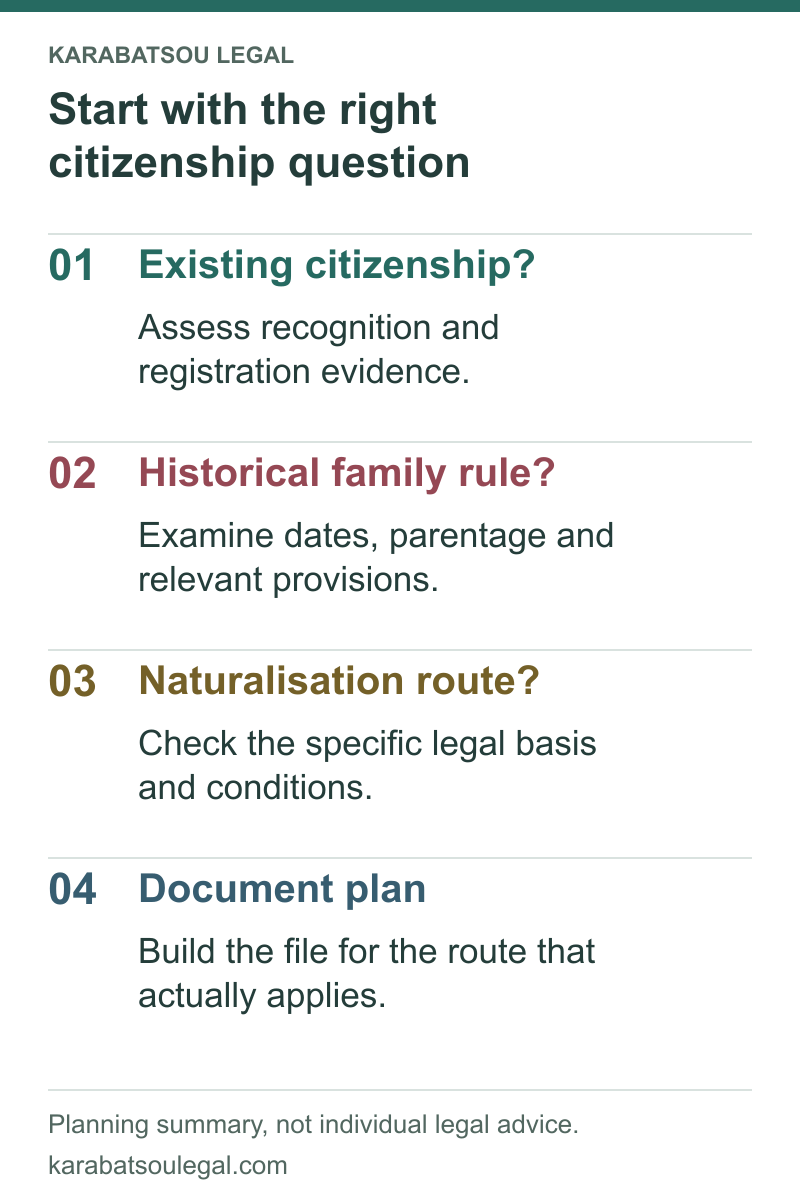
Infographic text
- Existing citizenship?: Assess recognition and registration evidence.
- Historical family rule?: Examine dates, parentage and relevant provisions.
- Naturalisation route?: Check the specific legal basis and conditions.
- Document plan: Build the file for the route that actually applies.
Residence-based naturalisation requires a different file
For a person without a qualifying ancestry route, naturalisation based on lawful, established residence in Greece raises different questions. These include the residence history, the immigration status held, substantive eligibility and the evidence required by the nationality authorities. Owning Greek property is not a substitute for this assessment.
The Ministry of Interior's naturalisation guidance addresses applicants without Greek ethnic origin who reside lawfully and permanently in Greece. Its application checklist describes the knowledge certificate, known as PEGP, and specified education-based exemptions. These requirements should not be imported into every recognition-by-descent case.
Equally, an ancestry article cannot tell a resident exactly when they may apply. Residence periods and applicable conditions require classification of the applicant's status. A general statement about a commonly cited number of years may conceal an exception or an ineligible period.
Prepare a continuous residence chronology showing permits, renewals, absences and any gaps. Ask for an explanation of which periods count, rather than adding up the years since the first holiday or property purchase.
Historical family rules need their own legal analysis
Older maternal-line cases, births outside marriage, adoption and later changes in parentage can alter the analysis. The correct question is not simply whether the family connection can be proved today, but which law governed the legally relevant events and whether a later provision provides a route.
For example, the MFA naturalisation guidance refers to acquisition under Article 14 of the Citizenship Code. That reference is a warning against blanket statements that every older maternal line failed, or that every later registration has identical effects. The relevant decision and its legal basis need examination.
Supply both favourable and difficult records. A marriage date inconsistent with a family account, or a formal name change, should be explained rather than omitted. Hiding the complication may lead to an application built around a chronology that the official records contradict.
Where the issue is historical, ask the reviewing lawyer to identify the provision relied upon and the event that activates it. A short, reasoned explanation is more useful than an unsupported statement that the case is either “automatic” or “impossible.”
Use a route-selection checklist before buying documents
Create a working sheet with one row per person and a separate column for the legal question. This keeps document collection tied to a purpose. A missing marriage certificate and uncertainty about a parent's citizenship acquisition are different problems requiring different work.
- Identify the Greek ancestor using names, birth details and the best available municipality reference.
- List each parent-child connection and the full civil record supporting it.
- Record every citizenship decision, including its issuing authority, legal basis and date.
- Separate unregistered family events from unresolved citizenship status.
- Flag historical maternal-line, adoption or parentage questions for legal assessment.
- State where you live, which nationalities you hold and whether you already have Greek residence status.
- Ask the reviewer to name the proposed procedure and explain why the alternatives do not presently fit.
Request a staged document list after that review. Some certificates establish eligibility; others are needed only when filing. Ordering everything immediately can mean paying twice when a receiving authority requires a different format or a more recent issue.
Add a status column showing whether each item is available, requested or still unidentified. For an unresolved point, name the evidence that would answer it: a parent's acquisition decision, a full birth record or a municipal search response. This makes the next research step measurable and prevents general family-history research from continuing without a clear nationality question.
A hypothetical comparison: similar ancestry, different applications
Consider two hypothetical adult cousins whose common grandfather was registered in a Greek municipality. Both hold foreign passports and live abroad. The first cousin's parent has a documented citizenship position relevant to the cousin's birth. The second cousin's parent acquired citizenship later through a separate procedure.
The common grandfather does not make the cousins' applications identical. For the first, the investigation may focus on the parent's status at the relevant time and completing the required family registrations. For the second, the acquisition decision may point toward an ethnic-origin naturalisation assessment or another applicable provision.
Now suppose the first cousin's birth certificate contains a surname different from the parent's Greek entry. That discrepancy requires evidence, but it does not automatically convert the case into naturalisation. Conversely, perfectly matching names do not establish that the second cousin already held citizenship at birth.
The lesson is to separate two questions: “Can we prove that these people are related?” and “What legal consequence follows from that relationship?” A strong document file answers the first; a reasoned nationality assessment addresses the second. Neither should be used as a substitute for the other.
What a useful initial legal assessment should deliver
Ask for a clear record of the proposed route, the evidence already available, the unresolved issues and the next authority to approach. The assessment should also identify personal attendance points, such as an interview or oath where the chosen procedure requires one. Authorised representation does not make every stage remote.
Separate the citizenship work from passport preparation. A positive nationality outcome may still need registration and identity checks before a passport application is ready. Do not use a promised passport delivery date as the measure of whether the underlying route was correctly chosen.
The Greek citizenship-by-descent guide provides the wider family-file framework. When requesting an individual review through the Greek citizenship service, send a concise timeline and a document index first. Agree a secure method before transmitting sensitive certificates.
Frequently Asked Questions
Is citizenship by descent always quicker than naturalisation?
No dependable timing comparison can be made from the label alone. A recognition file with missing generations or unresolved records may involve substantial preliminary work. A route must first be legally appropriate; speed should then be discussed by stage, with government processing and document research distinguished.
Does a Greek grandparent mean I can avoid naturalisation?
Not necessarily. The intervening parent's status and the relevant dates matter. Greek ancestry may support recognition in one file and an ethnic-origin naturalisation application in another. Request the reason for the proposed route in writing before paying for a standardised ancestry package.
Will I have to pass a Greek language examination?
That depends on the procedure. The PEGP framework belongs to the relevant naturalisation process, with specified exemptions; it should not be assumed to apply to every descent recognition. An ethnic-origin interview is also not interchangeable with the residence-based examination framework. Confirm the requirements for your exact route.
Can my parent's new citizenship cover me automatically?
Do not assume this, especially if you are already an adult. The parent's acquisition route, its effective date and your age at the legally relevant event require review. Provide the full decision, not only a new passport or a municipality certificate issued after the decision.
Should I pursue two citizenship routes at once?
First ask whether there is a genuine legal reason to do so. Parallel preparation can create duplicated expense and inconsistent statements about status. A preliminary assessment should identify the best-supported procedure, explain any alternative and specify which missing evidence would change that recommendation.
Author and Legal Review
Editorial author: Karabatsou Legal. Legal reviewer: Nadia Karabatsou.
This article was prepared with AI-assisted editorial support and legally reviewed before publication. Reading it does not create a lawyer-client relationship. For a correction or advice on your circumstances, contact the firm.
Sources and Further Reading
Discuss your circumstances
Get advice based on your documents, plans and deadlines.
Contact the firm