
General information, not advice for your individual circumstances. Requirements can change. Obtain case-specific advice before acting.
In this article
A Greek mother or grandmother can support a citizenship claim, including in a family line involving births before 1984. The answer depends on the woman's citizenship at the relevant time, the child's legal family circumstances, and any later declaration, recognition or reacquisition. It is inaccurate to say that every pre-1984 maternal line is automatically broken.
The important date is 8 May 1984, not 5 August. However, a date alone does not identify the procedure. Some cases concern citizenship from birth, others a declaration under Article 14 of the Greek Citizenship Code, and others a different remedial or naturalisation route. This guide explains what to investigate before assuming that registering one generation resolves every descendant's position.
Build a timeline for the woman and each descendant
Start with the Greek woman, not only the person applying today. Record her birth, citizenship evidence, marriage or marriages, children, and any recorded loss or reacquisition of nationality. Then repeat the exercise for each generation connecting her to the applicant. Include the form and place of marriage, not just the year.
Keep five dates distinct: birth, relevant marriage, declaration of intention, citizenship decision, and municipal registration. A sixth date, passport issuance, can be useful evidence but should not replace any of the others. Record the effective citizenship date stated in an existing decision rather than guessing from when the family collected a certificate.
Mark missing information explicitly. If a relative says the mother became Greek in 1998, ask whether that means she applied, received a decision, registered an event or obtained a passport. Those descriptions are not interchangeable. Obtain the document before deciding what happened legally.
Why the 1984 date does not decide the whole case
Article 1 of the Greek Citizenship Code published by the Ministry of Interior states the current rule that a child of a Greek father or mother acquires Greek citizenship from birth. Historical cases require examination of the rules and family circumstances relevant to that birth, not simply retrospective application of today's wording.
Earlier maternal transmission was not uniformly impossible. The official MITOS procedure concerning Article 23 expressly addresses people born before 8 May 1984 who acquired citizenship through a Greek mother and later lost it through specified historical parentage events. That alone contradicts an absolute claim that mothers could never transmit before 1984.
Birth within or outside a marriage, the marriage's treatment under Greek law, and later acknowledgment or other family-status changes can therefore matter. Do not infer the legal classification from a modern family tree or a certificate's shorthand description. The original records need to be read together.
What the Article 14 maternal declaration route addresses
Article 14(1) provides a declaration route for a person born before 8 May 1984 whose mother was Greek at the birth or at the marriage from which the child was born. The official MITOS administrative procedure sets out the relevant conditions and supporting process, including the valid-marriage circumstances to which that procedure relates.
This is not a rule that the grandmother must have been born before 1984. The date concerns the birth of the person whose acquisition under Article 14 is being assessed. In a grandmother-parent-applicant chain, that person may be the applicant's parent rather than the applicant.
Applicants abroad should confirm arrangements with the competent Greek consular authority. The official Article 14(1) procedure calls for the mother's municipal-registration certificate to establish citizenship at the birth or relevant marriage. Signing an ordinary letter about Greek ancestry is not a substitute for following the applicable procedure.
Before proceeding, ask whether Article 14 is actually needed or whether the evidence supports citizenship already held under another provision. A remedial acquisition procedure should not be selected merely because a family contains an older Greek mother.
Plan personal participation early. MITOS identifies the declaration application as an in-person step. A lawyer can help organise the evidence and explain the route, but a general power of attorney should not be assumed to replace the applicant's personal declaration. Confirm the consular appointment arrangements before arranging travel.
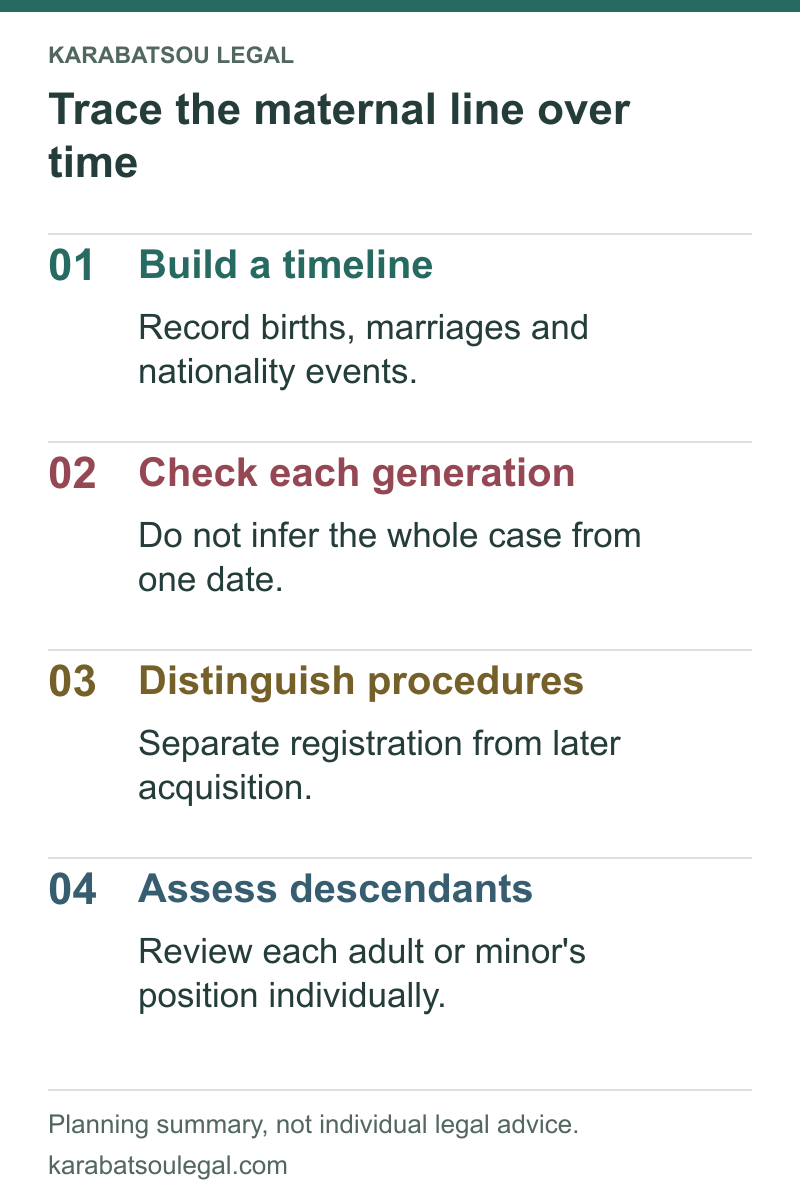
Infographic text
- Build a timeline: Record births, marriages and nationality events.
- Check each generation: Do not infer the whole case from one date.
- Distinguish procedures: Separate registration from later acquisition.
- Assess descendants: Review each adult or minor's position individually.
Distinguish late registration from later citizenship acquisition
A parent appearing in Greek records only recently can mean different things. Their citizenship may have been established as existing from birth, or they may have acquired it through a later legal act. The distinction affects the analysis of children born before the paperwork was completed.
Current MFA guidance addresses later determination of a parent's citizenship from birth. Separately, its ethnic-origin naturalisation guidance identifies cases involving a parent who acquired citizenship after the applicant's birth, including through Article 14. These pages illustrate distinct routes, not interchangeable labels for one application.
Request the decision, legal basis and effective date, together with the resulting municipal certificate. Ask the reviewer to explain the effect on the next generation in writing. Neither the phrase never registered nor the phrase now Greek is sufficiently precise to settle an adult descendant's entitlement.
Check legal parentage and any historical loss separately
Evidence of a biological relationship and evidence of legal parentage are not always the same. Where records include acknowledgment, adoption, a disputed marriage or a court determination, identify the operative document and date. Do not describe every missing name or absent registration as a clerical problem.
The Code contains distinct remedial provisions. Article 22 addresses reacquisition by a Greek woman who lost nationality because of marriage to a foreigner. Article 23 concerns a child born to a Greek mother who lost nationality through legitimation or recognition by a foreign father. Whether either applies depends on an actual history of loss, not merely an overseas marriage or foreign surname.
Look for deletion annotations, earlier municipal entries and the decisions behind later reinstatement. Ask for the reason an entry changed. A surviving certificate may reflect the outcome without explaining the intervening history. That history can be essential when assessing a child's position at birth.
If no loss decision has been found, say so. Do not invent a loss because an old rule could have applied, and do not assume uninterrupted citizenship simply because nobody remembers a problem. The assessment should distinguish documented events, unresolved evidence and legal conclusions.
Assess adult and minor descendants individually
Article 14(4) provides for the children of a person acquiring citizenship under that article where those children are minors and unmarried on the declaration date. That condition must not be rewritten as automatic citizenship for all descendants, regardless of age. The authority still needs the evidence required to establish and record the child's position.
An adult child should obtain a separate route assessment rather than assume inclusion in a parent's declaration. Equally, a recent municipal registration should not automatically force an adult into naturalisation if the parent's decision concerns citizenship from birth. Read the decision before classifying the child's case.
Where ethnic-origin naturalisation is the appropriate route, obtain its actual requirements. Do not promise that ancestry guarantees approval, removes every interview or creates a universal language-test exemption. Requirements and any exemptions must be checked for that procedure and the applicant's circumstances.
Keep separate assessment notes for siblings with different birth dates or family histories. Shared ancestry can reduce duplicated research, but it cannot substitute for checking each person's relevant age, status and supporting records.
Prepare a focused maternal-line evidence checklist
The initial bundle should answer legal questions rather than display every family document. Use the following checklist to organise existing copies before ordering replacements. Confirm the final filing requirements only after the procedure is identified.
- The woman's status: municipal citizenship evidence and any acquisition, loss, deletion or reacquisition decision.
- The relevant marriage: civil evidence showing the parties, date and place, with religious or other supporting records where needed for historical classification.
- Each generation's birth: records establishing the parent-child relationship, including annotations or amendments.
- Legal family changes: acknowledgment, adoption, divorce or court documentation where relevant, with evidence of when the act took effect.
- Previous citizenship steps: applications, declarations, decisions and registration certificates, not only current passports.
- Identity connections: records explaining married surnames, formal changes and significant discrepancies across countries.
Prepare a short question beside each missing item. For example, does the mother's certificate show citizenship at the relevant marriage, or only her current registration? This turns a document gap into an answerable request and helps prioritise spending.
A hypothetical two-generation decision review
Consider a woman who was Greek when her child was born abroad in 1965 within a marriage relevant to Article 14. That child, now an adult, has an adult daughter born in 1992. No citizenship decision for the 1965-born child has yet been obtained.
The review first checks the woman's status and the legal family circumstances. If Article 14 is appropriate for the 1965-born child, the daughter's position must then be assessed separately; her adulthood prevents treating her as an unmarried minor included by Article 14(4). The family should not be promised two automatic registrations from one declaration.
Change one fact: suppose an existing decision instead establishes that the parent held citizenship from birth. That document calls for a different analysis of the daughter, even if the parent's municipal registration occurred recently. The example demonstrates why the legal basis matters more than the year someone first received a Greek passport.
For the broader framework, see the citizenship-by-descent guide. For a tailored assessment, provide the Greek citizenship service with the chronology and actual decisions. Ask for separate conclusions for each generation, the evidence still missing, and the attendance required for the selected procedure.
Frequently Asked Questions
Is a Greek grandmother a weaker starting point than a grandfather?
Do not rank the routes by gender alone. A grandmother's citizenship, the relevant births and marriages, and any later legal acts must be examined. Historical differences may change the procedure, but they do not justify a blanket rejection of maternal ancestry or a promise of automatic eligibility.
Does Article 14 apply directly to every grandchild?
No. Its maternal provision concerns the person born to the Greek mother under the relevant conditions. In a grandmother-based file, that person may be your parent. Your own position then requires examination under the rules applicable to you, including the effect of any declaration or decision concerning the parent.
What if my parent registered after I was born?
Obtain the underlying decision. Later recognition of citizenship from birth and later acquisition are legally different situations. The date a municipal certificate was issued does not establish which occurred. Ask how the decision affects your status rather than relying on the family's informal description of registration.
Can registration fix a legal parentage problem?
Registration should not be treated as a way to create a relationship that has not been legally established. Provide the relevant acknowledgment, adoption or court documents for review. The authority may need a parentage or recognition issue resolved before the citizenship file can be assessed accurately.
Can someone act for a deceased parent under Article 14?
Do not assume a descendant can make the parent's personal declaration retrospectively. First investigate whether the parent already held citizenship, made a declaration or received a decision. Then obtain advice on the living applicant's available route. Missing parental participation is a legal question, not merely a missing signature.
Author and Legal Review
Editorial author: Karabatsou Legal. Legal reviewer: Nadia Karabatsou.
This article was prepared with AI-assisted editorial support and legally reviewed before publication. Reading it does not create a lawyer-client relationship. For a correction or advice on your circumstances, contact the firm.
Sources and Further Reading
Discuss your circumstances
Get advice based on your documents, plans and deadlines.
Contact the firm