
General information, not advice for your individual circumstances. Requirements can change. Obtain case-specific advice before acting.
In this article
A Greek Golden Visa property can generate rental income, but the permitted arrangement depends on the investment's legal regime and the property's actual use. Properties within the new rules are subject to restrictions on short-term letting and subletting. Converted residential properties also face a separate prohibition on use as a business headquarters or branch. A rental guarantee does not override those conditions.
Before buying or signing a management contract, establish which rules attach to the property, classify the proposed letting and test the projected income using a compliant model. The question is not merely whether an operator will pay rent, but whether the arrangement preserves the residence basis you are purchasing.
Start with the acquisition and permit history
Article 64 of Law 5100/2024 introduced paragraph 7A into Article 100 of the Migration Code. The provision restricts short-term rental use of the relevant investor properties and adds the business-address restriction for the conversion route. Read it together with later implementation guidance, not as an isolated sentence from a sales brochure.
The Ministry's Circular 1 of April 2026, clarification 7 states that the short-term restriction does not cover properties acquired under the previous provisions or investments completed within the statutory transitional period. A property-specific chronology is therefore essential.
Collect the deed, payment dates, original approval and any transitional evidence. Neither a recent card nor an old building proves which regime applies. On resale, the new buyer's application also needs its own assessment: do not assume the seller's historic treatment automatically settles the purchaser's position. Record the legal conclusion before the property is advertised for rent.
A separate planning-law restriction also matters: Article 56(2) of Law 5322/2026 prohibits short-term letting for at least five years for the residential conversions it specifies under Article 199 of the planning code. This is not a five-year expiry date for Golden Visa restrictions. Check both legal bases and the property's particular conversion permission.
Understand what counts as short-term letting
For this analysis, the circular refers to Article 111 of Law 4446/2016. AADE Circular E.2024/2024 explains the definition: a rental or subrental for less than 60 days, with no services beyond accommodation and bed linen, falls within that short-term framework, whether or not it is listed or concluded through a digital platform.
Removing a property from a familiar booking website does not, therefore, necessarily change the legal character of the stays. Direct bookings, private introductions and a manager's own website still require classification. Equally, a platform name alone is not a full legal analysis of an arrangement's duration and services.
The 60-day distinction is not a universal minimum lease term for every Golden Visa property. Nor does writing a longer period on paper automatically make the real operation compliant. Ordinary tenancy rules, genuine occupation and any tourism-business requirements remain separate questions. Have the adviser assess the contract and the intended conduct together.
Do not confuse management with a change in legal use
A manager may act as the owner's agent, become a tenant with subletting rights, or operate a licensed accommodation business. These structures allocate responsibilities differently. Ask who signs with occupants, who receives payments, who makes tax filings and whether the operator can alter the use without your consent.
The April 2026 circular clarifies that the investor restriction concerns short-term letting and subletting within the specified framework, rather than declaring every conceivable sublease prohibited. It gives examples involving genuine tourism businesses and additional services, subject to the relevant conditions. That clarification should not be advertised as a universal hotel-style workaround for ordinary apartments.
A long headlease to a company does not by itself answer what happens underneath it. If the company proposes repeated short stays, the downstream operation must be examined. Adding a cleaning service or changing the contract heading is not a substitute for establishing the proper legal category, licences and permitted building use. Obtain the conclusion before relying on promised returns.
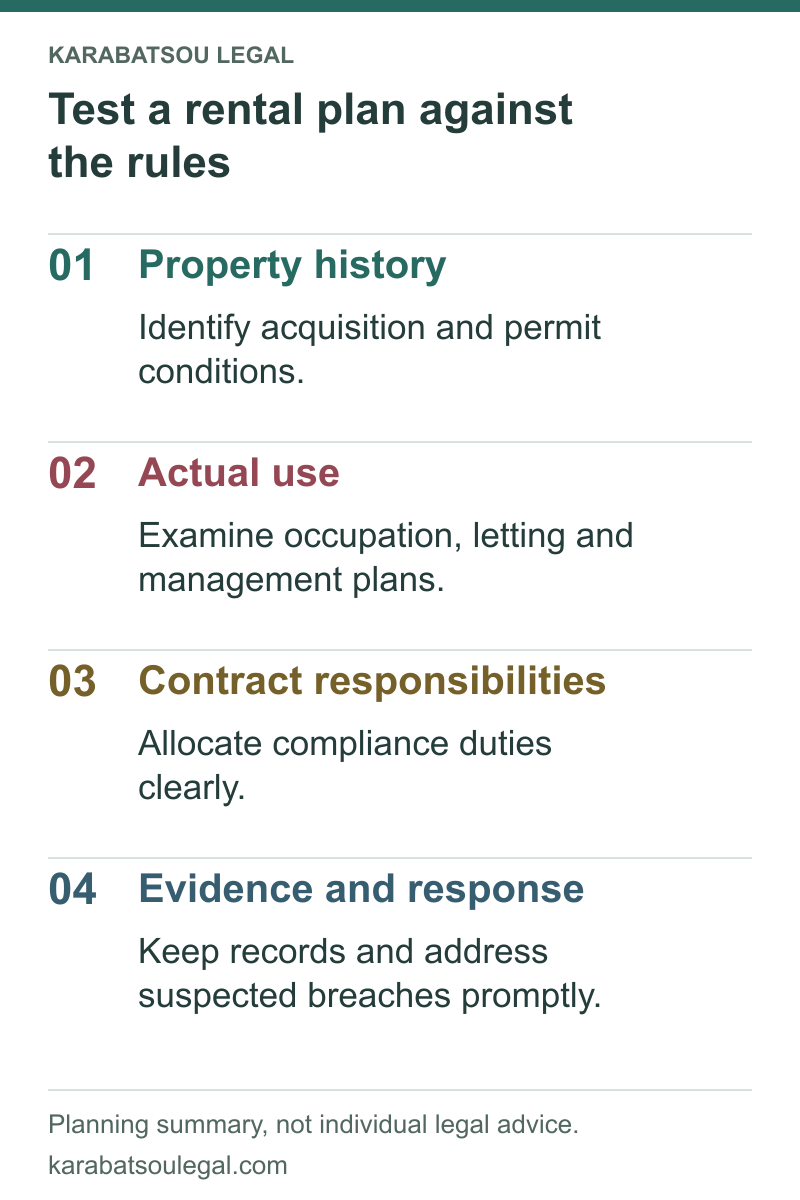
Infographic text
- Property history: Identify acquisition and permit conditions.
- Actual use: Examine occupation, letting and management plans.
- Contract responsibilities: Allocate compliance duties clearly.
- Evidence and response: Keep records and address suspected breaches promptly.
Check the extra limits on conversion properties
For properties qualifying through the EUR250,000 conversion route, the main spaces must remain residential and the property cannot serve as a business headquarters or branch. This requires attention even where the tenancy is not short-term. A seemingly ordinary corporate arrangement may raise a separate problem if the tenant registers an operating office there.
Joint Ministerial Decision 214926/2025 makes the continuing position visible at renewal: the applicant must declare that the main spaces remain residential and that the property is not used as a business headquarters or branch. The owner needs records that support that declaration, not just confidence that the manager knows the programme.
Ask specifically about registered addresses, signage, reception facilities, customer visits and any proposed change to the approved plans. Do not assume that occasional computer use at home and formally establishing a business branch are identical questions. Ambiguous work or corporate-accommodation arrangements need individual assessment rather than a blanket promise that all residential-looking occupation is acceptable.
Put compliance responsibilities into the contract
A lease or management agreement should describe the permitted use in operational terms. General language requiring compliance with Greek law is useful, but it does not tell a manager what information to provide or what activities require the owner's approval. Request clauses tailored to the investment route.
- Define whether the operator is an agent, tenant or other service provider.
- Specify the approved occupation model and any restrictions on downstream letting.
- Require consent before changing use, appointing another operator or registering a business address.
- Provide access to leases, booking records and the tax information needed for compliance checks.
- Require prompt notice of complaints, inspections, enforcement notices and proposed alterations.
- Allocate responsibility for maintenance, safety, insurance and accurate public advertising.
- Provide workable inspection, termination and document-handover provisions.
- State how revenue, expenses, deposits and any guarantee are calculated and verified.
Contractual recourse against an operator is not the same as protection from public-law consequences. An indemnity may matter commercially, but it cannot guarantee that an immigration authority will disregard a breach. Review the operator's ability to perform and pay, as well as the wording of the promise.
Test rental projections against a lawful base case
Ask for the assumptions behind the advertised yield: rent, occupancy, management fees, maintenance, common charges, insurance, tax and periods when the property is unavailable. Separate gross receipts from the amount the owner actually retains. Where a developer offers a guarantee, identify the guarantor, duration, conditions and security.
Use a lawful letting scenario as the base case. Then calculate what happens if the tenant leaves, repairs take longer or the management agreement ends. Do not use prohibited short stays as the financial fallback. An investment that only works through an unavailable use is not rescued by an optimistic spreadsheet.
In a hypothetical purchase, a converted apartment is offered with a return based on frequent tourist turnover. The buyer asks for a residential-tenancy forecast, written classification of the proposed operator arrangement and a revised contract. If the compliant forecast no longer meets the buyer's objectives, the sensible commercial decision may be to choose a different property or investment route before paying a non-refundable deposit.
Maintain tax and operating records without confusing permissions
Tax registration or acceptance of a declaration does not, by itself, establish that a use complies with immigration, planning or tenancy rules. Keep those workstreams connected but distinct. An accountant needs accurate information about the operation; the immigration adviser needs the same facts when assessing the property's ongoing eligibility.
Create a property compliance folder containing the legal-regime assessment, approved plans, signed contracts, statements of income and expenditure, relevant tax filings and communications about use. Record when a tenant enters and leaves and what happened during any vacancy. Update the folder when a manager or operating model changes.
Retain evidence over the permit period, not just in the months before renewal. A current photograph or empty booking calendar cannot explain several years of activity. Where an operator controls online accounts, secure contractual access to records before the relationship ends. Data-handling arrangements should also protect occupants' personal information rather than collecting unnecessary identity material without a defined purpose.
Set a review routine proportionate to the arrangement. Compare the operator's report with the signed lease and the income received, and ask about any unexplained change in occupants or payment pattern. Check that public advertisements still describe the agreed model. This is a practical supervision measure, not an additional statutory reporting interval. Record concerns when they arise and obtain an answer rather than waiting for the permit renewal.
If you change managers, make document handover a closing task. Obtain the current lease, relevant operating records, account access and a statement of outstanding bookings or obligations. An incoming manager should receive the property's written restrictions before taking instructions to maximise revenue.
Respond promptly to suspected non-compliance
Article 100(7A) provides for permit revocation and a EUR50,000 administrative fine for breaches of the specified rental and business-address prohibitions. These are significant immigration and financial consequences, not simply a routine operating expense. Their application to particular facts requires legal assessment.
If you discover unauthorised use, preserve the contracts, booking history, advertisements and communications. Ask the manager for a factual account and obtain advice on stopping further non-compliant activity while respecting existing contractual obligations. Do not destroy records or submit an inaccurate declaration because the listing has since been removed.
The reviewing lawyer should establish the relevant regime, actual use, dates, responsible parties and any official action already taken. The response may involve contract enforcement, corrections or representations to an authority, but no generic article can guarantee a cure. For the wider investment framework, see the Golden Visa guide; for a property and contract assessment, consult the Golden Visa service before adopting a new rental model.
Frequently Asked Questions
Can every Golden Visa property be listed for holiday rentals?
No. The new-regime restrictions must be checked, while earlier and transitional investments have specific treatment under the April 2026 guidance. Even where the investor restriction does not apply, other rental, tax and planning requirements remain relevant. Establish the property's legal history before advertising it.
Does a booking made without a platform avoid the restriction?
Not necessarily. The short-term definition referenced by the official guidance can apply whether or not the property is listed or the agreement concluded through a digital platform. The duration, services and actual arrangement matter. Direct payment is not a general exemption.
Is a lease of at least 60 days always compliant?
No automatic conclusion follows. Sixty days is relevant to the particular short-term definition, not a complete test of immigration or tenancy compliance. Review the genuine occupation, any subletting, the property's route and the other applicable rules. Avoid treating a duration label as a substitute for legal analysis.
Can I let the property to a company?
The company's role and actual use need examination. A genuine residential arrangement is different from an operating office or a business offering downstream tourist stays. Converted properties have additional business-headquarters and branch restrictions. Obtain a contract-specific opinion before relying on the tenant's corporate status as proof of compliance.
Does a management guarantee protect my permit?
No private guarantee binds the immigration authority. It may give contractual rights against the guarantor, depending on its wording and enforceability, but it does not authorise a prohibited use. Evaluate the legal operating model and the financial promise separately, and keep the evidence needed to supervise both.
Author and Legal Review
Editorial author: Karabatsou Legal. Legal reviewer: Nadia Karabatsou.
This article was prepared with AI-assisted editorial support and legally reviewed before publication. Reading it does not create a lawyer-client relationship. For a correction or advice on your circumstances, contact the firm.
Sources and Further Reading
Discuss your circumstances
Get advice based on your documents, plans and deadlines.
Contact the firm