
General information, not advice for your individual circumstances. Requirements can change. Obtain case-specific advice before acting.
In this article
A name discrepancy in a Greek citizenship application should be investigated before anyone changes a certificate or translation. First identify whether the difference is transliteration, a documented legal name change, an error in the original record, or uncertainty about the person's identity. Then establish which authority can accept an explanation or correct the relevant record.
The aim is a traceable identity history, not a bundle in which every name has been made to look identical. Altering an accurate older record to match a later name can create another problem. This guide sets out a practical repair process for inconsistent names, dates and family details, while distinguishing ordinary presentation differences from questions of legal parentage.
Classify the difference before choosing a remedy
Start with the two documents that conflict and copy the relevant fields exactly. Do not replace a nickname with a formal name in your notes or convert an ambiguous date without recording the original. Your reviewer needs to see the actual discrepancy, including punctuation, surname endings and omitted names.
Useful categories are spelling or transliteration, use of a married surname, formal name change, transcription error, conflicting date, and conflicting family relationship. One person can have several categories at once. A consistently anglicised first name does not explain why two records name different fathers.
Record the practical consequence of each difference. Does it make the ancestor hard to locate, interrupt the connection between generations, or cause the applicant's current passport to differ from the proposed Greek entry? A repair should answer that specific problem rather than pursue cosmetic uniformity.
Do not assume that the newest document is correct. A later certificate may accurately reproduce an older registration error. Equally, an old family document can be wrong. Compare the underlying evidence before deciding which entry, if any, should change.
Create an identity matrix with document references
Use a separate matrix for each person. Include the issuing authority, event date, issue date, exact name, parents, birthplace and any annotation. Number the documents so a reviewer can move directly from a disputed field to its source. Keep evidence and proposed explanations in separate columns.
| Difference | Evidence to investigate | Question for the reviewer |
|---|---|---|
| Birth surname and later married surname | Marriage record and subsequent identity documents | Does the record adequately connect the two names? |
| Greek name and anglicised name | Earlier passports, formal change records and matching family details | Is the identity connection sufficiently documented? |
| Different birth dates | Original registration, later amendments and the issuer's file | Which date is supported, and who can correct an error? |
| Different named parent | Parentage, acknowledgment, adoption or court documentation | Is this a legal relationship issue rather than a spelling issue? |
For every proposed explanation, label its source. A relative's recollection that a clerk shortened a surname is different from a court order showing that change. Both may help research, but they should not be presented as equivalent evidence in the submission.
Distinguish transliteration from a change of identity
Transliteration represents a name in another alphabet. It does not authorise a translator to substitute an entirely different name or repair incorrect facts. An English version of a Greek given name, several Latin spellings and an adopted surname may each need a different explanation.
Give the translator existing Greek official records and a reference list, but ask for a faithful rendering of every source. Where an original contains a variation, discuss how that variation and any translator's note should be presented. The file should make the difference understandable without pretending it never existed.
The official Greek certified-translator register identifies professionals in the MFA register. Confirm the receiving office's permitted translation arrangements before commissioning work. A translation and a decision about the legal sufficiency of identity evidence are separate professional tasks.
Check the first completed translation carefully before authorising the rest of a large batch. Compare names, places, dates and parent details against the originals and the Greek records already located. Resolve a translation error at that stage so it is not reproduced across the whole family bundle.
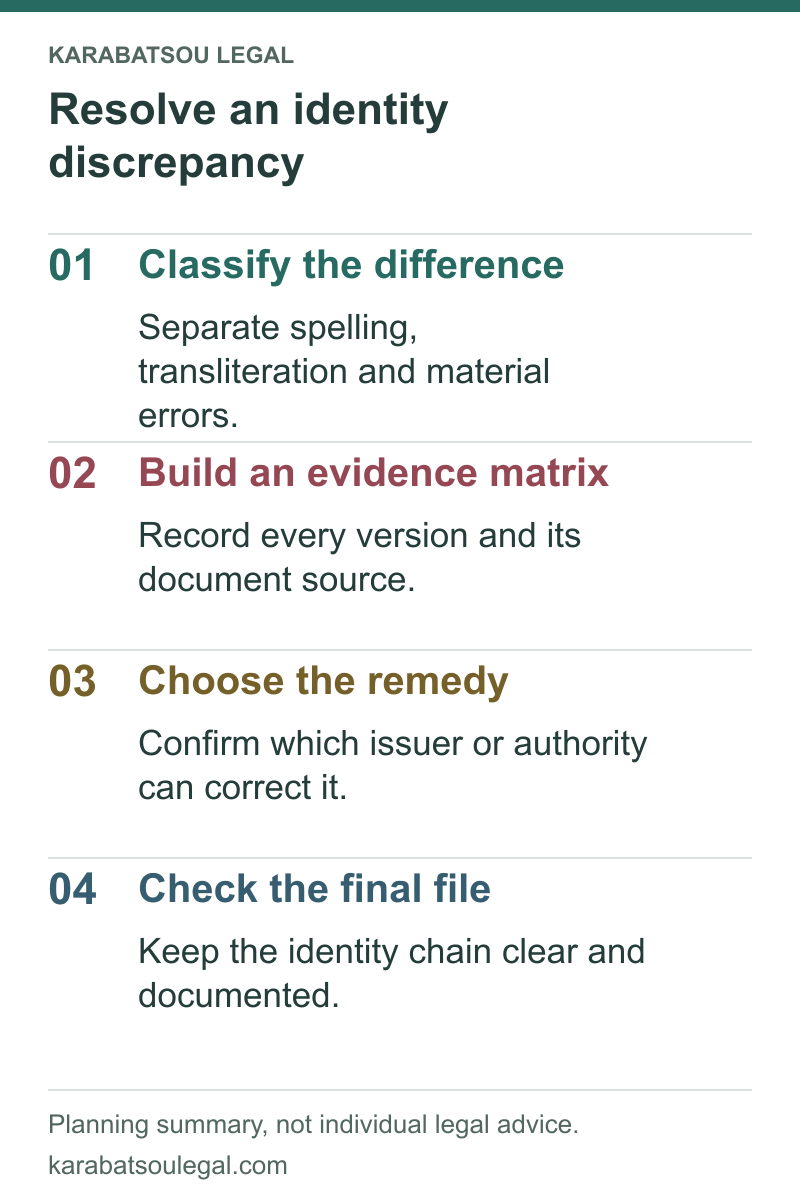
Infographic text
- Classify the difference: Separate spelling, transliteration and material errors.
- Build an evidence matrix: Record every version and its document source.
- Choose the remedy: Confirm which issuer or authority can correct it.
- Check the final file: Keep the identity chain clear and documented.
Connect documented name changes without erasing history
A marriage, court order or other official name-change instrument may explain why a person uses different names at different times. Collect the actual connecting document and check whether it identifies both the earlier and later forms sufficiently. A current passport alone may show the present name without explaining how it relates to the birth record.
The Greek MFA's UK ethnic-origin naturalisation guidance specifically requests official evidence of name changes and marriage evidence where a married surname is used. This is an example of consular documentary guidance, not a promise that one document resolves every discrepancy in every procedure.
Arrange successive changes chronologically. If an ancestor used a birth surname, a first married surname and a later surname, do not jump directly from the first to the last because the middle period seems inconvenient. The missing period may be exactly where the next generation's birth certificate belongs.
Ask the reviewing lawyer whether the change needs any recognition or registration step in Greece. Avoid treating a foreign legal name change as an instruction to rewrite all historical Greek entries. The appropriate treatment depends on the document, the person and the relevant procedure.
Investigate errors with the foreign record's issuer
If the discrepancy appears in the foreign original, contact its issuing authority about the correction process. Describe the field at issue and the evidence available. Ask whether the office distinguishes clerical amendments from changes requiring a court order, and who is permitted to apply for a deceased relative's record.
Do not begin with a sworn statement drafted to produce a desired conclusion. First find out what evidence the issuer and Greek receiving authority require. An affidavit may have a supporting role where accepted, but it should not be presented as a universal replacement for an official correction or missing parentage record.
For an American example, the CDC's vital-record directory identifies state and territorial sources. Use the actual event jurisdiction to find the responsible office. The availability of amendments, supporting evidence and access rules must then be checked with that office, not inferred from another state's process.
Ask what the amended output will look like and whether the earlier entry or amendment history remains visible. Keep the original version, correspondence, decision and replacement together. Where a correction is pending, delay unnecessary translation of the superseded version unless it is specifically needed to explain the history.
Identify the correct Greek correction procedure
First locate the Greek record containing the error. Is it a civil birth act, a municipal entry, a consular record or a translation? Do not assume that correcting one automatically updates every other record. Ask which office has responsibility and what downstream updates will be necessary.
The Ministry of Interior's guidance on birth-act corrections distinguishes corrections requiring a final court decision, specified corrections possible with prosecutorial permission, and certain obvious clerical errors handled administratively. It does not support a blanket assertion that every typo requires litigation or that every conflicting date can be fixed by an email.
For records held by the Special Registry, the Ministry's current Special Registry guidance also addresses discrepancies between foreign records and municipal details. A request to transcribe a foreign event is not a general power to rewrite its facts. Have the competent office and legal route confirmed before commissioning a correction application.
Ask for a written scope identifying the exact entry, requested amendment, supporting evidence and required authority. Where proceedings are necessary, understand whether the resulting order must become final and how it will be registered. Avoid buying a broad legal package before the underlying mismatch has been classified.
Escalate parentage and material date conflicts
Differences concerning parents deserve particular care. A birth certificate, an adoption order and an acknowledgment record can describe different parts of a person's legal history. Do not ask a translator to merge them into one apparently simple relationship. Identify the documents and let the lawyer determine their legal effect for the proposed citizenship route.
Similarly, a date conflict can change more than a form field. It may affect which historical nationality rule needs examination or whether someone was a minor at a relevant event. Verify ambiguous numerical dates against the issuing country's format before concluding that the records disagree.
If the evidence genuinely conflicts, record what remains unresolved and pause any assertion of eligibility based on the disputed fact. This is especially important where a maternal-line history, later citizenship decision or change of parentage is involved. The wider citizenship-by-descent guide helps explain why the family chronology matters.
A hypothetical repair plan and final quality check
Suppose a grandfather's Greek record uses his original surname, his foreign marriage certificate uses a shortened surname, and the parent's birth certificate repeats that shortened form. A naturalisation file contains a formal change document. The applicant's own passport uses a different surname acquired through marriage.
The first task is to examine whether the naturalisation document connects the grandfather's two names and matches his other identifiers. The applicant's marriage record addresses a separate change. Neither issue should be solved by asking the translator to replace every surname with the current one. If a date also differs, investigate it independently.
After the agreed repairs, compare every affected document again. Confirm that replacement translations correspond to the latest certificates, the index identifies superseded versions, and the submission includes the evidence explaining each remaining variation. Ask the Greek citizenship service to review the identity matrix alongside the family timeline, with unresolved issues clearly marked.
Keep a change log showing what was corrected, by whom, on which date and under what reference. This makes later questions answerable without relying on memory and helps prevent an outdated scan from being resubmitted accidentally.
Frequently Asked Questions
Does every spelling difference require a court order?
No universal rule applies. A transliteration difference, an obvious clerical error and a material conflict can require different treatment. Establish which original or Greek entry is affected and obtain the competent authority's requirements. Do not equate minor presentation differences with disputed identity or parentage.
Can the translator make all names identical?
A translator should render the documents faithfully, not remove genuine differences. Provide existing Greek spellings for reference and discuss consistent treatment where justified. If the source itself is incorrect, investigate correction with the issuer. If the source is accurate but uses an earlier name, document the connection.
Will a same-person affidavit always be accepted?
No. Ask whether such a statement has a role in the particular procedure and what supporting evidence is required. A personal declaration does not automatically amend a civil record or establish a disputed legal relationship. Do not purchase a generic affidavit package before the discrepancy has been assessed.
Should I change my current passport to match an ancestor's spelling?
Not merely to make the family file look uniform. Your legal identity and the evidence connecting generations are separate issues. Obtain advice about the accepted Greek registration details and any genuine error before changing current identity documents, which may have consequences beyond this application.
What should I send for an initial discrepancy review?
Provide clear scans of the conflicting documents, existing translations, relevant name-change or family-status records, and a short matrix quoting the differences exactly. Explain which citizenship route is under consideration, but do not present an unconfirmed legal conclusion as fact. Keep originals secure until submission arrangements are confirmed.
Author and Legal Review
Editorial author: Karabatsou Legal. Legal reviewer: Nadia Karabatsou.
This article was prepared with AI-assisted editorial support and legally reviewed before publication. Reading it does not create a lawyer-client relationship. For a correction or advice on your circumstances, contact the firm.
Sources and Further Reading
Discuss your circumstances
Get advice based on your documents, plans and deadlines.
Contact the firm